In September, China consumed more electricity than it did a year ago, but burned fewer fossil fuels. According to the Center for Research on Energy and Clean Air (CREA), the growth in CO2-free energy sources more than offset the increase in demand, despite a sharp decline in hydropower, which fell by 17.2%. Solar power rose by 21.6%, wind power by 16.6%, and nuclear power by 22.4%. As a result, production from coal and natural gas decreased by a total of 1.4% year-over-year, marking the third consecutive monthly decline. Coal production fell by 1.5%, while natural gas—which accounts for a much smaller share of China’s energy mix—rose by 8.5%.
This figure is striking because it comes from the country that is both the world’s largest emitter and the world’s second-largest economy. If the “world’s factory” can increase electricity consumption while reducing fossil-fuel-based power generation, the argument that decarbonization and development are at odds with each other collapses.
The Coal Paradox
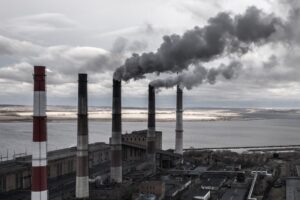
Of course, China’s development is not without environmental problems. Beijing continues to add thermal power plants: in the first eight months of 2026, it installed 58.7 GW of new capacity—the highest level in the past 15 years for the period analyzed—an 18% increase compared to 2025. This decision was driven by energy security and peak-load coverage considerations, but it risks leaving plants underutilized. In fact, during the same period, 97.2 GW of solar and 53.3 GW of wind capacity came online: over 150 GW of renewables, nearly three times the new fossil fuel capacity. Thermal power plants remain in operation as a reserve, but the additional energy is increasingly being generated by solar panels and wind turbines.
And there is one factor that goes beyond the climate. China has established industrial leadership in clean technologies: it dominates the supply chains for photovoltaic modules, batteries, and electric vehicles. In Beijing, the transition is not a cost to be borne, but an industrial policy that brings market share and reduces dependence on fuel imports.
Two Different Battles
Meanwhile, Europe has changed course—in the opposite direction. The focus is shifting from the Green Deal to the Clean Industrial Deal, the plan presented by the Commission in February 2025, and the list of delays is growing. As the Corriere della Sera pointed out, the European Parliament has pushed back the rules on monitoring methane emissions for importers of oil, gas, and coal from 2027 to 2030—two years later than the Commission had proposed. Italy and Poland are leading the push to delay the ETS2 for heating and fuels until 2030. The phase-out of gasoline and diesel engines starting in 2035 has been watered down: the required reduction in tailpipe emissions for manufacturers has been lowered from 100% to 87.5%.
The anti-green offensive, however, is driven by two very different forces. The first is the fight against bureaucratic excesses: disproportionate reporting requirements, unrealistic deadlines, and procedures that place a particularly heavy burden on small businesses. Here, there is very broad consensus, and the Omnibus simplification packages address a real need. The second driving force stems from the fossil fuel lobbies’ attempt to buy time by stifling innovation to protect their profits. The case of natural gas is emblematic: pressure from the United States and the Gulf states—that is, gas suppliers—played a key role in the delay.
Balancing these two forces means trying to use the consensus on the first to push through the second. The real challenge for Europe lies elsewhere: streamlining procedures and making businesses more competitive, with EU-wide support and agreements to create jobs by promoting innovation and social cohesion, rather than digging in and losing ground more slowly.
The Price of Waiting
Playing it safe comes at a high cost, both economically and in terms of reputation. And the continent is paying the price. Every year of delay is another year of dependence on imported fuels, while the conflict in the Middle East is driving up energy prices. It’s another year of uncertainty for those who need to invest in grids, renewables, and storage. And it’s a year’s head start given to those—like China—who have realized that clean technologies are the battleground for industrial competition in the coming decades.
The message coming from Beijing is that the green transition is both possible and worthwhile. Simplifying the process is the right approach. But Europe must decide whether it is doing so to move faster or to come to a halt.