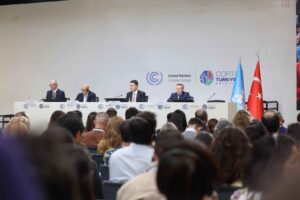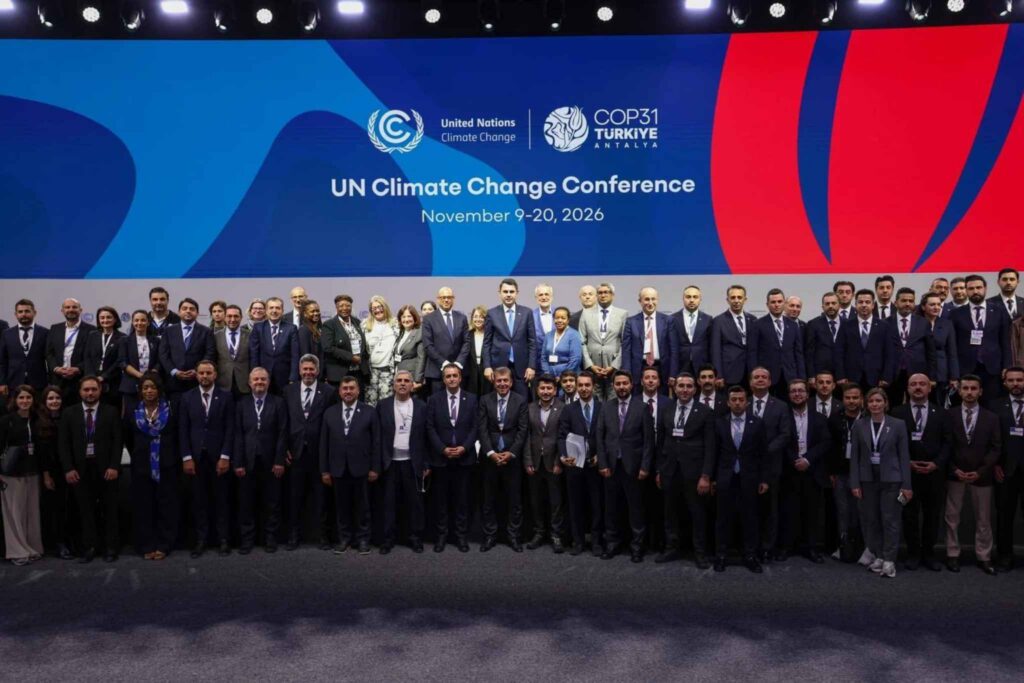
Sometimes disappointments help us grow. This is likely the case with the resounding failure (which is exactly what it is and should be called, because such a deep rift hasn’t been seen since Copenhagen 2009) of COP31 in Antalya, where the Parties failed to reach an agreement on the most political aspect of the conference, the “cover decision.” This document was supposed to set the tone for the COP, but instead it went spectacularly off the rails, rejected by the EU, in close alliance with the United Kingdom and the AOSIS island states, and also by Norway, Switzerland, and the group of Least Developed Countries, which comprises 44 of the least developed nations (and among those most affected by climate change), of which 32 are in Africa, 8 in Asia, 3 in the Pacific, and one in the Caribbean.
A diverse alliance, yet one motivated by an awareness of the threat that an empty and in some ways even dangerous document (think of carbon capture and sequestration) posed to the integrity of the UNFCCC process and to the Paris Agreement, which has been the guiding star around which climate negotiations have revolved for the past eleven years.
A burst of dignity
The EU has shown courage and a burst of dignity after years of lacking ambition. “I want to make it clear that the European Union and its member states,” said Darragh O’Brien, Ireland’s environment minister, speaking on behalf of the Irish rotating presidency, “oppose this text. We say this on behalf of our citizens and our member states, because these decisions fall far short of the level of action or ambition needed to address climate change. It is unacceptable to have a climate law that makes no reference to fossil fuels or to the transition away from them. And it is for this reason—for all these reasons—that the European Union firmly opposes this text.”
“We will not accept,” he continued, “a decision that fails to take scientific data into account, that ignores the implementation gap, and that risks, in fact, widening the gap between global commitments and the actions needed to bring the 1.5-degree target back within our reach. We will not endorse a superficial decision or an Antalya agreement that does not even mention fossil fuels, which are the key driver of climate change. And we will not agree to negotiate a return to the past.” Enough was enough. A signal had to be sent to the petro-states (Saudi Arabia, its allied Arab states, Russia, and Iran) that their obstructionism was no longer tolerable. And so it was.
The parallel process
But the political failure of COP31 does not undermine multilateralism, which remains—despite the wishes of Trump, Xi, and Putin, who would prefer a tripolar world—alive and essential. Europe’s test of maturity also serves as an important stepping stone for the parallel (and not alternative) Santa Marta process on the transition away from fossil fuels, which will hold its second meeting next year and which, in Antalya, saw as many as twenty-five countries—including Germany, France, the Netherlands, Spain, Brazil, Indonesia, Guatemala, and Panama—announce that they had submitted or were in the process of submitting a roadmap for phasing out fossil fuels.
Rejecting an inadequate cover decision (which the Turkish presidency likely pushed under pressure from Saudi Arabia, Ankara’s political and military ally) may give impetus to enhanced cooperation initiatives such as Santa Marta, which can only benefit the fight against climate change and the energy transition. Something positive can emerge from a failure, even if the road to the next COP in Addis Ababa—whose presidency will need to act with intelligence and wisdom—promises to be more complicated. But the COPs are still useful, even if some people think they serve no purpose and, in fact, have never served to solve the problem of climate change. Yet that is their sole purpose, and it always has been, even if they have produced far less than was expected and needed. If they were merely an exercise in multilateralism for its own sake and not focused on a specific issue, they should be shut down. But that is not the case. And this is also the view of countries that are very active in the energy transition but have so far avoided taking on major responsibilities within the UNFCCC, such as China. “We are disappointed,” said Deputy Minister Li Gao, head of the Chinese delegation, in Antalya, “but we cannot and do not wish to consider this a failure of the multilateral process. We believe this serves as a reminder that we must strive to advance the multilateral process to reach consensus.”
“We can’t put out a fire by pouring fuel on it”
Especially since the emperor has no clothes. “The key message of COP31,” commented United Nations Secretary-General António Guterres, “is clear: the world must do much more to address the climate crisis, and it must do so immediately. The first step is to acknowledge how we got to this point. Those who profit from the destruction of our planet must never dictate the terms of the fight to save it. Fossil fuels are at the root of the climate crisis. Continued reliance on coal, oil, and gas is fueling climate chaos, exposing economies to price shocks, and undermining energy security.”
“We can’t put out the fire,” he continued, “by continuing to pour fuel on it. Yet, powerful fossil fuel interests continue to follow the playbook of the big tobacco companies: distorting science, delaying policies, blocking action, and raking in huge profits while people around the world pay the price. At COP28 in Dubai, all countries agreed to phase out fossil fuels in a just, orderly, and equitable manner. The task now is to accelerate that transition, finance it, and make it a reality. I welcome countries that are presenting concrete plans to that end. We must build on the roadmaps proposed by the Brazilian presidency of COP30 for phasing out fossil fuels and reversing the trend of deforestation and forest degradation.”
The hard part begins now
“Governments,” notes Kaysie Brown, Associate Director of Climate Diplomacy & Geopolitics at the think tank E3G, “rejected a cover decision that failed to send the signals needed to show a serious response to the overshoot of the limits, or a commitment to the centrality of science.” “But in many negotiating rooms,” she emphasizes, “agreements with concrete results were reached: this COP has shown that the Action Agenda has become the driving force behind implementation. Neither that progress nor the need for multilateralism will disappear after Antalya. The United Nations process remains the only forum where every country has a say and where laggards can be held accountable for their actions.”
The hard part comes now. For the European Union, first and foremost, the challenge is great—and so are the opportunities. Let’s see if it will be able to seize them with a climate policy that is once again ambitious, or if its stand in Antalya will turn out to be nothing more than a fleeting act of courage.