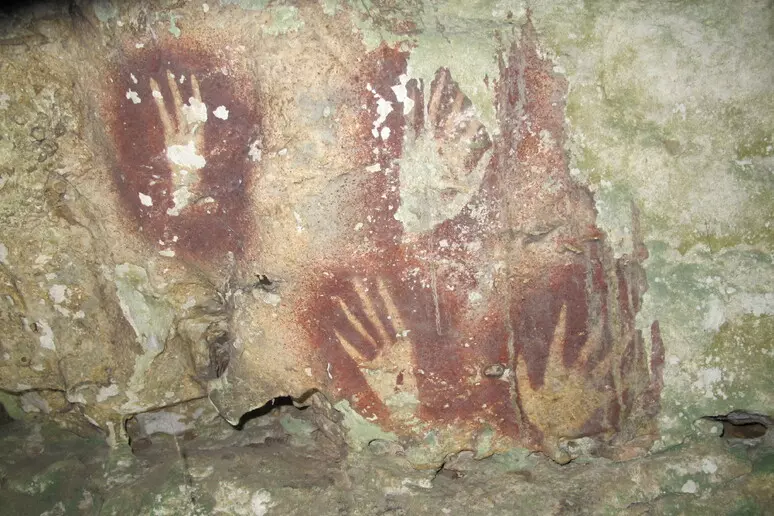
In the bowels of a limestone cave on theisland of Muna, off the Indonesian coast of Sulawesi, lies a secret that demolishes certainties once considered established. It is a hand or, rather, the faded outline of a hand, traced with a red pigment, 67,800 years ago. A“red claw,” as the researchers who traced it have dubbed it, because the fingers have been deliberately modified, elongated and tapered into something that resembles, precisely, more a claw than a hand.
The discovery, published in the journal Nature by an international team led by Adam Brumm of Griffith University in Australia and Maxime Aubert of the same university, does more than just backdate rock art. It redefines where and when our species began to think symbolically and abstractly. That ability that led us to invent language, religion, science. To tell stories, and to pass them on.
Beyond Eurocentric dogma
For decades, academia believed that the creative explosion of homo sapiens occurred in Europe, some 40,000 years ago. The spectacular paintings of Altamira or Lascaux seemed to testify to a sudden “Big Bang” of the human mind that occurred among the ice of the Old Continent. “When I was in college, in the mid to late 1990s, that was what they taught us,” Brumm recounted. But Muna’s red claw tells a different story: creativity is not a European invention, but an innate trait of our species that has been with us since we left Africa.
Liang Metanduno’s stencil is now officially the oldest reliably dated rock painting in the world, surpassing by more than a millennium the Spanish stencil from Maltravieso Cave (66,700 years old), the dating of which, moreover, is still debated among experts. In Indonesia, however, the technique used-analyzing the thin mineral crusts formed over the pigment-seems to leave no room for doubt.
A new chronology for early aborigines
The implications of this discovery transcend the realm of art. Indeed, Sulawesi is located along the sea route that led to the ancient Sahul continent (which included Australia and New Guinea). If Homo sapiens were already in Sulawesi 67,800 years ago, producing complex symbolic art, it becomes much more credible that early humans reached Australia about 65,000 years ago-a full 15,000 years earlier than the commonly accepted dating.
The island of eternal hands
The walls of the Liang Metanduno cave reveal that this place has been the focus ofartistic activity for at least 35,000 years. Some much more recent paintings on the same panel, made about 20,000 years ago, overlap with the older traces, revealing that the cave has been used repeatedly for tens of thousands of years.
Years of fieldwork by Indonesian colleagues uncovered hundreds of new rock art sites in remote areas of Sulawesi. The island, then, was not an isolated laboratory, but part of a widespread, sophisticated, ingrained artistic culture. That red-clawed hand, faded and fragmentary, is tangible evidence that our ability to imagine, symbolize, and transform the world through art was already fully developed tens of thousands of years ago, much earlier than we thought. And that this ability was not confined to one corner of Europe, but had spread wherever our ancestors went.