Trump effect. Perhaps Europe is starting to get serious. Thefree trade agreement signed with India marks a turning point in global economic relations and strengthens the role of the Old Continent as a central player in the new international trade balances. After years of hiccuping negotiations, Brussels and New Delhi have decided to speed up, closing a deal that opens one of the Planet’s largest and most dynamic markets to European companies and, at the same time, consolidates the strategic partnership with the world’s most populous democracy.
The agreement provides for a gradual reduction in tariffs on a very large share of goods traded between the two economies. For the European Union, it means more competitive access to a market of more than 1.4 billion consumers that until now has remained partly protected by high tariff barriers. For India, it represents a decisive step toward greater integration into global value chains, with expected benefits in terms of investment, employment and technology transfer.
Meeting with the Indian and European business community in Delhi.
— Ursula von der Leyen (@vonderleyen) January 27, 2026
Under the FTA, European exporters will save up to €4bn a year in duties.
And EU exports are expected to more than double over time.
Major opportunities ahead.https://t.co/jfwbyNiDjr pic.twitter.com/408hsFGlYI
International law is strengthened
Among the sectors affected are manufacturing, machinery, automotive, chemicals and pharmaceuticals, but also symbolic Made in Europe sectors such as wine and spirits, which are today burdened by very high tariffs. The agreement also marks significant steps forward on the agricultural front, traditionally the most sensitive, with progressive openings and safeguard mechanisms that have made it possible to overcome much of the historical resistance between the two sides.
Today is a day that will be remembered forever, marked indelibly in our shared history.
— Narendra Modi (@narendramodi) January 27, 2026
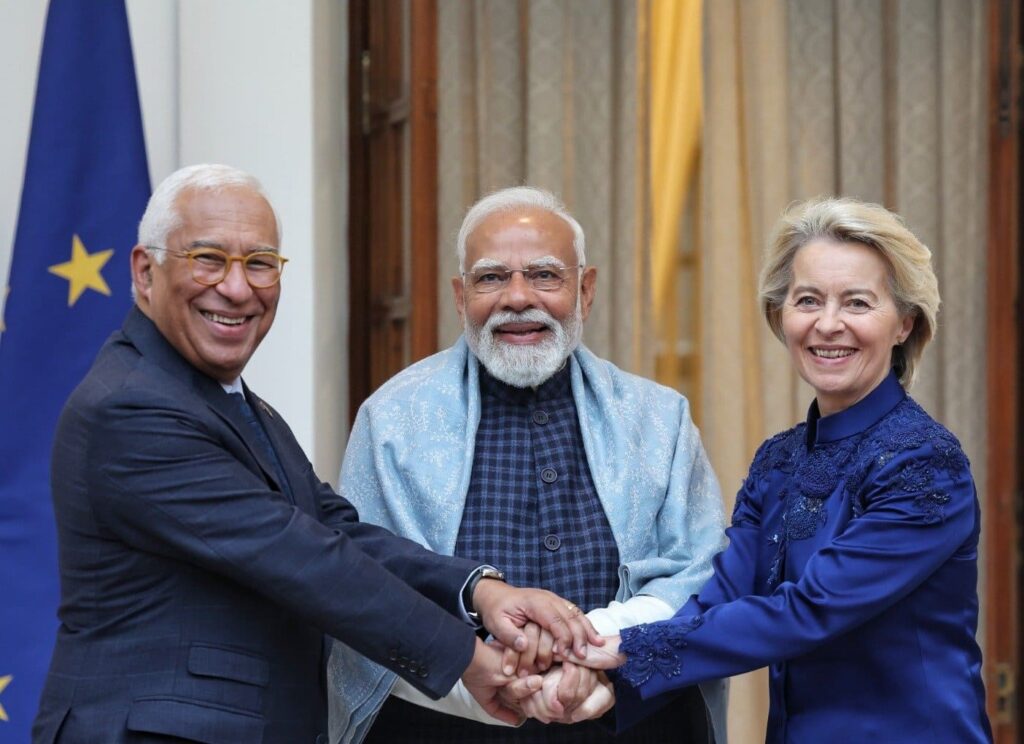
European Council President António Costa and European Commission President Ursula von der Leyen and I are delighted to announce the conclusion of the historic India-EU Free Trade Agreement.… pic.twitter.com/yaSlPm2b2L
The value of the understanding, however, goes beyond trade figures. As European Commission President Ursula von der Leyen pointed out, the agreement with India is a political signal in an increasingly fragmented world of rising geopolitical tensions, protectionism and repeated violations of international law. Europe is claiming an open vision of trade based on shared rules and partnerships with countries that, though with clear differences, focus on economic growth and stability.
Another central element of the understanding concerns the chapter on trade and sustainable development, which confirms the EU’s strategic trajectory. The agreement strengthens commitments on environmental protection and combating climate change, calls for respect for workers’ rights, and includes explicit references to gender equality and women’s empowerment, creating a stable platform for dialogue and cooperation on the social and environmental impacts of trade. These are not just stated principles, but a framework that creates a stable platform for dialogue and cooperation between Brussels and New Delhi on the environmental and social impacts of trade, with the goal of ensuring concrete and verifiable implementation of the commitments made. Trump calls for Europe to move away from sustainability: the India deal reinforces this.
Ursula von der Leyen spoke of a historic step, calling the agreement with India “the mother of all trade agreements” and stressing that “we are creating a free trade area covering two billion people, from which both sides will benefit.” Indian Prime Minister Narendra Modi also remarked on the scope of the deal, calling it” the largest free trade agreement ever” and explaining that it will provide “enormous opportunities for 1.4 billion Indian citizens and millions of people in European countries,” going beyond tariff reduction to strengthen long-term economic cooperation.
Two strategic dossiers
This is the second major opening of games in a matter of weeks, following the understanding reached with the Mercosur, the South American bloc that brings together Brazil, Argentina, Uruguay and Paraguay. In that case, too, it is a historic agreement, which has been awaited for more than two decades and is now one step closer to final closure, pending the green light from the Court of Justice on whether the agreement is congruent with European legislation as a whole.
Read together, the two dossiers tell a clear strategy: the European Union is trying to diversify its economic relations, reducing dependencies and strengthening ties with areas of the world experiencing strong demographic and economic growth. An implicit response to the White House’s messy muscular policy and the tariff war unleashed every other day by Trump.
The most delicate phase now remains: implementation. Agreements will have to be translated into operational rules, face domestic resistance and prove on the ground that they can combine market opening, protection of environmental and social standards and protection of the most exposed sectors. But the political message has already come through loud and clear: Europe does not intend to remain a bystander, and on global trade it has decided to play the game all the way.