Italy moves (too much) by car. This is told in the new “Mind the Gap” report by Clean Cities, the European coalition aiming for zero-emission urban mobility by 2030. The document peels back the veil on a gap that is not only infrastructural, but cultural and economic: our cities offer a local public transport (TPL) service that is trudging along, even more so when compared to that of the continent’s major capitals.
European metropolises—from Madrid to Warsaw via Prague—boast on average twice the supply in terms of seat-kilometres per inhabitant and five times as much in mass rapid transit miles. Metro systems, trams and trolleybuses that remain a mirage here remain the norm elsewhere.
The South pays the heaviest bill
The geography of the Italian gap is even more unforgiving. Milan defends itself, whilst remaining far from European standards. But moving down to the Centre-South, the picture becomes bleak, “regardless of population and geographic size,” as the study points out.
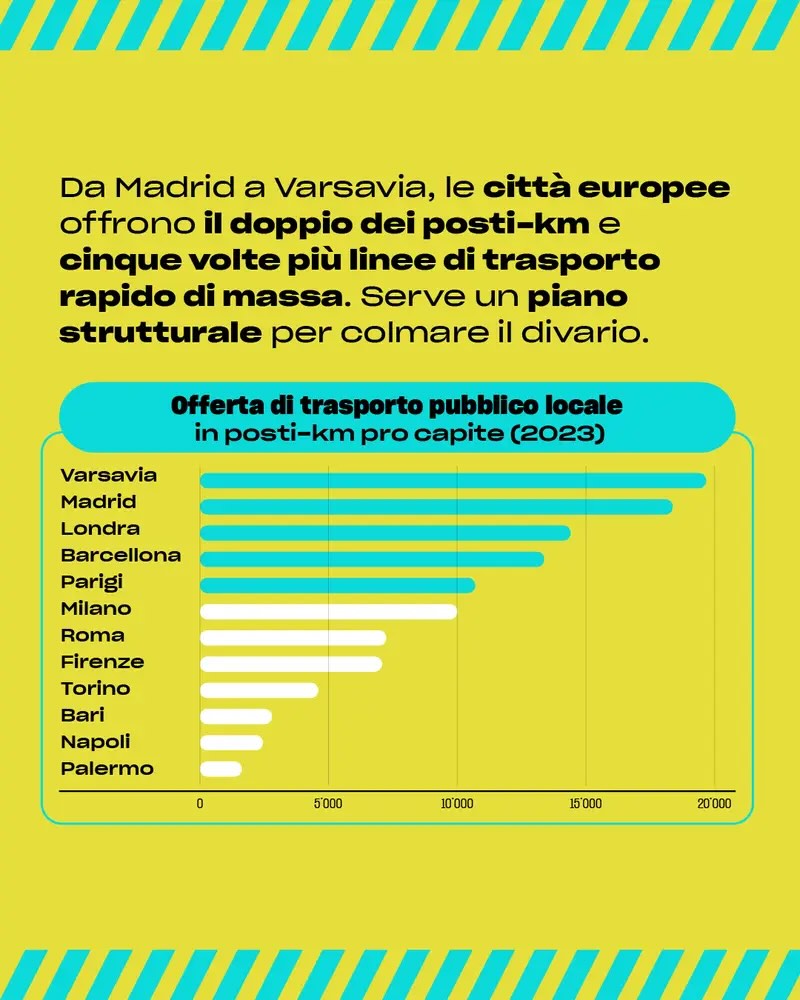
Between the top three European cities by supply (Prague, Madrid, Warsaw) and those in central-southern Italy there is a gulf: a ratio of 1 to 8. For every passenger who boards a bus in Naples, Palermo, Bari or Catania, there are eight who do the same in Warsaw, Paris or Prague. This is no accident: where supply languishes, utilisation plummets accordingly. There are fewer than 300 passengers per capita in the North Central, just 70 in the South Central. The European median is 410: we are off the scale.
The spiral of dissatisfaction
When service is in short supply, a short circuit is triggered. In Vienna and Prague, approval ratings are close to 90 per cent. In Bologna and Turin it drops to 68 per cent and 56 per cent, respectively. But it is in the South that the numbers plummet vertically: fewer than one in three Neapolitans or Romans say they are satisfied with TPL, and in Palermo the consensus plummets to one in five.
The complaints are the same, but amplified: poor frequency, dancing reliability, perceived insecurity. The result is “dependence on the private car”—or forced car ownership, as economists call it. A bitter paradox: regions with the lowest incomes have the lowest levels of TPL and the highest motorisation rates. Cars that weigh on already strained household budgets.
Three out of ten Italians have had to give up at least one essential activity—work, study, medical appointments, social relations—because of difficulties in getting around. It is not just a matter of convenience: it is a problem of access to basic rights.
Inflation eating away at funds
Behind this scenario is a knot that has been throttling the system for years: chronic underfunding. The National Transportation Fund (Fondo TPL), established in 2014, is the main source of oxygen for companies in the sector. Over the past decade, allocations on paper have fluctuated between 4.8 and 5.3 billion euros. In 2025, the allocation was 5.3 billion.
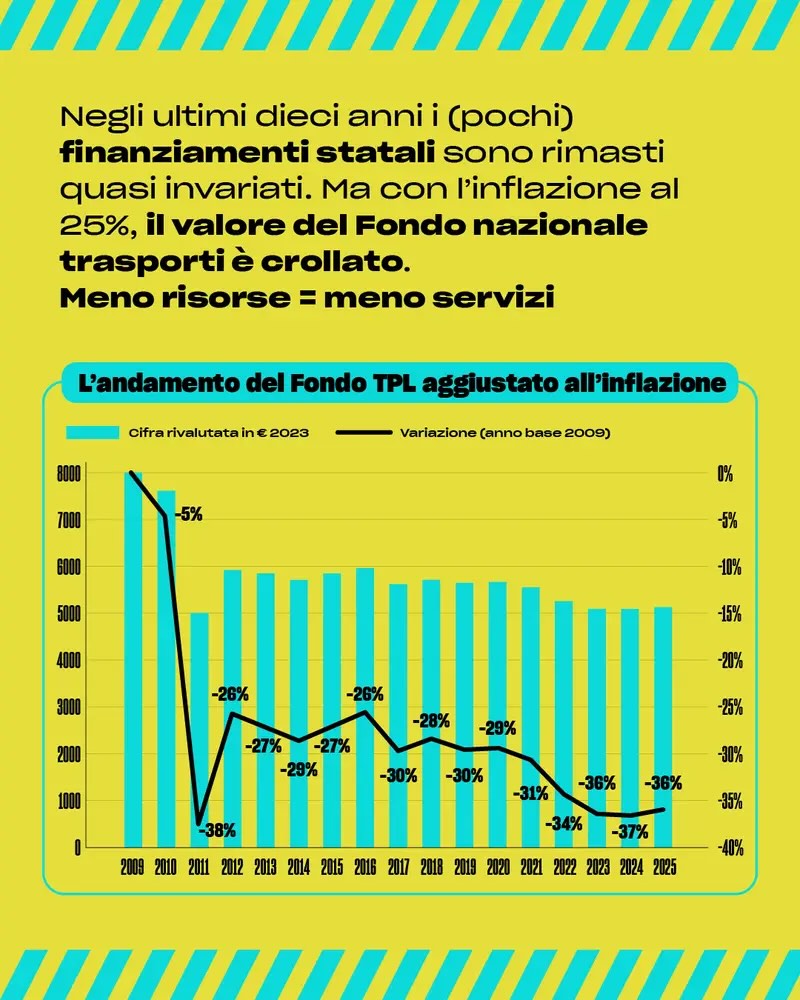
These are values that do not take inflation into account. And transportation sector inflation, between 2014 and 2025, was 25 per cent. Translated into real terms, it means a consistently negative trend. The total shortfall in the last five years post-Covid exceeds four billion euros. If 2009 is taken as a reference, the real decline is 37 per cent.
Added to this is the “hole” left by the pandemic: more than three billion in lost revenue from tickets and passes, of which the state has made up for less than one-sixth. The TPL companies find themselves with their backs against the wall, and the current response risks jeopardising “their very survival and economic-financial viability.”
Invest, don’t cut
Streamlining and raising fares are possible but insufficient and risky strategies. Raising prices would push the occasional user towards the private car, exacerbating the problem instead of solving it. There is only one way: invest. And invest massively. Because the resources allocated to the TPL are not a cost, but an economic multiplier. Every euro invested can generate 3 to 4.5 euros of direct benefits for the community, in terms of productivity, pollution reduction, accessibility to services.
As Claudio Magliulo, head of Italy campaign at Clean Cities, explains, “Investing in local public transport means not only enhancing a mobility service for citizens, but also supporting the productive fabric and contributing to the country’s overall competitiveness, ensuring that millions of citizens can get around safely and affordably, reducing inequality and ensuring equal access to school, work and essential services.”
The plan: 6.5 billion to get going again
Clean Cities’ proposals are clear and measurable. First, restore the National Transportation Fund to actual 2010-2011 levels, or about 6.5 billion at current prices. It means allocating an additional 1.2 billion in the 2026 budget law. The ultimate goal is to reach 2009 levels, an increase of about three billion a year.
Second, increase resources for infrastructure by injecting cash into the Single Fund for the strengthening of metropolitan networks. The estimated need for projects that have already applied for tenders exceeds 10 billion euros.
Third, accelerate the electrification of fleets. An electric bus costs 0.48 euros per kilometre versus 0.8 for a diesel, and the gap is likely to widen. 560 million euros a year is needed to support the transition.
Magliulo closes with a thought-provoking comparison: the additional 1.2 billion requested for the TPL Fund is “on the same scale as what was made available for the ecobonus for private vehicles.” Meanwhile, the state continues to support harmful environmental subsidies worth an estimated €24.2 billion to €78 billion.
A field choice
Closing the TPL gap is a field choice between a country that invests in its collective future and one that clings to the 1900s model, with all its contradictions and inefficiencies. Between national cohesion and territorial fragmentation. Between environmental sustainability and fossil dependence. We must interrupt the decline of real financing and put Italy back on the tracks of Europe.