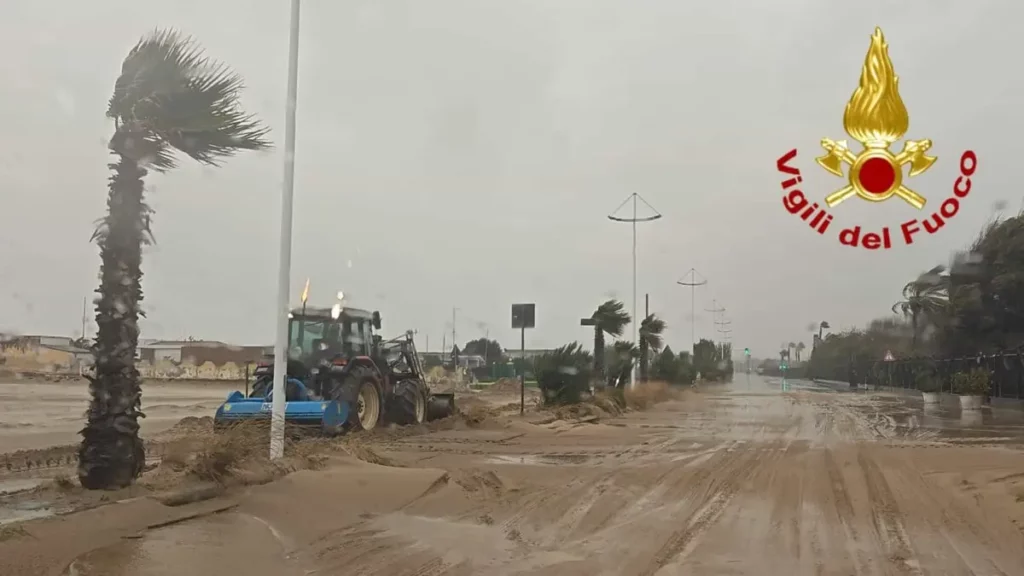
More than a few, perhaps, will remember“Harry, meet Sally.” Today – and I don’t want to blame director Rob Reiner – the pun imposes itself, but in the tragedy that has devastated the South, our ideal “Sally,” there is really nothing romantic about it. The territories affected by Cyclone Harry, with damage exceeding 1.5 billion euros, do not evoke sentimental comedies: they are the setting for a horror movie, a landscape in which the meteomar fury has completed, dramatically, a work of destruction that began many decades ago. It is decades, in fact, that coastlines and population centers in the South have been transfigured by hyper-cementification and systemic squatting, with ruling classes that have failed to ensure routine maintenance, prevention and safe risk management in territories with a fragile orography.
#Maltempo, prosegue il lavoro #vigilidelfuoco, oltre 3.250 interventi in 6 giorni: dal 19 gennaio svolte 1.900 operazioni in Sicilia, 700 in Calabria, 650 in Sardegna.
— Vigili del Fuoco (@vigilidelfuoco) January 25, 2026
Nella clip Drago 156 in sorvolo sull'isola di Linosa (CL), fortemente colpita dalle mareggiate [#25gennaio… pic.twitter.com/vUh8sSou62
The national picture outlined by the 2024 Ispra Report on hydrogeological instability confirms, then, that these fragilities are neither episodic nor circumscribed. 94.5 percent of Italian municipalities are exposed to landslides, floods, coastal erosion or avalanches; more than 636,000 landslides surveyed make Italy the most exposed country in Europe; 1.28 million people live in high and very high hazard areas, while 6.8 million are at risk of flooding in the medium hazard scenario. The new Pai (Hydrogeological Planning Plans) mosaic shows a 15 percent increase in areas classified as at risk compared to 2020-2021, with a 9.2 percent increase in the most dangerous classes. Italian beaches – already reduced, fragmented and victims of the unsustainable financialization of state property – have undergone significant changes in more than 1,800 km of coastline.
The hottest three-year period
The three-year period 2022-2024, the hottest ever recorded in Italy, saw extreme rainfall events with intensities up to six times higher than historical averages, confirming that hydrogeological disruption is now a permanent condition of the national territory. Anthropogenic pressure, with land consumption rising from 2.7 percent in the 1950s to 7.16 percent in 2023 (again according to Ispra data), has further aggravated vulnerability, reducing the land’s capacity to absorb, drain and dissipate the energy of extreme events.
Recent tragedies and Ispra data converge on one point: on the one hand, land management for decades has been marked by the commodification of land, systematic derogation, erasure of natural defenses and total lack of maintenance; on the other hand, climate change is accelerating beyond predictions, amplifying pre-existing fragilities. Italy is simultaneously paying for political and climate inertia: the former has built vulnerabilities, the latter is turning them into recurring catastrophes. The combination of unwise land use and tropicalization of average temperatures in the Mediterranean produces a systemic risk that can no longer be addressed with emergency tools. Climate experts, from the Cmcc to international research centers, warn that the Euro-Mediterranean region is now a global hotspot of climate change: the Mediterranean is warming at a rate about 2.2 times the global average, with marine temperature anomalies exceeding +4 °C above climatological values on several occasions in the 2023-2024 biennium.
More than 60 days a year of marine heat waves in the most exposed areas
In the Mediterranean, the European remote sensing program Copernicus notes an increase in the frequency and intensity of “marine heatwaves,” with more than 60 days per year of marine heatwaves in the most exposed areas, a threefold increase since the 1990s. This additional heat energy fuels more intense cyclonic systems: Copernicus documents a 30 percent increase in extreme precipitation events in southern Europe over the past two decades and a 20 percent increase in hourly precipitation intensity, exactly the kind of dynamics that make phenomena like Harry possible. The tropicalization of the Mediterranean-characterized by warmer waters, a wetter atmosphere, and increased instability-creates conditions for Mediterranean cyclones with characteristics increasingly similar to tropical systems, with winds in excess of 120 km/h, waves in excess of 10-15 meters, and precipitation concentrated in a few hours.
Yet, even at the cost of sounding trite, solutions exist and are already available. On the one hand, nature-based solutions and ecosystem services can transform urban fabrics into green infrastructure capable of absorbing water, mitigating heat, reducing erosion, and rebuilding ecological continuity: widespread reforestation, stream renaturalization, dune restoration, sustainable land management, regenerative agriculture, ecological corridors, and sustainable urban drainage systems. On the other hand, the energy transition must accelerate: the most recent Ember data show that wind and solar have overtaken fossil sources in European electricity production for the first time, confirming the correct trajectory. Clean energy production alone, however, is not enough: we need to electrify consumption in all industrial and civil sectors, integrate storage and flexibility, digitize monitoring systems, make demand smarter, and reduce structural dependence on gas.
Science points the way
In conclusion, Italy can become a country capable of living safely in a climate that is, irreversibly, more extreme: a territory, therefore, that reduces, structurally, its vulnerability and rebuilds, progressively, lost natural defenses. Science has been pointing the way for years: soil care, river renaturalization, coastal protection, cities designed to drain and mitigate, renewable energy systems integrated with smart grids and storage. It is a model in which prevention and adaptation become a solid national infrastructure, not an emergency response. Achieving it requires a clear political will: treating climate security as a strategic interest of the country, on par with energy security and economic security. It means planning multi-year investments, strengthening the technical skills of administrations, overcoming the logic of derogations and returning centrality to integrated territorial planning. It means, above all, recognizing that the protection of ecosystems is not a cost, but the investment needed to ensure well-being, competitiveness and social stability in an increasingly unstable and unlivable Mediterranean and Planet.