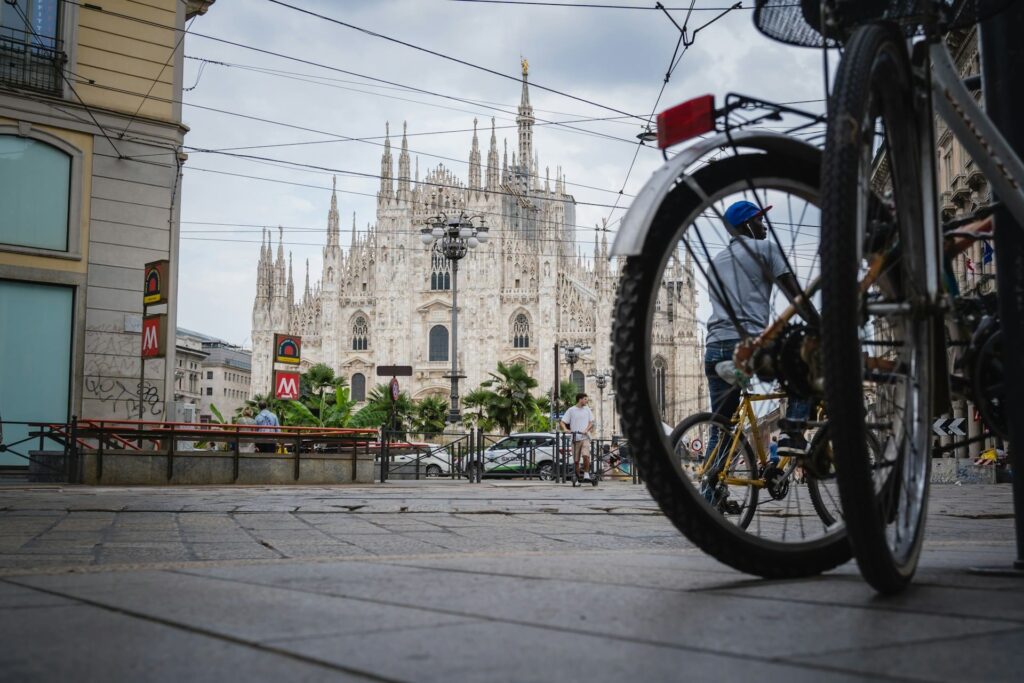
In Milan, getting around by bicycle is about to get easier. Just before Christmas, the City Council unanimously approved an amendment to the 2026-2028 budget that allocates 100,000 euros to give shape to a hitherto neglected idea: making the bicycle network as readable as the subway network.
The focus of the project: signage
The project is called bicipolitana. And the focus of the intervention is signage. Directional signs, first and foremost, to clearly indicate where one is going. And progression signs, designed to give pedestrians back an overview: from this point, what places can I reach? With what connections? With what continuity?
It is precisely continuity that is the knot that the bicipolitana tries to unravel. Bicycle lanes exist in Milan, but they often appear as fragments: well-designed stretches that do not always dialogue with each other. Applying the logic of lines, colors and subway maps to bicycle mobility means transforming those fragments into a recognizable network that can be traveled even by those who do not know the city by heart.
A network designed like the subway
The strategy did not come out of nowhere. It was built together with Möves – “move,” in Milanese dialect – the document that collects guidelines for active mobility in the city. And it finds an operational reference in the Metropolitan City’s Biciplan, approved in 2021, which designs an ambitious network: four circular lines, sixteen radials and four greenways. A system designed to connect the center with the suburbs and, in several cases, push beyond municipal boundaries to the hinterland.
In this scheme, circulars are used to move between neighborhoods without passing through the center; radials are used to move in and out of the city; and greenways are used to provide routes surrounded by greenery. Much of this infrastructure is already in place; others will become a reality with upcoming investments. The bicipolitana has the task of stitching them together, at least from an information perspective.
The EmbraceMe case
A preview of this approach already exists and has been visible since 2018. It is called AbbracciaMi and is a circular route of about 70 kilometers that connects parks, stations, suburbs, and places of interest. Its strength lies in its recognizability: consistent signage that accompanies those pedaling along the entire loop. Until now, it has remained an exception. With new funding, the goal is to make it the rule.