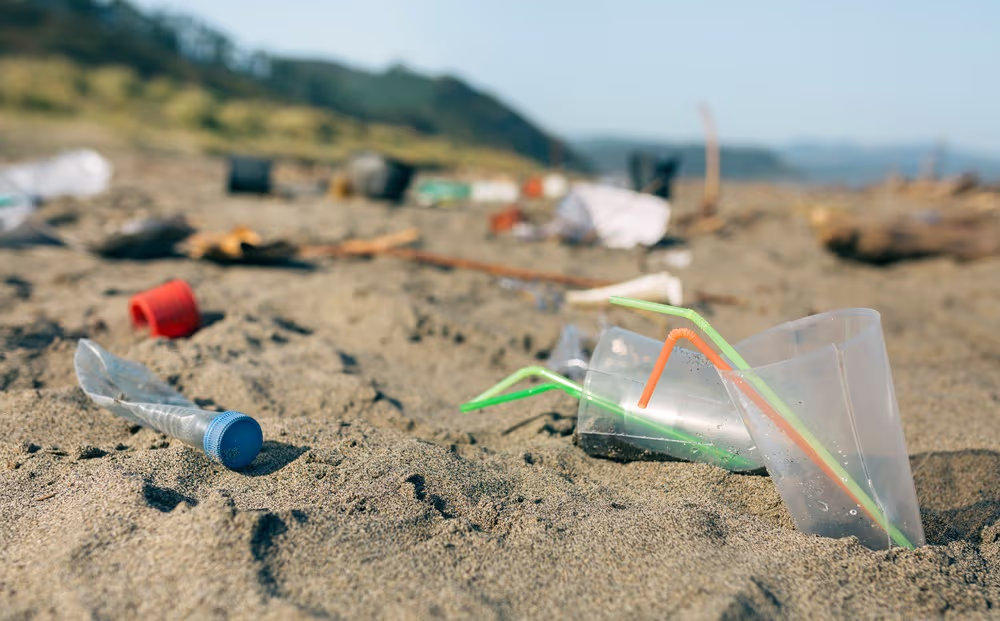
Four years after the transposition of the European Single Use Plastics ( SUP) directive, Italy’s track record on the environmentally dispersed waste front is far from reassuring. Beaches and urban parks continue to tell the same story: traditional plastics dominate unchallenged, while compostable alternatives remain a marginal presence. This is certified by Legambiente’s new“Beach and Park Litter“ study, which for the first time also systematically monitors compostable bioplastic waste on a national scale.
Between 2021 and 2024, the association collected and catalogued more than 40 thousand pieces of waste at 10 beaches and 10 urban parks on the Peninsula. The figure that immediately jumps out at you is stark: 80 percent of the waste is traditional plastic, mostly packaging and single-use items. Compostable bioplastics, often brought up as a supposed new environmental problem, account for just 0.2 percent of the total. An almost symbolic amount.
A merciless photograph
The monitoring returns a merciless picture. On the beaches, where nearly two-thirds of the total waste was collected, traditional plastics come in at more than 90 percent, while bioplastics remain stationary at 0.2 percent. In urban parks, the composition is more varied, with a significant presence of metals, paper, glass and ceramics, but even here traditional polymers remain the main component. In both contexts, littering continues to affect mainly disposable items: beverage caps and lids, small and large format bottles, bags and cups.
One of the most interesting elements of the study is precisely the attention given to compostable bioplastics, which until now have been excluded from official European monitoring protocols. Legambiente decided to include them as an independent category, flanking the citizen science work with laboratory analyses carried out by the Chemistry Department of Sapienza University in Rome, which confirmed the reliability of the method. The goal is not just to count waste, but to understand how to improve end-of-life management of these materials and refine prevention policies.
A threat to biodiversity
A fact emerges. The problem is not bioplastics, but the huge amount of single-use plastic still leaking into the environment. As Giorgio Zampetti, director general of Legambiente, points out, “pollution from littering continues to remain a constant emergency in Italy and a threat to biodiversity, the environment and ecosystems, despite the transposition of the European UAS directive.” For the association, the directive needs to be applied more consistently and a crucial regulatory gap needs to be filled: the failure to define the concept of “reusable,” which risks weakening the effectiveness of measures against littering.
Four years after SUP, then, the problem has not changed nature: it is still a matter of quantity, habits and incomplete regulations. Italian beaches and parks say it without mincing words. Disposable plastic continues to be everywhere. The alternatives, numbers in hand, do not.