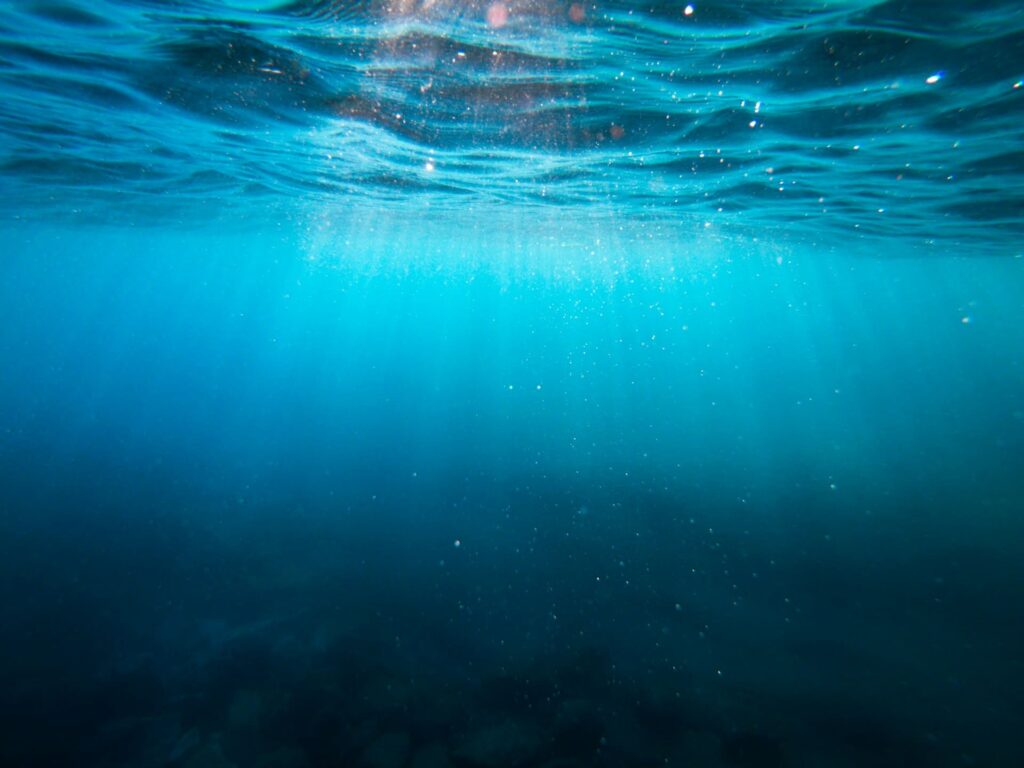
4,000 meters below the surface of the Pacific Ocean, where darkness is total and pressure crushes all certainty, someone has found oxygen. Not a marginal trace, but such quantities as to raise a question that weighs like a fracture in basic knowledge: where does it come from if light cannot reach there? The discovery, published in Nature Geoscience in 2024, opened a crack in the established narrative that free oxygen, in the oceans, is the almost exclusive child of photosynthesis.
Now that doubt is back at the center of a new scientific campaign. The goal is not to amaze, but to understand whether there really is a source of “dark oxygen” on the seafloor, produced without the sun, and what processes make it possible.
An unexpected discovery
Oxygen was detected in the Clarion-Clipperton area between Hawaii and Mexico, a vast abyssal plain best known for its polymetallic nodules: concretions rich in manganese, cobalt and other metals that have grown over millions of years like black truffles on the ocean floor. Here the team led by Andrew Sweetman, a seafloor ecologist with the Scottish Association for Marine Science, was conducting environmental studies related to potential mining. He was not looking for new sources of oxygen.
Yet the data indicated something anomalous. A production that could not be explained by either currents or instrumental errors. Too deep for photosynthesis, too consistent to be ignored.
Robots, pressure and new measurements
The answer will come, if it comes at all, thanks to instruments built specifically for this enigma. By May, a $5.2 million Nippon Foundation-funded expedition will return to the Clarion-Clipperton aboard the research vessel Nautilus. Descending to the seafloor will be new landers, probes designed to land on the deep and stay there to measure.
“We will bring along landers specifically designed to observe dark oxygen production,” Sweetman explained in London. Among the new features are pH sensors that can detect the concentration of protons in water: an increase could indicate the splitting of water molecules and the formation of molecular oxygen. The instruments used in the first observation could not do this. People did not know what to look for then.
In parallel, the processes will be replicated in the laboratory, in chambers capable of simulating the 400 atmospheres of pressure in the deep. An artificial environment to see if the phenomenon is real, reproducible, measurable.
Ancient metals or invisible microbes
There are two hypotheses on the table, and they are not mutually exclusive. The first calls into question electrochemistry: polymetallic nodules could function as catalysts, facilitating the splitting of water into hydrogen and oxygen, similar to what happens in some electrochemical cells. The second involves biology: as yet little-known microbial communities could contribute to the process.
“Our main culprits are electrochemistry and biology. Maybe they work separately, maybe they work in tandem,” said Jeff Marlow, a Boston University geobiologist and team member. The idea is to build real microscopic maps that relate microbes, minerals and metabolic activity within nodules.
Instead, chemist Franz Geiger, of Northwestern University, will study the recovered nodules with electron microscopes in liquid cells, capable of observing mineral surfaces immersed in salt water. Electrodes placed on hundreds of spots will measure voltage differences to understand whether those rocks can indeed “turn on” chemical reactions.
Science, mining and open controversy
The discovery is not neutral. It occurred during studies commissioned by The Metals Company, a Canadian company interested in mining from the seabed. After publication, some researchers linked to the same company raised doubts and concerns, initiating a post-publication review that is still ongoing, Nature Geoscience confirmed. A critical opinion article appeared in Frontiers in Marine Science.
Sweetman does not dodge the issue: understanding the role of dark oxygen in abyssal ecosystems is essential “so that, should mining continue, we can suggest extraction practices that limit damage as much as possible.”
In the deep, where humanity has explored only a tiny fraction of the seafloor, every new measurement counts. If oxygen can be born even without light, then those places are not just potential mines, but living systems more complex than imagined.