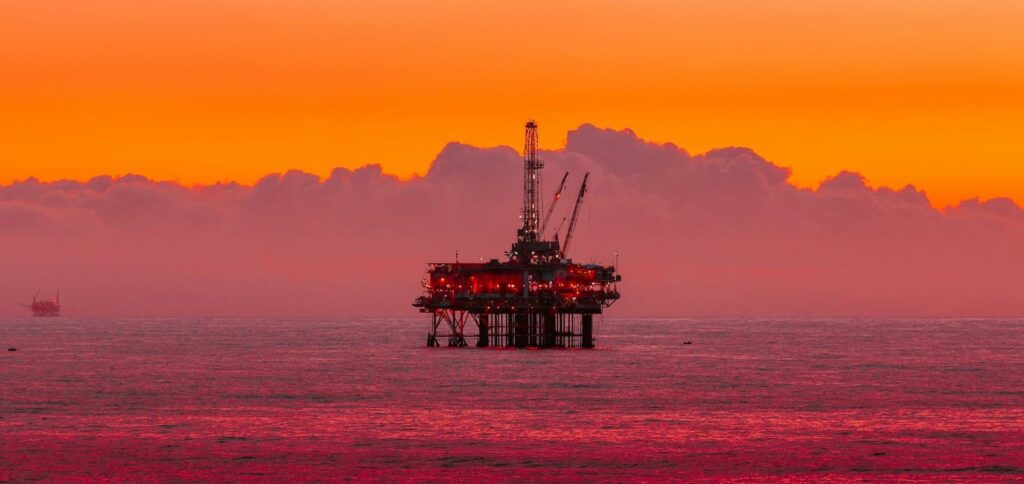
An ocean of barrels floats between the Atlantic and Pacific: 1.3 billion “oil on water,” the most since the black days of 2020. Cargo freighters slow, command decks scan longer routes and deeper discounts. And as tankers seek shores, at the pump the mileage counter of dear life is turning in reverse: gasoline under $3 a gallon in the US, Brent around $60. A paradox? No: it is an echo of a world that consumes differently, and of an industry that produces more than it sells.
Guyana exports nearly a million barrels a day, Brazil shattered its record at 4 million, North America pushes on with shale oil and new infrastructure. OPEC+ has loosened the brakes in 2025, except to pause further increases in early 2026. Russia must finance its wars. Result: a wide, wide market. The International Energy Agency sees a surplus in the range of 3.8 million barrels per day for 2026; other analysts predict smaller figures, but no one denies the direction: rising stocks, pressured prices.
Geopolitical thrusts
The dynamic is simple and relentless: when supply runs more than demand, the price adjusts. If Brent slid toward $50 in the spring, as some traders speculate, an additional incentive to buy would arise: large Asian importers and strategic reserves would have convenience to fill.
Then there is geopolitics. The tensions between Washington and Caracas, the squeeze on big Russian companies, the peace talks between Russia and Ukraine: any news can inflate or deflate futures in the space of hours. But behind the noise is a more tenacious reality: sanctioned barrels don’t stay at sea forever. They change names, mix origins, land elsewhere. And meanwhile, the bulk of the excess comes from non-sanctioned producers, from the Western Hemisphere to the Gulf.
Consumers cash in
Consumers, for now, cash in. Falling prices at the pump are a widespread mini-fiscal maneuver: money saved that spills over into other purchases, from coffee to groceries. And the effect on inflation is real: a drop of $10 a barrel can shave a few tenths of a point off consumer prices in large economies. In the short term, it’s oxygen for compressed incomes and strained government budgets.
For producing countries, the music is darker. State budgets built on $90-$100 thresholds suffer; pharaonic projects are postponed or recalibrated. Majors reduce headcount, shale companies tighten suppliers and revise growth plans. Technology helps pump more for the same amount of money, but it cannot undo a lower price curve. The classic consequence? Over time, investment cuts and natural declines in fields slow down supply — and that’s how prices find a floor again. The oil market is cyclical; it always has been.
On the demand side, the energy transition is not an on/off switch. It is a gradual substitution: more efficient motors, more affordable batteries, changing behaviors. Every extra electric vehicle is one less gallon; every heat pump replaces a fuel boiler. Still, aviation, chemicals, heavy transport remain large consumption basins.
The silent losers in this phase are the middle-heavy African producers, squeezed by closer and cheaper alternatives. Nigeria and Angola are struggling to place loads that until recently would have had lines of buyers. This, too, is a sign: the market rewards accessibility, logistics, and discounts. Those who don’t keep up, stay in the dock.
The competition has arrived
What does all this tell us? That the “blessing” of low prices is not a fluke, but the outcome of a double push: more barrels, less intensity of use. It is not yet the end of the oil era; it is the end of the era when oil ruled without answering to anyone. Now it has to contend with competing technologies and more attentive consumers. And when it has to chase demand-not drive it-the prices normalize.
That’s good overall. For households, for businesses, and yes, even for the climate: moderate prices reduce rents and drive efficiency. 2026 promises to be a year of abundance that brings order: less a distorting mirror of geopolitics, more a true mirror of what we actually consume. Oil shrinks in size. And we learn to do without it a little more, without drama.