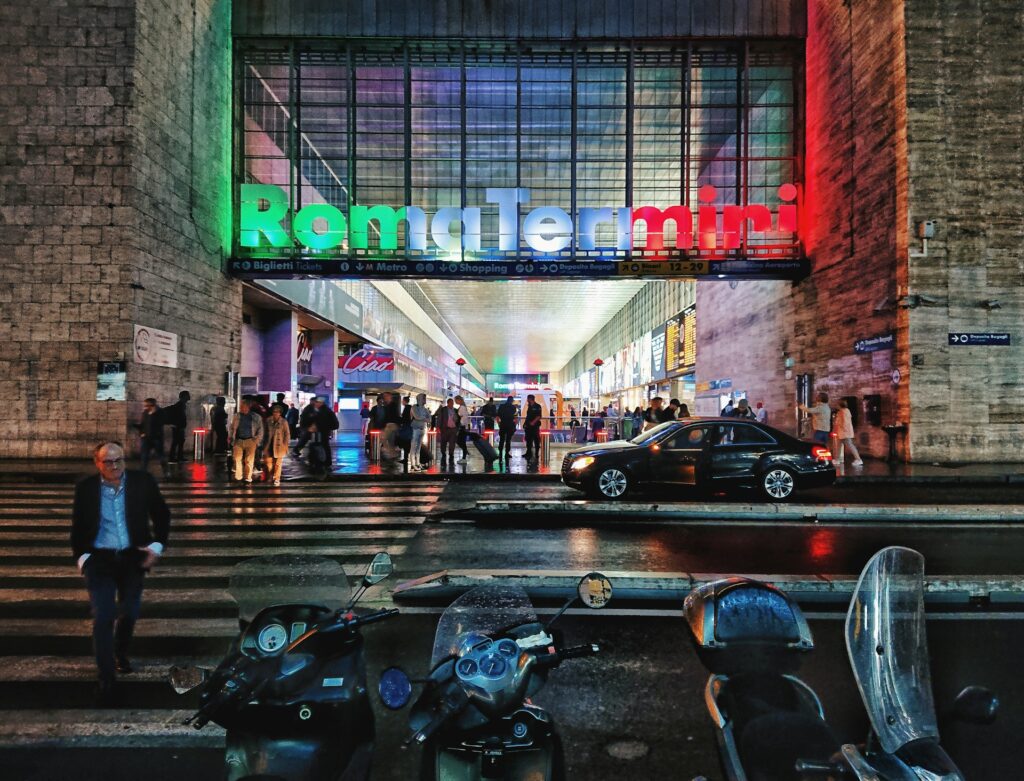
In 1951, the College of Italian Railway Engineers published a well-documented volume on Termini Station including a small volume of a collection of out-of-text design plates.
The cover of the collection was symbolic and at the same time concise and illustrative; in fact, on the cover through an arch of ancient Rome one can see the Station with the dinosaur, the head building, the rubberised gallery and the Mazzonian wing of Via Giolitti, on that side there is not what is commonly called the “carious tooth” (a quadrilateral of low buildings whose fate of demolition has been talked about for over 30 years).
Roma Termini is so named not because it represents the end of travel but because (although set back from the old station that stood on the Baths of Diocletian where Piazza dei Cinquecento is today), the name derives precisely from the Latin word “thermae.”
Various phases can be identified in the history of the station, originally (in 1863) it was called: Stazione Centrale delle Ferrovie, then in 1868 the construction of a much larger station began, in 1930 a new railway junction of Rome and the construction of a new Termini station was planned and the design by Arch. Angiolo Mazzoni was approved.
Work was stopped in 1943 and resumed in 1946 with the setting aside of Mazzoni’s design and the overcoming of that design’s excess of monumentality. In 1947 a competition was held for the construction of the new front building positioned further forward than Mazzoni’s, and so the 1950 inauguration was achieved with the front canopy known as the “dinosaur.” The other major renovation was carried out for the Jubilee of 2000.
The quality of reception and services to the traveller has expanded and grown in quantity, quality, and functionality, but the design activities of the Piazza dei Cinquecento for Jubilee 2025 have shown some limitations.
Over the past decades, the mission and role that Termini should have in relation to Tiburtina Station has been discussed and changed, and what weight commuter traffic should have at Termini. But discussing this before and without having a plan for the Rome node or knowing whether or not there will be a serious and true closure of the rail loop (which would change the role, missions and loads of the node Stations) makes little sense.
It makes much more sense to discuss the role of a lead station as an attractor and generator hub, even in light of the construction of the parking deck above the Station tracks.
In the 1950s, 60s, 70s in the area around the station, from Via Principe Amedeo to Viale Pretoriano, were located arrival stalls, ticket offices and waiting rooms of bus lines coming from different regions and the regional hinterland. They ranged from Forletti and Polsinelli to Zeppieri, the buses with Zorro’s Z on the front radiator grille.
These arrival and departure, loading and unloading stalls were placed to ensure the possible exchange with Termini and the already then Terminicentric city. About 900 trains/day, 150 million passengers/year, Rome’s two underground lines A and B (which are not network) crossing only at Termini, concentration of mobility services: these are some of the reasons for Termincentricity.
But the bus connections of 40/50 years ago have been sucked up by rail services, only two types of services endure: airport connections and double-decker sightseeing-type tour buses.
No nostalgia for the Piazza dei Cinquecento in the days of the Osram lamp, with dozens of public service buses stopped at the terminus or rows of taxis, mobility services that were inefficient partly because they were poorly coordinated with train arrival times.
One can think (there is also the necessary technology) of doing away with the ATAC terminuses altogether and make on the square only through rides; one can think of creating a lung stop for taxis that would regulate and order the flow for customers to get in so as to eliminate, amongst other things, that obnoxious way of interrogating customers “where are you going?” and then being sorted and shunted amongst the taxis in the queue, not only based on the destination address but also on the “value” of the ride.
People arriving at Termini with or without luggage are not going to take the tourist bus around the city as soon as they arrive, so it makes little sense to fill the station area with terminals and stalls; it would be more useful to decentralise them to areas around the Aurelian Walls with separate stalls.
It is a different matter for airport connections, incoming buses with customers getting off the plane who find at Termini the city’s first calling card, the first impression, the first feeling of welcome or otherwise.
The stalls of the airport connections, which have a market share that resists and grows compared to the competition of the train because of the advantage they have in flexibility, should be placed close to Termini Station as it was in the past, because those customers have a real need for exchange, even during the period of stay with the urban network and considering that they will leave from where they arrived.
The decision to move to the bottom of Via Marsala, close to Piazzale Sisto V, hundreds of metres from the undergrounds and ATAC services, the stalls of the airport connections is wrong and illogical.
The penalisation of services on buses coming from Ciampino and Fiumicino affects a type where major technological developments are announced regarding traction but also the structure and manoeuvrability of the vehicles.
Redevelopment of Termini Station, redesign of the area, a new road system, rearrangement of the types of connections to and from Termini, reorganisation of tourist buses, and technology for security are the faces of a cube with a much simpler solution than Rubik’s Cube.
There is still time to make choices that take into account variables such as the construction of post-Jubilee works or the queues of delayed Jubilee works, choices aimed at enhancing the Termini area.