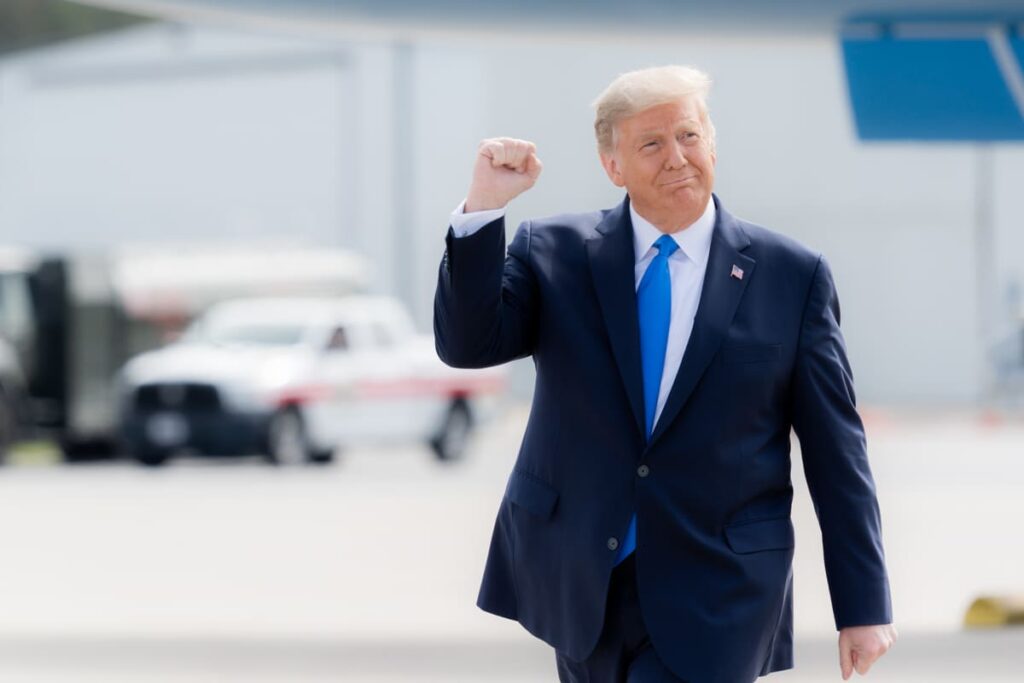
There is a strong wind blowing on global energy, but not everywhere in the same direction. On one side are Europe, China and much of the industrial world reinforcing renewables as an economic and strategic pillar. On the other is Donald Trump‘s United States, which is returning to question renewable energy in general and particularly wind power, trying to slow down projects and investments. Two opposite trajectories that tell more than just a technological dispute.
Europe sets its sights on the North Sea
In Northern Europe, offshore wind has become a system issue. Ten countries-including the United Kingdom, Germany, France, the Netherlands, and Denmark-have agreed to work together to turn the North Sea into a giant shared renewable power plant. The goal is ambitious: to reach 50 gigawatts of installed capacity between 2031 and 2040 (rising to 100 gigawatts thereafter) by creating an integrated power grid capable of powering tens of millions of homes.
This is not just about climate. Behind this choice is energy security, the reduction of dependence on imported gas and the desire to stabilize energy prices in the medium term. The constant and predictable North Sea wind is considered a strategic resource on par with the great industrial infrastructure of the twentieth century.
A global trend that goes beyond Europe
Europe is no exception. In Asia, wind power is growing at an impressive rate, often integrated with solar in huge energy parks. China, in particular, is now the world’s leading country in terms of installed wind capacity, with installations ranging from inland desert regions to offshore marine. A growing share of China’s electricity comes from wind itself.
Other emerging countries are also investing heavily in renewables, attracted by increasingly lower costs and industrial supply chains that generate jobs and innovation. Wind, in short, has become serious business.
Against this global backdrop, the position of the United States under Donald Trump’s leadership is bucking the trend. In recent months, the president has openly attacked wind power, claiming that it is unreliable, that it defaces the landscape, and that other countries-such as China-do not actually use it. Claims that are not reflected in the data, but are being used as a media cudgel and as a premise for a massive attack on clean energy to make way for fossil fuels. Indeed, the U.S. administration has halted or slowed down several offshore wind projects, suspending concessions already underway and calling into question plans approved in previous years.
Ideology vs. market
The paradox is that wind power today is not growing out of environmental idealism, but because it pays off. In many areas of the world, producing electricity from wind is cheaper than doing it with coal or gas. Yet in the United States the issue has become a political symbol, a flag to wave against global climate policies.
So while European and Asian companies consolidate technological leadership and industrial supply chains, Washington risks falling behind in one of the key areas of the energy transition. On one side is the vast majority of countries that see renewables as a lever for development, autonomy and stability; on the other is a superpower that chooses to slow down, turning the wind into an ideological battleground. The result is a two-speed global energy, where the future blows hard, but not everyone decides to unfurl the sails.