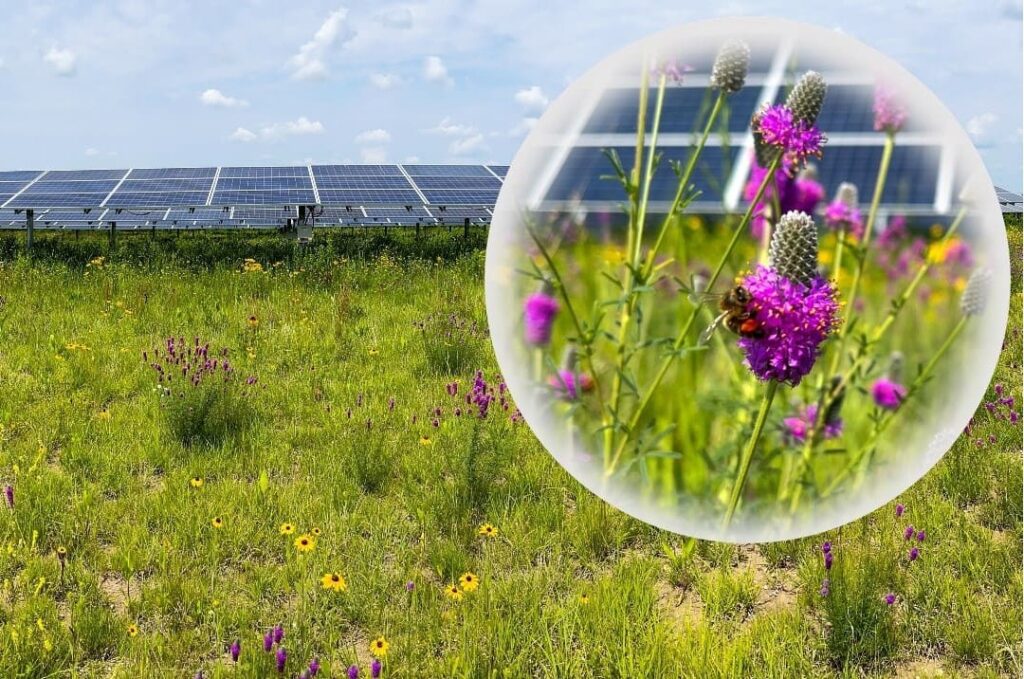
In the U.S. Midwest, in an area dominated by intensive agriculture and large ground-mounted photovoltaic systems, a team of researchers has been monitoring birdsong for two years to answer one question: what happens to wildlife when a cornfield becomes a solar installation also designed to function as a habitat?
The answer comes from research published in November 2025 in Journal of Applied Ecology and led by Leroy J. Walston along with a large group of researchers, who made more than 11,000 hours of acoustic recordings between 2023 and 2024 at 13 solar power plants and 12 agricultural control fields. All of the solar sites analysed, spread across five states, were on former corn and soybean farmland.
What is ecovoltaic
The installations observed largely fall into the ecovoltaic category: photovoltaic parks that, in addition to producing electricity, integrate ecosystem function. Under and between the panels, a mowed lawn is not maintained, but mixtures of herbaceous plants and perennial grasses, often native, are sown, designed to improve soil quality and provide habitat for wildlife.
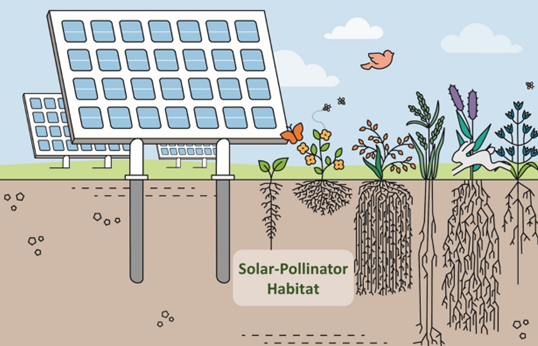
This approach was created to reduce conflicts between energy production and land use, one of the central issues in the deployment of ground-mounted solar. In the Midwest, almost all new solar installations are built on farmland that has already been profoundly transformed. Here, ecovoltaics do not replace intact natural ecosystems, but intervene on simplified landscapes with the goal of increasing their ecological value.
Listening to the birds, week after week
To assess the actual effect of these implants, the researchers used passive acoustic monitoring: automatic microphones that record sounds at dawn and dusk, the times of greatest vocal activity of the birds. The recordings were analyzed with BirdNET, an artificial intelligence-based system capable of recognising species by their calls.
Sixteen species of grassland birds were identified, many of them in steep decline in North America. Comparison with control agricultural fields revealed that for much of the breeding season, ecovoltaic systems host more species and more stable communities. In crop fields, on the other hand, species presence is more intermittent and time-varying .
In early summer, the difference is particularly marked: species richness at sun sites comes to be about twice that of agricultural fields. Only towards the end of the season, as many species migrate, do the values tend to come closer together.
Biodiversity amongst the panels
The analysis does not stop at the number of species. The study also assessed the probability of a species permanently using a site. Ten of the 13 species analyzed show a higher probability of occupancy in solar facilities than in agricultural fields. These include typical grassland species such as dickcissel, eastern warbler, and Savannah sparrow.
Not all, however, respond in the same way. The horned lark and jumping sparrow turn out to be more related to open agricultural fields, probably because they avoid the presence of PV structures and greater plant complexity.
During the fieldwork, researchers observed numerous active nests on PV structures, mostly of generalist species, that is, birds capable of adapting to different environmental contexts and less dependent on very specific habitats. In some cases, even typical grassland species used these sites for nesting, indicating that the facilities are not only crossed, but can be integrated into the life cycle of some of the local avifauna.
A useful piece of data for decision making
The study does not compare solar with intact natural ecosystems, but with the land use that preceded the installations: intensive agriculture. Within this framework, ecologically designed and operated solar installations show measurable improvement in conditions for birdlife. A relevant finding for choices about location and design of new solar capacity in already heavily transformed territories.