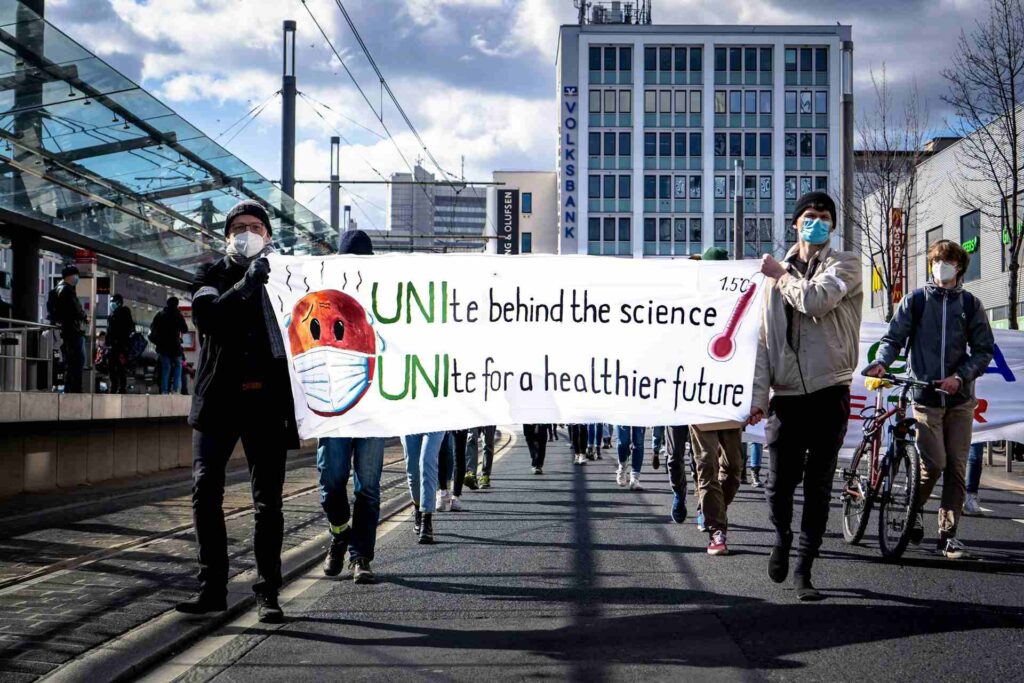
In six European countries, including Italy, people on average estimate that 68 percent of climate scientists agree that climate change is caused by human activity. The actual percentage, as measured in international scientific publications, exceeds 99 percent. The perception figure comes from a 2023 study by the Policy Institute at King’s College London, conducted on more than 12,000 people as part of the European PERITIA project. The one on reality comes from a study published in Environmental Research Letters in 2021, which analyzed more than 88,000 scientific articles on climate published between 2012 and 2020.
The distance between 68% and 99% is huge, and it is not accidental. Part of the explanation lies in the word itself.
The political interpretation of “consensus“
In Italian, “consensus” has a predominantly political connotation: the consent of voters, the consensus around a proposal, the consensus of public opinion. It is a word that evokes deliberate agreement, negotiation, majority. When applied to science, the meaning changes but the sound remains. “Scientific consensus” is read as “scientists agreed,” as if there had been a meeting, a discussion, a kind of vote. The phrase “science is not democracy, you don’t vote” starts from this reading and uses it to suggest that the 97 percent or 99 percent figure is irrelevant or suspect.
And the scientific one
The misunderstanding is understandable, because the mechanism is actually different from what the word suggests. Scientific consensus on climate is not the product of a survey of scientists or a joint statement signed at a conference. It is what happens when thousands of researchers, working independently, with different methods, different data, in different institutions and countries, come to the same conclusions. In philosophy of science, this process is called convergence of evidence: the point at which independent lines of research stop contradicting each other.
The most cited figure is from Cook et al. (2013): out of 11,944 scientific articles published between 1991 and 2011, 97% of those expressing a position confirmed that global warming is caused by human activity. The study was updated by Lynas et al. in 2021, who reviewed 88,125 articles published between 2012 and 2020: the consensus exceeded 99%, with just 28 explicitly skeptical articles in the entire sample. A result consistent with that of Myers et al. (2021), who through a survey of earth science researchers found 98.7 percent agreement among climatologists actively engaged in publication.
The IPCC, the United Nations Intergovernmental Panel on Climate Change, used the term “unequivocal” in its Sixth Assessment Report (2021): human influence has warmed the atmosphere, oceans and landmasses. In IPCC language, “unequivocal” is not a degree of probability: it is a statement of fact, reserved for conclusions supported directly by observation.
Dissent exists, and it is physiological. In any scientific field there are researchers who question prevailing conclusions-it is part of how research works. The point is that in climate science, dissent is about specific aspects (the exact climate sensitivity, the speed of certain feedbacks, the regional distribution of impacts), not the basic conclusion. It is the difference between debating how fast the water is rising and debating whether the water is rising.
Misperceptions
A study published in Nature Human Behaviour in 2024, conducted among more than 10,500 people in 27 countries including Italy, measured what happens when data about the scientific consensus is communicated: misperceptions are reduced and beliefs about the reality of climate change are strengthened. The effect was found to be across the board, without polarizing the public. The gap between perception and reality is not inevitable: it is a communication problem.
This column was created to address a recurring type of ambiguity: climate words whose technical or regulatory meaning diverges from common perception. We have seen this with “natural gas,” which sounds clean but remains a fossil fuel; with “carbon neutral,” where offsetting is perceived as equivalent to reduction; and with “sustainable” in the EU taxonomy, which includes sources that most Europeans would not classify that way.
“Scientific consensus” adds a different case: here the ambiguity is not between a technical term and its perception, but between two meanings of the same word in different contexts. Political “consensus” is negotiation. Scientific “consensus” is convergence of independent evidence. Confusing the two meanings is the mechanism that makes the “science does not work by consensus” objection credible.
The next time someone says “science does not work by consensus,” the short answer is: he is right. It does not work by vote. It works by convergence of evidence. And on this, the evidence converges.