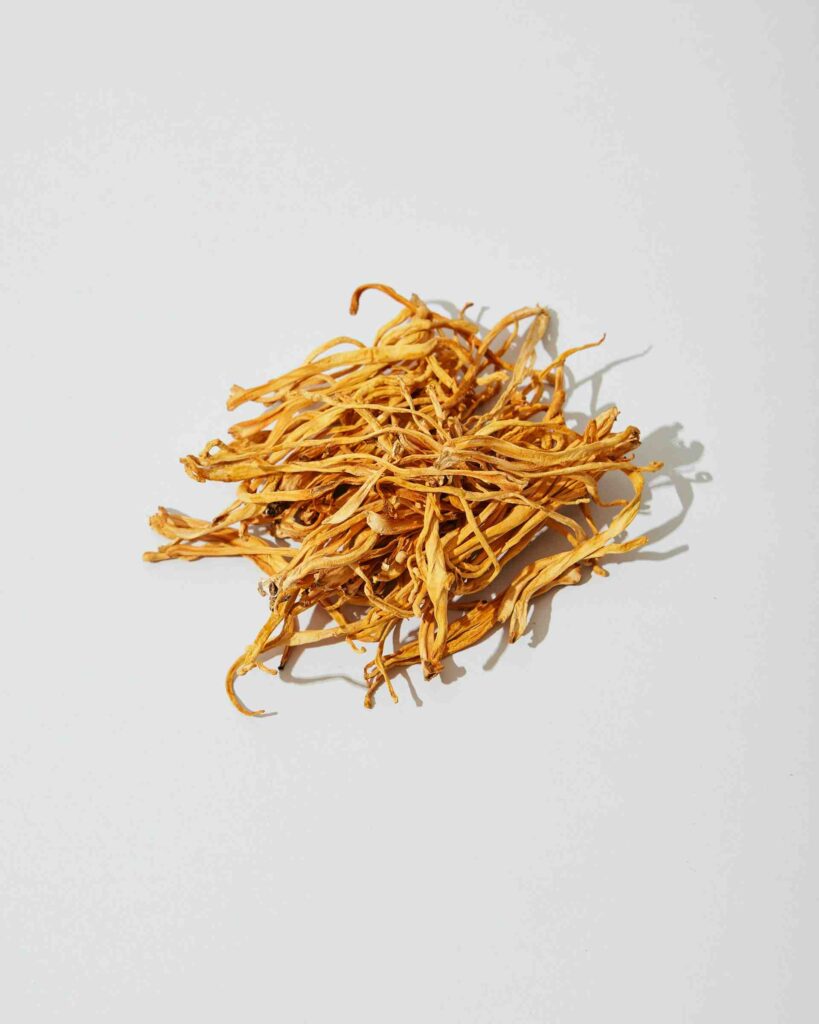
Until a few decades ago, the Wild Cordyceps was worth more than gold. In Tibetan and Chinese markets, a kilogram of hand-picked mushroom on the Himalayan highlands could cost tens of thousands of dollars. Harvesting it were peasants who climbed more than four thousand meters, looking for the tiny orange-brown growth that signaled the mushroom underground. Inside was a moth larva, consumed from the inside by a parasite that, having completed its life cycle, emerged as a sapling.
Today you can find that mushroom in capsules on Amazon, in neighborhood herbalists, and in organic supermarkets. Price: between ten and forty euros per packet. But what do we know about this substance that has traveled through three thousand years of traditional Chinese medicine to arrive on the shelf next to vitamin C in tablets?
A parasite with a resume
The active compounds most studied today are mainly two. The first is chordicepin, an adenosine analogue with potential anti-inflammatory and immunomodulatory effects. The second isadenosine itself, involved in the production of ATP, the molecule that powers cellular energy processes. Then there are polysaccharides, which would act on the immune system, and a number of natural antioxidants.
Studies exist, and some have produced interesting results. One published in Foods in 2021 showed that taking Cordyceps before exercise reduced muscle damage and promoted cellular repair. Research appearing in Nature in 2024 documented increased immune cell activity in subjects who consumed a drink made from the mushroom. A study in Frontiers in Molecular Biosciences in 2021 found reduced blood sugar and lipids in animal models.
The problem is what is written in the margins of these papers: small samples, measurements of biological markers rather than actual clinical outcomes, data mostly on animals. None of these studies show that Cordyceps cures or prevents disease. They show that it is worth continuing to study.
The paradox of cultivation
The shift from wild harvesting to controlled cultivation is an ecological necessity. The pressure on certain Himalayan ecosystems had become unsustainable: massive harvesting has already compromised local populations of the pest in parts of Tibet and Qinghai.
Lab-grown varieties are biochemically similar but not identical to the wild. They do, however, have the advantage of being standardizable: chordicepin and polysaccharide content can be controlled, contaminants eliminated, and consistent quality ensured between batches. For those who buy supplements, this is actually good news: a certified product from controlled cultivation is safer and more predictable than “natural and wild,” which sounds better on the packaging but carries considerable compositional uncertainty.
Those on anticoagulant or immunosuppressive therapies should consult their doctor before taking this mushroom: its immunomodulating action may interfere with the drugs. The same applies to those with autoimmune diseases. During pregnancy, lactation, and in childhood, data are absent or insufficient, and in these cases “no studies” is a call for caution.
The most common side effects, such as nausea, diarrhea, and skin irritation, are generally mild and reversible.
What we really buy
Dosages reported by the most reputable studies are between 500 and 1,500 milligrams per day of standardized extract. But “standardized extract” is the key word: a product that does not list the percentage of chordicepin or polysaccharides on the label does not guarantee that it contains therapeutically relevant amounts of anything.
Cordyceps can be, for some people and in certain contexts, a useful adjunct to a healthy lifestyle. It is not a cure, it is not a revolution. It is a mushroom with an extraordinary history and science still under construction.