They don’t make noise like gas or oil, they don’t open the news, and they rarely trigger immediate crises. Yet without them the energy transition simply does not exist. Lithium, cobalt, rare earths, nickel: these are the critical raw materials and, as the mini-book “Critical Raw Materials and Security of Supply” published in February 2026 by the Utilitatis Foundation points out, they are becoming the real ground on which European economic security is being played out.
This is not a traditional report, but a concise analysis that focuses on a specific point: Europe’s dependence has not disappeared, it has transformed. If in recent years fragility was all about energy, today it is shifting to materials. With one major difference: many of these resources have no immediate technological alternatives.
A stark photograph
The picture drawn from the mini book is stark. China covers about 98 percent of the rare earths used in Europe and dominates much of the global processing, with shares exceeding 80 percent for some materials. Turkey supplies 98 percent of borate, South Africa 71 percent of platinum, while lithium comes about 78 percent from Chile. These are joined by the Democratic Republic of Congo, which produces more than 70 percent of the world’s cobalt, and Indonesia, which is worth more than half of global nickel production. An extreme concentration that exposes Europe to systemic risks along the entire value chain.
The central issue is not only extraction, but more importantly processing. The mini book insists on this point: the real power lies in the refining and processing stages, where China has built a decisive advantage. It refines about 70 percent of cobalt, more than 60 percent of lithium, and more than 80 percent of rare earths. Even when raw materials are mined elsewhere, they often pass through its plants before reaching the market.
This is where the issue becomes geopolitical. An export restriction, diplomatic crisis, or logistical disruption can bring entire industrial supply chains to a halt. Batteries, renewables, electronics, defense-all depend on these materials. And according to estimates recalled in the analysis, global demand for critical minerals for clean technologies could quadruple by 2040, with lithium set to grow up to 40 times current levels.
The Critical Raw Materials Act
The European response came with the Critical Raw Materials Act, passed in 2024 and referred to in the document as a key step. The regulation marks a paradigm shift: raw materials become an economic security issue. The Union has set clear targets for 2030: at least 10 percent of extraction must take place in Europe, 40 percent of processing must be domestic, and 25 percent of requirements must be covered by recycling. In addition, no third country will be allowed to exceed 65 percent of supplies of a single strategic material.
The problem is that global demand runs much faster than solutions. Investment in critical minerals is expected to grow by 20 percent in 2021 and an additional 30 percent in 2022, driven mainly by the United States, China and large emerging economies. Europe, on the other hand, risks falling behind in a game that is being played now.
Opening new mines is not a shortcut
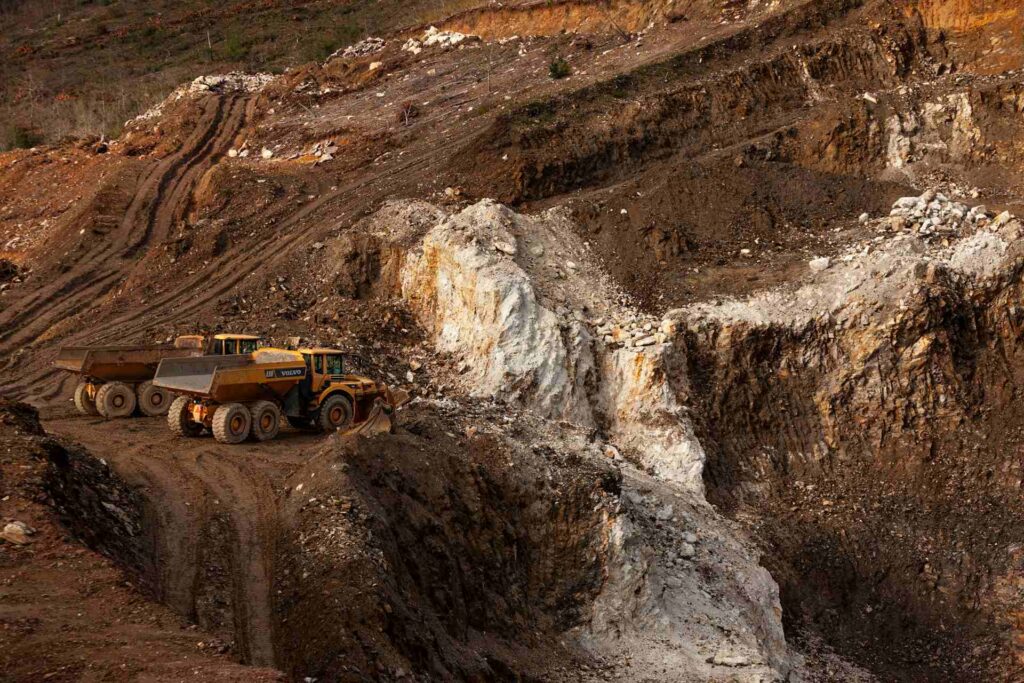
Opening new mines is not a shortcut. It takes an average of 10 to 15 years to bring a project into production, between permitting, environmental assessments and plant construction. And even when the resources exist, they do not always have the quality required for the most advanced applications. The result is increasing pressure on prices and industrial competitiveness.
That’s why the Utilitatis Foundation’s mini-book insists on an often-overlooked lever: the circular economy. Today, less than 5 percent of rare earths are recycled globally, and for many critical materials, recovery rates remain below 10 percent. Yet so-called urban mining represents an already available reservoir. Electronic waste, spent batteries, vehicles and infrastructure contain significant amounts of strategic metals that could be recovered.
Europe aims to cover at least a quarter of its needs through recycling by 2030. This is not just an environmental choice, but an industrial strategy to reduce dependence and strengthen the resilience of supply chains.
The picture that emerges from the analysis is clear: critical raw materials have become a lever of global power. More and more countries are protecting their resources, limiting exports and investing in processing to move up the value chain. In this scenario, Europe is called upon to build greater autonomy without chasing self-sufficiency. Diversifying partners, strengthening the industry and accelerating on recycling are the main directions.