Gas before renewables. Oil before public transportation. The past before the future. The Meloni government’s hierarchy of choices is unwavering. With the fourth excise decree, 145 million euros were cut from the Fund for the Enhancement of Metropolitan Networks and Mass Rapid Transport to finance yet another fuel discount. A transfer of resources from collective, low-emission infrastructure to direct support for fossil fuels. This is not an accounting accident. It is a repeated series indicating a direction of travel.
The occasion, in this case, was fuel prices. To call it an emergency is a stretch of the Italian. Because the fact that by curbing renewables and the energy transition we would find ourselves exposed to market instability accelerated by geopolitical crises was known to all. An awareness that had long emerged, not a surprise. Yet the government got caught with its energy guard down.
So prices go up, families suffer, businesses are forced to pay higher energy prices than our competitors. The country’s productive structure gets sick, but the discount on gasoline fill-ups is seen, heard, told. Some hope to turn it into votes.
The paradox of subsidized fossils
Those aids, however, do not solve the problem: they keep alive the addiction that generates the problem itself. It is like merely administering analgesics to a patient who needs an operation: it takes away the pain for a few hours, but leaves the cause intact.
The only way out of the energy price trap is to reduce dependence on fossil fuels. And the only way to reduce that dependence, in the transportation sector, is to build credible alternatives with low environmental and social impacts: subways, streetcars, trains, bicycle networks, shared mobility services. Infrastructure that allows people to get around without having to suffer a bloodletting every time a war or a dispute between producers cuts off oil flows.
The excise decree does exactly the opposite: it takes resources away from alternatives to finance dependence. It is a self-feeding policy: the more you support fossils, the more people depend on fossils, the more every increase in the price of those fuels becomes a political emergency requiring new fossil subsidies. A vicious cycle. Which only a radical reversal of perspective can break.
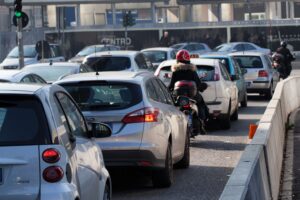
Every year of delay in building credible alternatives to fossil transport has a cost. Not just environmental but economic and social. Italian cities lose billions in productivity every year due to traffic congestion. They lose quality of life, attractiveness for businesses, ability to retain talent. Rome and Milan compete not only with Turin and Naples: they compete with Barcelona, Amsterdam, London, cities that have invested heavily in public mobility and today reap the benefits of those choices.