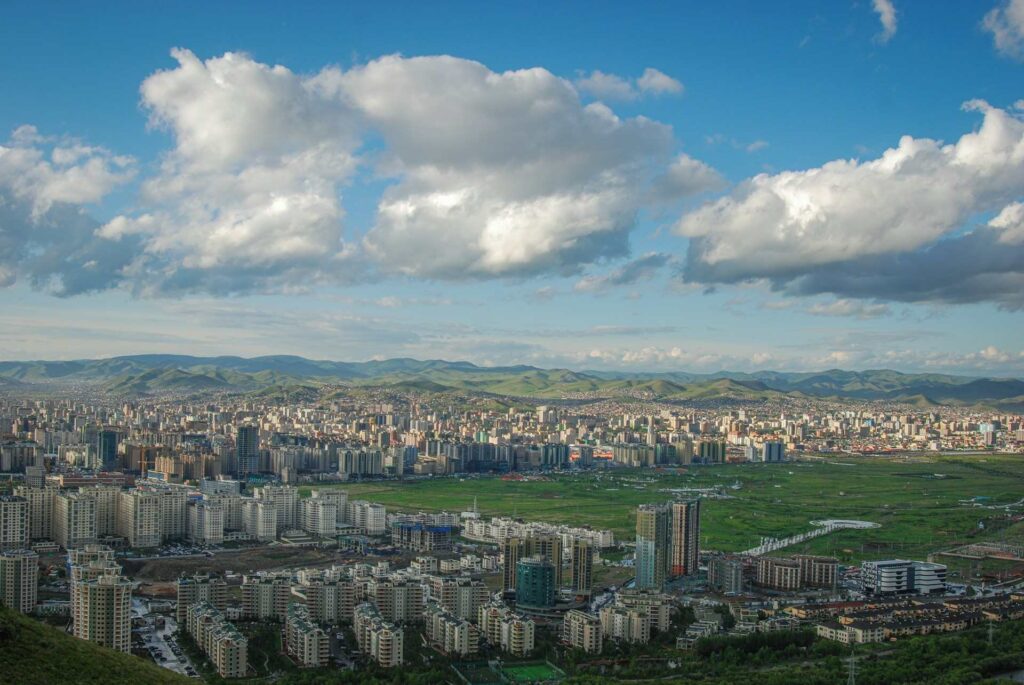
In Ulaanbaatar, the capital of Mongolia, winter is an endurance test. Temperatures below -35°C, a valley that traps the air, and, most importantly, a million people who burn almost everything they can to keep warm: coal, wood, garbage, and even plastic. The result is one of the world’s worst air pollution crises. A Nature report by photojournalist Dave Tacon tells how a bottom-up, concrete and measurable energy transition is being attempted in this city.
The smog trap
The numbers are hard to ignore. In the winter of 2025-2026, PM2.5 concentrations reached peaks of 687 micrograms per cubic meter, 27 times above the limits recommended by the World Health Organization. Pollution is responsible for thousands of deaths each year and, according to studies cited in the report, accounts for one in ten deaths in the city.
The root of the problem is structural. Ulaanbaatar, designed in the 1970s to accommodate 600,000 inhabitants, now exceeds 1.6 million. About two-thirds live in ger, the traditional circular dwellings of Mongolian nomadic culture (known in Italian as “yurts”), but unsuitable for modern urban life. Here domestic coal generates up to 80% of the smog.
Also driving thousands of families to the capital is the weather: drought and extreme phenomena such as zud-which exterminates livestock by freezing pastures-have eroded the pastoral economy. “Catastrophic weather events are occurring more frequently,” Unurba tErdenemunkh, a physicist and entrepreneur, explains in the report.
From the laboratory to the yurt
Erdenemunkh comes from medical research. After years between the United States and Europe, he decided to return to Mongolia to deal with an emergency he also knows on a personal level: his children have been hospitalized several times for smog-related respiratory problems.In 2022, he co-founded URECA, a start-up that launched the Coal-to-Solar (C2S) project. The idea is to replace coal stoves in ger with integrated solar systems equipped with batteries and electric heating.
“We have shown that even low-income families can take the lead in climate action,” he says. The pilot project now involves dozens of families and aims to expand rapidly.
Technology adapted to reality
The C2S system functions as a hybrid: it stores energy in batteries and heat in internal elements, providing autonomy even during frequent power outages. A crucial aspect in a fragile urban context. Also crucial is insulation. The ger dissipate up to 25 percent of heat from the roof and significant percentages from walls, floors and doors. Targeted interventions-additional layers of felt, structural improvements-make it possible to maintain interior temperatures of up to 20°C even in the coldest months.
Changing lives, not just energy
The effects are not only environmental. Davaajargal, a single mother, was among the first to join. “I was tired of having to burn coal and put up with the soot,” she says. Today her yurt is clean, her children have more time to study, and she left a precarious job to pursue art.
This is something that emerges strongly in the report: clean energy frees up time, health and opportunity. And it creates new economic dynamics. Households will be able to resell excess energy and, eventually, benefit from carbon credits.
A fragile but real transition
The project remains a drop in the bucket compared to the scale of the problem: 20,000 households, out of hundreds of thousands, reached by the change is the stated goal over the next few years. But initial results are encouraging: in the ger involved, coal has disappeared.
In a city where pollution is often perceived as inevitable, this is perhaps the most relevant fact. Ulaanbaatar remains a capital choked with cold and smoke. But among the hills that surround it, where yurts draw an ancient landscape, something different is beginning to be seen: roofs dotted with solar panels that indicate a real possibility for improvement.