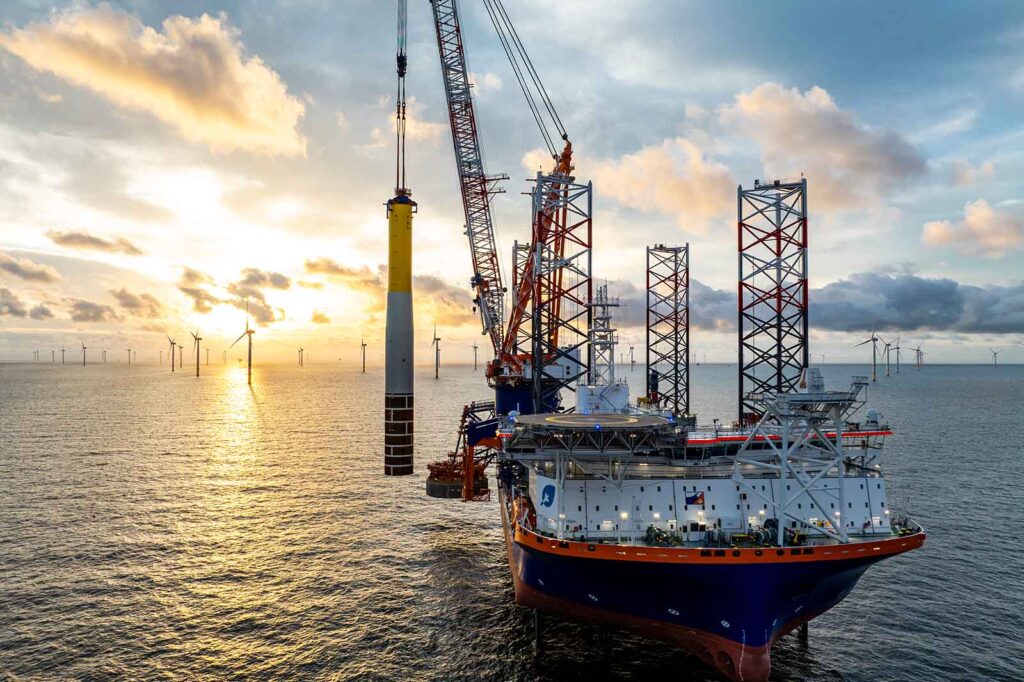
Germany continues to push offshore wind and adds a new piece to its energy strategy. The Federal Maritime and Hydrographic Agency has authorized the construction of two wind farms in the North Sea, north of the East Frisian Islands. The project, entrusted to a subsidiary of the RWE Group, will have a total capacity of 900 megawatts and the installation of 60 turbines spread over an area of about 62 square kilometers. To give an order of magnitude, such a capacity can cover the electricity needs of hundreds of thousands of households, making a real contribution to reducing energy imports.
The two plants will be built tens of kilometers off the coast, between the islands of Borkum and Norderney, in water up to more than 30 meters deep. The planned turbines are among the most powerful available today: each will have a capacity of 15 megawatts, with rotors more than 230 meters in diameter and an overall height exceeding 260 meters.
Numbers that explain well how offshore wind has changed in recent years: fewer turbines, but much larger and more efficient. Construction is scheduled to start in 2027, while the first power outputs are expected to arrive in 2028.
Energy and geopolitics: why Berlin accelerates
The push on wind power is not only environmental. In recent years, Germany has had to deal with the vulnerability of its energy system, which is heavily dependent on gas imports. International tensions and price volatility have made it clear how strategic it is to produce energy at home.
In this context, offshore is one of the most effective levers: large-scale production, greater stability than solar, and the possibility of exploiting abundant natural resources such as North Sea wind. Not surprisingly, German authorities emphasize how these projects directly contribute to security of supply and reduced emissions.
The role of wind power in the German transition
Germany is already one of Europe’s leading markets for wind energy. In recent years, the share of electricity from renewable sources has steadily exceeded 50 percent, with wind – onshore and offshore – representing the largest component of the mix.
The stated goal is even more ambitious: to achieve almost entirely renewable electricity generation by 2035. To do so, Berlin is focusing primarily on expanding offshore wind, with targets calling for tens of gigawatts installed by 2030 and more in the following decade. The new farms fit precisely into this trajectory: increasing generating capacity, stabilizing the system, and reducing dependence on imported fossil fuels.
A European model
The German case is also being closely watched by other European countries. Indeed, offshore wind is one of the pillars of the Union’s energy strategy, especially for northern countries. With projects like those in the North Sea, Germany is trying to show that energy transition is not only an environmental choice, but also a concrete response to geopolitical crises and market instability. Wind is not just for generating electricity: increasingly, it is a matter of energy sovereignty.