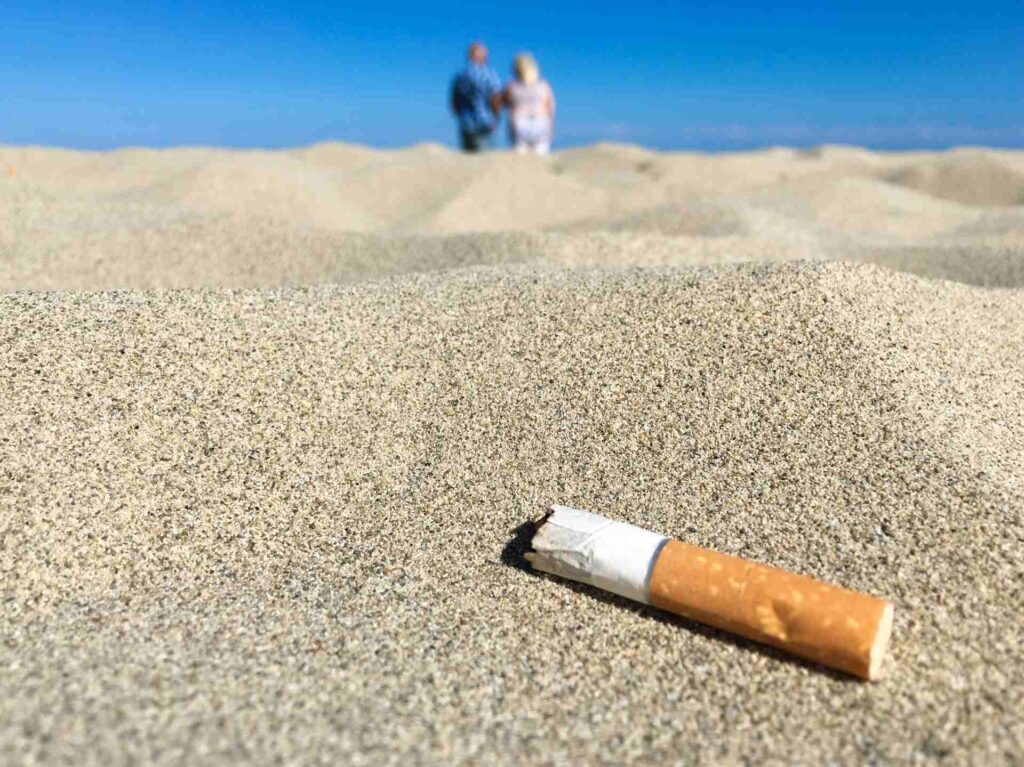
If one imagined walking along one hundred meters of Italian beach, one would find an average of 77 cigarette butts. This is not a catastrophist hypothesis, but the concrete result of twelve years of field surveys conducted by Legambiente as part of the Beach Litter project. From 2014 to 2026, as many as 50,053 butts were catalogued in 653 corridors distributed along the coasts of the Peninsula. A number that earned cigarette filters second place in the ranking of the most waste found on Italian shores, surpassed only by plastic fragments (61,785 those collected during the same period).
Butts account for 87 percent of so-called “smoking waste,” a category that also includes spent lighters, empty packets and tobacco boxes. In total, over the 12 years of monitoring, this category has 57,099 abandoned items. The overall picture is even more discouraging: adding up all the types of waste found in the 653 corridors monitored brings the total to 512,934 objects, for an average of 785 pieces per hundred linear meters of beach. Plastic and derivatives account for 80 percent of the total.
Not just dirt: filters fragment and release poisons
The problem with cigarette butts does not end with their aesthetic appearance. Cigarette filters are composed largely of cellulose acetate, a plastic material that does not readily biodegrade. A recent study by the University of Naples Federico II showed that filters abandoned in the environment undergo progressive fragmentation into smaller and smaller particles, a process that can take up to more than a decade. But it gets worse: the research showed a second peak in the release of nicotine and other toxic chemicals about five years after abandonment, right at the most intense fragmentation.
Littering at the beach not only threatens water quality or the beauty of landscapes-it directly affects the wildlife that depends on those ecosystems. In Italy, among the species most at risk are the loggerhead turtle Caretta caretta and the Kentish plover (Anarhynchus alexandrinus).
Faced with this situation, Legambiente is relaunching with the 36th edition of “Clean Beaches and Seabeds,” its historic mobilization campaign, which this year takes place over the weekend of April 10, 11 and 12, coinciding with National Sea Day on April 11. Scheduled are more than 80 initiatives in 16 regions of the Peninsula, organized by the association’s clubs and regional structures with the involvement of volunteers and citizens of all ages. The goal is to clean up beaches, coastlines and seabeds, as well as the mouths of rivers and streams, which are too often turned into open dumps.
The European directive
On the regulatory side, the picture is critical. The European UAS Directive (2019/904) on single-use plastics provides for the principle of Extended Producer Responsibility (EPR) for the tobacco sector as well: cigarette manufacturers must cover the costs associated with managing the waste generated by their products, including the costs of collection, cleaning, transportation, and awareness raising. In France, the tobacco EPR is already operational; in Germany, Spain and Sweden the regulatory basis exists to initiate it. In Italy, three years after the directive came into force, no binding legal instrument has yet been adopted.
The situation is so serious that the European Commission has opened an infringement procedure (2052/2024) against Italy, which includes among the objections precisely the failure to implement tobacco EPR. In our country there are only voluntary initiatives-such as those promoted by the ERION CARE consortium-but the regulatory act (decree or program agreement) that would make producers’ responsibility mandatory is missing. Legambiente calls on the Ministry of Environment and Energy Security to take urgent action.
“To combat marine and beach litter, it is essential to reduce disposability, provide for more information and awareness campaigns, and also more controls and effective penalties for those who throw butts on the ground, on the beach or in the sea,” stresses Giorgio Zampetti, director general of Legambiente. It is worth remembering that Italian legislation already provides for fines of 30 to 300 euros for those who abandon butts on the ground, in water and in drains – a measure that is, however, poorly enforced and controlled.
Some good news: smoke-free beach ordinances growing
Among the few positive notes is the growth of municipal anti-smoking ordinances on shorelines. Legambiente has surveyed 18 of them throughout Italy. The latest in chronological order is that of the municipality of Pesaro, which updated a 2019 measure by extending the smoking ban to the entire shoreline, including waters up to 200 meters from the shore. Prior to Pesaro, similar ordinances had already been adopted by San Benedetto del Tronto (Marche), Rimini, Cesenatico and Ravenna (Emilia-Romagna), Latina, Pomezia and Gaeta (Lazio), Lerici, Arenzano and Loano (Liguria), Porto Cesareo and Barletta (Puglia), and six Sardinian municipalities-Arzachena, Alghero, Oristano, Olbia, Tortolì and Quartu Sant’Elena.
Rome, too, is preparing to move in this direction: as early as summer 2026, beaches along the Capitoline coastline-Ostia, Castel Porziano, and Capocotta-may be affected by a smoking ban that would include electronic cigarettes. These are still partial signals, but they indicate a growing awareness on the part of local governments. Because a beach without butts is not only more beautiful: it’s safer for the turtles, for the kittens, for the children who play there. And for everyone.