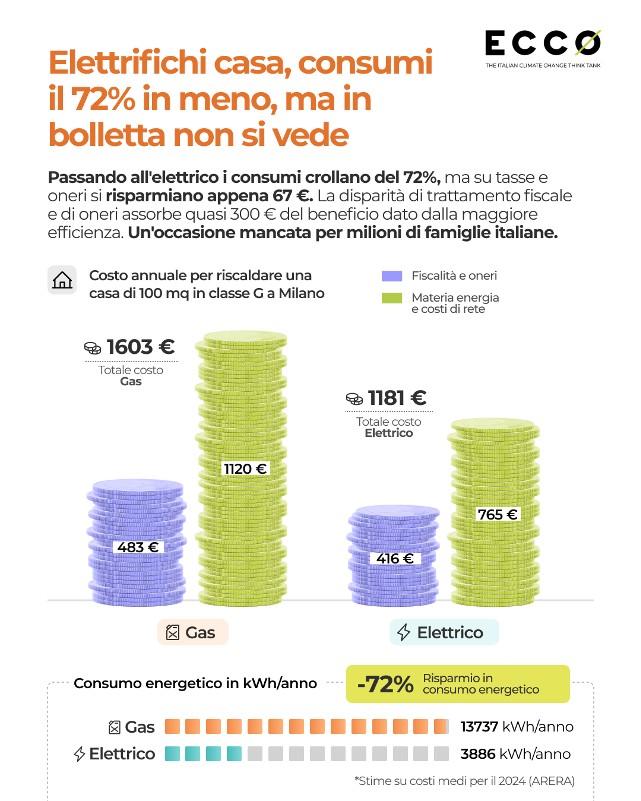
Italian households that have chosen to switch to electricity pay taxes and fees on electricity that are up to four times higher than those applied to natural gas. In the industrial sector, the gap exceeds twenty times. This is according to a new study by ECCO, the Italian climate think tank, presented on June 11 in Brussels during European Sustainable Energy Week.
This paradox is weighing on the country’s competitiveness and slowing down the energy transition. According to Matteo Leonardi, co-founder and executive director of ECCO: “At a time when energy costs have become a crucial factor for households and businesses, those investing in electrification are unable to fully benefit from the economic advantages of innovation. This slows down investment, reduces competitiveness, and hinders the energy transition.”
The numbers speak for themselves
The study’s figures are clear. In 2024, the average cost of electricity for Italian consumers was approximately 31 cents per kilowatt-hour: 49% was accounted for by the cost of the raw material, 16% by network services, and the remaining 35% by tax components, charges, and costs related to the ETS system. For gas, however, the average cost stood at about 10 cents per kilowatt-hour, with 50% attributable to the raw material, 22% to network services, and 28% to taxes and charges. Translated into concrete figures: a small or medium-sized business pays 11 euro cents per kilowatt-hour of electricity on its bill, compared to just 0.6 cents for gas. Even in transportation, the various modes of electric charging are subject to taxes and charges that are up to twice as high as those levied on diesel and gasoline.
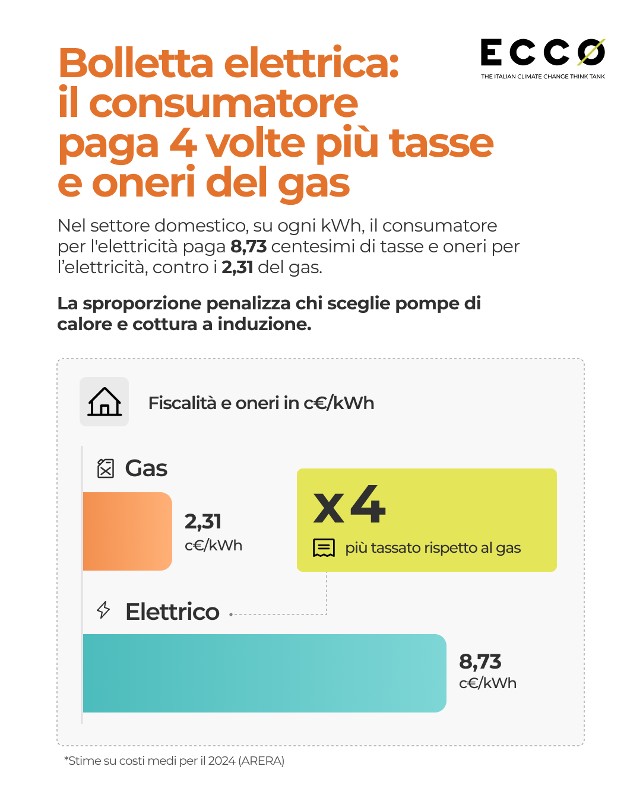
The main cause of this imbalance is the general system charges. Originally created to finance sector-specific policies and support the development of renewable energy, these charges now fall almost exclusively on electricity consumption, while gas, diesel, and gasoline have not borne costs of comparable magnitude. In other words, the transition has continued to be financed by a tax on those who are already making the transition.
For this reason, the study calls for a structural reform of energy taxation. According to ECCO, the starting point must be to achieve at least an equivalent level of taxes and charges per unit of energy content across electricity, gas, diesel, and gasoline. A rebalancing that, “if well designed, would be capable of raising the necessary resources to finance transition-related policies, which are currently supported by system charges, the ETS mechanism, and public spending that is poorly coordinated with energy policy.”
Inconsistent charges
Leonardi rejects the objections of those who argue that the level of Italy’s public debt prevents action, or that the problem will resolve itself through the gradual reduction of costs associated with the development of renewables: “It’s the opposite. The failure to establish a link between consumer costs and the financing of transition policies makes the costs of energy carriers inconsistent with consumer benefits.”
The stakes are high. Italy currently imports 95% of the gas and 89% of the oil it consumes: maintaining the current imbalance means leaving the economy exposed to the volatility of fossil fuels, jeopardizing growth, competitiveness, and household spending power. According to ECCO, electrification—thanks to greater efficiency and the contribution of renewables—remains “the only way to lower energy bills,” but only if the tax system stops penalizing it.