For those living with Parkinson’s disease, finding the right balance in treatment is a daily challenge. Levodopa, the main medication used to control the movement problems caused by the disease, must remain within a therapeutic window—that is, a dosage range in which it is effective without causing side effects. An insufficient dose leaves the patient unable to move, while an excessive dose can cause involuntary and uncontrolled movements.
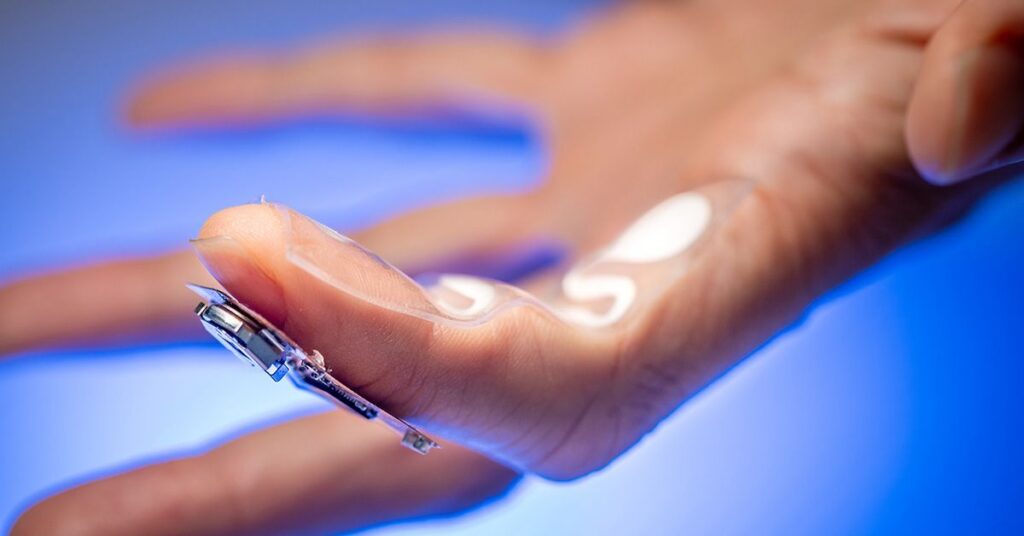
It is precisely on this point that a study fromthe University of California, San Diego, published in *Proceedings of the National Academy of Sciences* (PNAS), which presents a soft patch that can be applied to the fingertip and is capable of continuously monitoring the amount of levodopa in the body through sweat, without batteries and without the need for blood draws.
Sweat powers the sensor
The most innovative aspect of the device is how it works. The patch uses a gel with a high concentration of salts that naturally draws sweat from the pores of the fingertips, one of the areas of the body with the highest concentration of sweat glands. When the levodopa present in the sweat comes into contact with the enzymes embedded in the sensor, a chemical reaction occurs that generates a small electric current. This same reaction provides the energy needed to power the device and, at the same time, indicates the amount of medication present in the body.
In clinical trials conducted on healthy volunteers and people with Parkinson’s disease, the measurements obtained from the patch were comparable to those from traditional laboratory tests, which measure the amount of a drug in the blood with great precision, with the advantage of providing real-time data rather than having to wait for blood test results.
A discovery that is also useful to doctors
The study also revealed a clinically significant finding: patients with Parkinson’s disease eliminate levodopa significantly more quickly than healthy individuals. This finding helps explain why many patients experience sudden periods during which the drug’s effect wears off and symptoms return or worsen between doses.
As the authors of the study point out, the new system could allow doctors to tailor treatment based on objective data, moving beyond the current patient-reported diaries, which are inevitably subjective and unable to capture all the fluctuations in the response to the medication.
Toward “Smart” Therapy
The work coordinated by the research groups led by Joseph Wang and Irene Litvan is already looking beyond monitoring. The goal is to develop a “closed-loop” therapeutic system in which the patch can communicate with an infusion pump capable of automatically administering the necessary dose when levodopa levels fall below the therapeutic threshold.
For now, this is still an experimental approach, but the goal is to shift from occasional monitoring of drug levels to a continuous monitoring process. This change could improve the quality of life for people with Parkinson’s and provide neurologists with a much more precise tool for personalizing treatment.