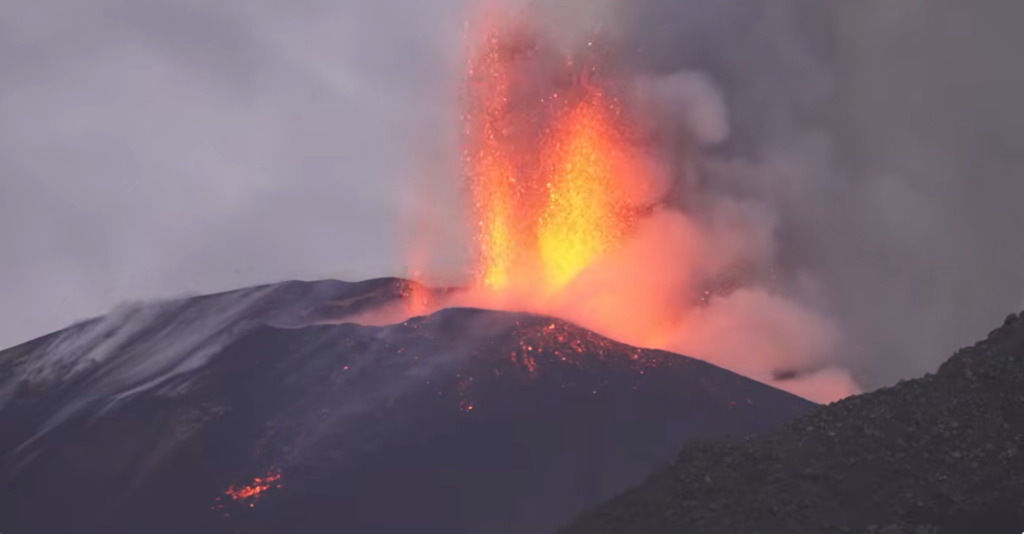
Mount Etna is once again demonstrating its power with a new eruptive phase and, at the same time, is proving to be one of the most interesting places in Europe for testing space technologies. On July 30, the Voragine Crater produced a fountain of lava accompanied by emissions of ash and incandescent material, while on the volcano’s slopes, researchers from the Italian Space Agency (ASI) were conducting tests— which were later suspended, of the“Etna Rover,” a prototype developed to prepare for future robotic explorations of the Moon.
The activity was monitoredby the Etna Observatory of the National Institute of Geophysics and Volcanology ( INGV), which recorded an intensification of volcanic tremor in the early hours of the day, with levels rising to high values starting at 3:30 a.m. The network of cameras observed Strombolian activity at the Voragine Crater, with ash dispersing toward the northwest, which subsequently evolved into a lava fountain with fragments of magma falling back onto the summit area.
The INGV has issued a VONA (Volcano Observatory Notice for Aviation) at the highest alert level—red—with a precautionary closure of the airspace above the volcano. However, the eruptive phase did not affect operations at Catania’s Vincenzo Bellini International Airport. During the day, the lava fountains ceased, while tremor activity remained at high levels. During the paroxysmal phase, a small pyroclastic flow toward the Valle del Bove was also observed, along with a volcanic plume that reached a height of approximately seven kilometers.
A Natural Laboratory for Lunar Technologies
Volcanic activity has forced a temporary suspension of the Etna Rover tests for safety reasons, but the ASI project continues to be one of the most advanced examples of using an Earth-based environment to simulate another world.
The Italian Space Agency team has been working on the volcano for about a month as part of the“Universalcomotion System” program, carried out in collaboration with an industrial consortium comprising large companies, small and medium-sized enterprises, universities, and research institutions. The choice of Mount Etna is no accident. The lava surfaces, volcanic rocks, elevation changes, and terrain conditions share characteristics similar, in some respects, to those a rover might encounter on the lunar surface.
“It may seem strange, but Mount Etna is one of the best places to prepare for space missions. Its volcanic terrain, rich in rocks and uneven surfaces, resembles the lunar landscape in many ways,” explained Giuseppe D’Amore, head of the technological development projects division at ASI.
Autonomous robots for exploring extreme environments
The Etna Rover was designed as a complex advanced robotic system. The tests evaluate advanced locomotion systems, terrain analysis capabilities, and autonomous navigation algorithms based on artificial intelligence. The goal is to develop vehicles capable of moving in challenging environments without relying solely on commands sent from a control center on Earth.
“Our rover will not only be able to move by receiving commands from a control center, but it will be able to do so autonomously,” explained D’Amore, emphasizing how this capability could increase the effectiveness of future lunar missions and reduce operational risks. Mount Etna thus offers a twofold scientific opportunity: to observe up close one of the most active volcanoes on the planet and to test instruments designed to operate far from Earth. This constantly changing landscape also serves as a testing ground for the robotics of the future.