There are numbers that the mind refuses to process: 110 quadrillion kilometers is one of them. To put it into perspective, we need to resort to astronomical comparisons: it’s nearly a billion times the distance between Earth and the Sun. The entire Milky Way is about 100,000 light-years across; if stretched out, this fungal network would cover 10% of our galaxy.
Yet it is not found in deep space. It is right here, in the first fifteen centimeters of soil beneath our feet. On June 11, 2026, the journal *Science* published the first global map of this hidden infrastructure, created by an international team led by Justin Stewart and Corentin Bisot on behalf of SPUN, the Society for the Protection of Underground Networks. This is the first time science has been able to quantify, using rigorous methods, the extent and biomass of what is perhaps the largest biological structure on the planet.
What are hyphae, and why can’t we see them?
The protagonists of this story are not the mushrooms we know: not the porcini, not the honey mushrooms, not the white caps that sprout in the woods after the rain. Those are the reproductive parts—the “tips of the icebergs”—of organisms that live almost entirely underground.
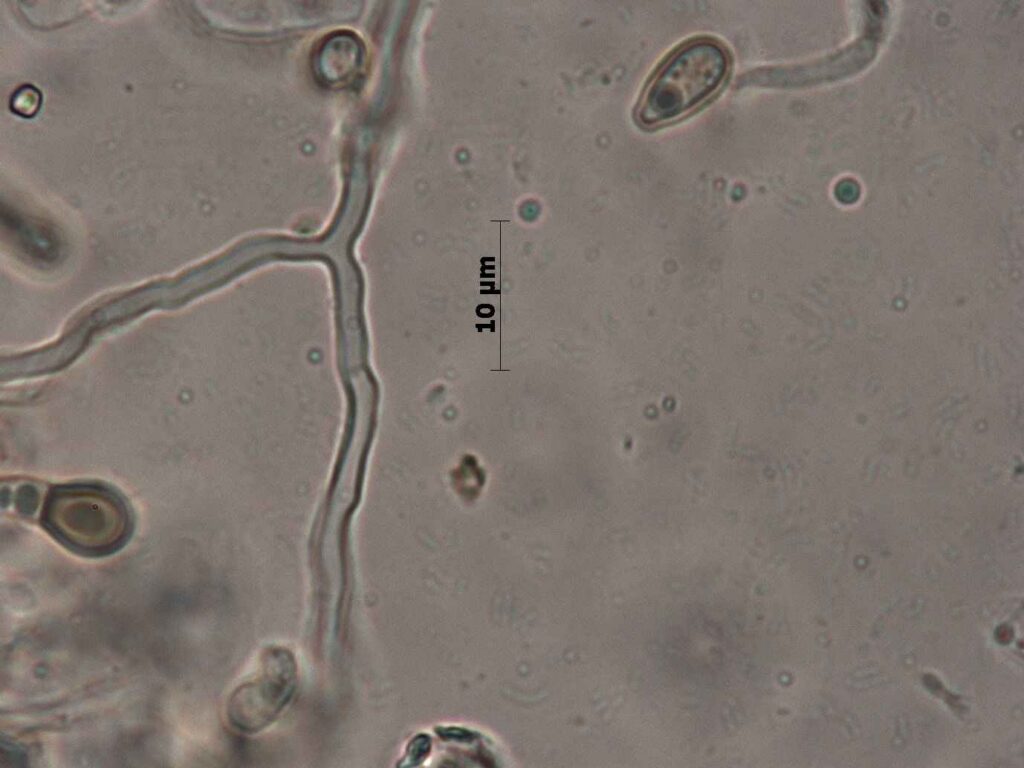
Fungi form microscopic filaments called hyphae—from the Greek word *hyphe*, meaning “fabric”—which penetrate the soil in all directions, intertwining with plant roots in an evolutionary symbiosis that has lasted for about 450 million years.
Each mycelium filament is ten to fifty times thinner than a human hair. Invisible to the naked eye, fragile to the touch, and easily destroyed by a shovel. Yet, when combined with the billions of billions of filaments that populate every gram of fertile soil, it forms the most extensive biological infrastructure in existence.
The mass of carbon stored in these networks is estimated to be between four and six times that of all living humans. These organisms, which no one sees and very few people know about, support a substantial portion of the Earth’s living system.
The exchange that made life on land possible
To understand why this network exists—and why it matters—we need to understand the agreement that underpins it. Plants produce organic carbon through photosynthesis and transfer a portion of it to fungi through their roots. Fungi incorporate it into their own structures or release it into the soil in the form of organic compounds. In this way, they transfer approximately 4 billion metric tons of CO₂ equivalent into the soil each year, equivalent to 11% of annual global emissions from human activities.
In return, fungi provide plants with phosphorus and water, drawing from areas of the soil that roots alone would never reach. The hyphae extend into the soil far beyond the root zone, increasing the plant’s effective absorption area up to a hundredfold. About 70% of terrestrial plant species participate in this partnership: much of the vegetation covering the continents depends, to varying degrees, on this underground alliance.
How to Map the Invisible
Measuring fungal density in the soil on a global scale is a methodological challenge of enormous proportions. There is no satellite capable of detecting hyphae. Systematically collecting soil samples from every square kilometer of land is not feasible. The team analyzed 322 previously published studies, over 16,000 soil samples from nine biomes, and more than 4,000 measurements of hyphal density, then applied machine learning and robotic imaging to over 300,000 fungal structures.
The map revealed a surprise that overturns some common assumptions. One would expect tropical forests—the planet’s great green lungs, rich in biomass and biodiversity—to also be the heart of the fungal network. This is not the case.
Grasslands, steppes, and wetlands have turned out to be much richer in fungal hyphae than previously thought. Forty percent of the Earth’s fungal network is hosted by grassland ecosystems, particularly those found in Sudan, Florida, and the Tibetan Plateau, which have exceptionally high densities.
The problem is that grasslands are being converted into farmland at a faster rate than forests, partly because it is physically easier to plow a steppe than to clear a tropical forest. The cultivated areas are the poorest in quality, with potential repercussions for soil health.
Italy Split in Two
The Italian data paint a clear picture, one that is almost brutally straightforward. The areas with the highest fungal density are the northwestern region between Liguria and Piedmont, Sardinia, and the Apennine mountain range. Those with the lowest density are the Po Valley and Puglia: two of the most intensively farmed and industrialized areas in the country.
This coincidence is no accident. Mechanical plowing physically breaks the filaments. Artificial fertilizers reduce the symbiosis because, if phosphorus is already available in the soil, the plant has no evolutionary incentive to invest energy in maintaining the fungus. And many modern crop varieties have been bred to grow well even in the absence of fungal symbiosis: a short-term advantage that comes at the cost of structural soil depletion over longer time scales.
What Climate Models Don’t Know Yet
There is one implication of this study that deserves attention, beyond simply marveling at the numbers. Current climate models do not yet include this variable in detail, precisely because, until now, there has been a lack of sufficiently precise data on the geographic distribution of these fungi.
Four billion metric tons of CO₂ equivalent are removed from the soil each year: this is a figure that should be included in the equations we use to try to understand where the climate is headed. It isn’t included—or is included only very roughly—because, until ten days ago, there was no global map precise enough to feed into those calculations. Now there is one. Knowing how to use it—and, above all, knowing how to protect it—is another matter entirely.