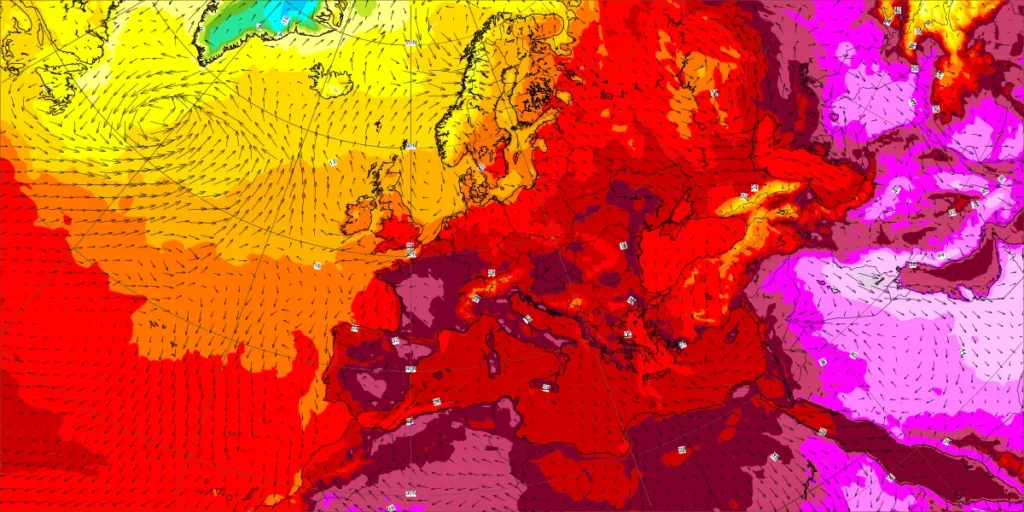
Astronomical summer began just a few hours ago, but Europe is already grappling with temperatures typical of mid-August. From the Iberian Peninsula to Italy, through France and Germany, the season’s first major heat wave is reaching nearly 40 degrees and forcing governments, local authorities, and infrastructure operators to take extraordinary measures.
#IPCC's 2022 #ClimateReport shows heatwaves in Europe will become more frequent, more intense & will last longer.
— IPCC (@IPCC_CH) June 22, 2026
By 2050, about half of the European population may be exposed to high or very high risk of heat stress during summer.
➡️ https://t.co/FkIviyk5Qp pic.twitter.com/QOxbfGVLHW
The images that have emerged in recent days paint a picture of a continent trying to adapt: tourists lining up in the sun in front of the Colosseum, pilgrims sheltering under umbrellas in St. Peter’s Square, fountains swarming with people in Bologna, World Cup fan zones closed in Madrid, and concerts canceled in Paris.
When the problem isn’t just about the weather
According to meteorologists cited by Reuters and Deutsche Welle, the heat wave is being fueled by a mass of air from the Sahara and a strong African high-pressure system that has created a heat dome over western and central Europe. The result is a gradual buildup of hot air that is pushing temperatures to record highs as early as June.
In Italy, red alerts have been issued for cities such as Milan, Turin, Bologna, and Florence. In Spain, the Spanish Meteorological Agency (AEMET) has warned that temperatures in many areas could exceed 39–40 degrees at least until midweek. In France, about one-third of the departments are under a red alert.
Infrastructure Put to the Test
In France, the SNCF railway company has canceled 71 intercity trains on major national routes. High temperatures can, in fact, compromise power lines and cause the tracks to expand. CEO Jean Castex described the rail network as “severely affected” by the high temperatures, announcing the deployment of 3,500 staff for monitoring and another 2,000 for potential emergency response. One question is now coming to the forefront: how well-prepared is Europe’s infrastructure for a climate that is changing more rapidly?
Cities That Never Cool Down
It’s not just the daytime highs that are a cause for concern. In large urban centers, the heat accumulated by asphalt, concrete, and buildings during the day is slowly released at night, making natural cooling difficult. According to forecasts reported by Adnkronos and iLMeteo.it, in many lowland areas and along the coast, minimum temperatures could remain consistently above 25 degrees, with peaks nearing 27 degrees.
So-called “tropical nights” are one of the main sources of stress for the population, as they reduce the body’s ability to recover from the heat accumulated during the day. High humidity and a lack of ventilation can also exacerbate the feeling of stifling heat, especially in densely built-up urban areas.
The African high-pressure system is expected to maintain stable conditions for several more days. However, the energy accumulated in the atmosphere could lead to the development of sudden and particularly intense thunderstorms later this week, when cooler air currents come into contact with the very hot air in the lower layers.
The Invisible Effects
The heat wave is also having less obvious consequences. In Belgium, the CREAVES wildlife rescue center has taken in about 150 animals suffering from heat stress in just a few days. The most vulnerable are young birds. “Chicks would rather jump out than let themselves die and literally bake in their nests,” the center’s founder, Romain De Jaegere, explained to Reuters. These incidents rarely make the front pages, but they help us understand how ecosystems are already reacting to increasingly extreme conditions.
A rising cost
The economy, too, is beginning to feel the effects of the heat. The governor of the Bank of France, Emmanuel Moulin, noted that in the medium term, heat waves end up weighing on economic activity, due to reduced productivity, increased energy consumption, and widespread disruption.
Meanwhile, according to the European office of the World Health Organization, as reported by Deutsche Welle, more than 200,000 people on the continent have died from heat-related causes over the past four years. These figures help put what is happening right now into perspective.
Europe continues to set temperature records, issue increasingly frequent alerts, and deal with emergencies that, until just a few years ago, were considered exceptional. The risk is that getting used to extreme heat will become the most insidious form of adaptation: one that leads us to consider normal what, climatically speaking, is anything but normal.