Western Europe is in the midst of one of the most intense heat waves ever recorded in late May. From Spain to France to the United Kingdom and the Netherlands, temperatures have reached typical summer highs, with highs over 35 degrees in London and nearly 40 expected in some French areas. Pressure is bearing down on health services, transportation and emergency systems, while the first heat-related fatalities are already being counted.
Today is now the hottest day in May on record with Heathrow and Kew Gardens provisionally reaching 35.0°C
— Met Office (@metoffice) May 26, 2026
Until yesterday the highest temperature in May was 32.8°C, but we've now exceeded that record on consecutive days by a full two degrees Celsius 🌡️ pic.twitter.com/s4ichw1fZU
In the United Kingdom, the Met Office extended health alerts to much of England and Wales after new record temperatures for May: 35 degrees between Heathrow and Kew Gardens in the London area, with lows above 20 degrees, exceptional conditions for late British spring. In France, the government reported at least seven deaths associated with the heat.
GLOBAL WARMING RECORD MAY HEAT HITS EUROPE AND ENGLAND
— Peter D Carter (@PCarterClimate) May 25, 2026
Huge fossil fueled heat dome is scorching all western Europe and Enland, relatively unsual for England to be hit this hard. At 1.45°C global.#heatwave #globalwarming #climatechange pic.twitter.com/b5epjmqmy2
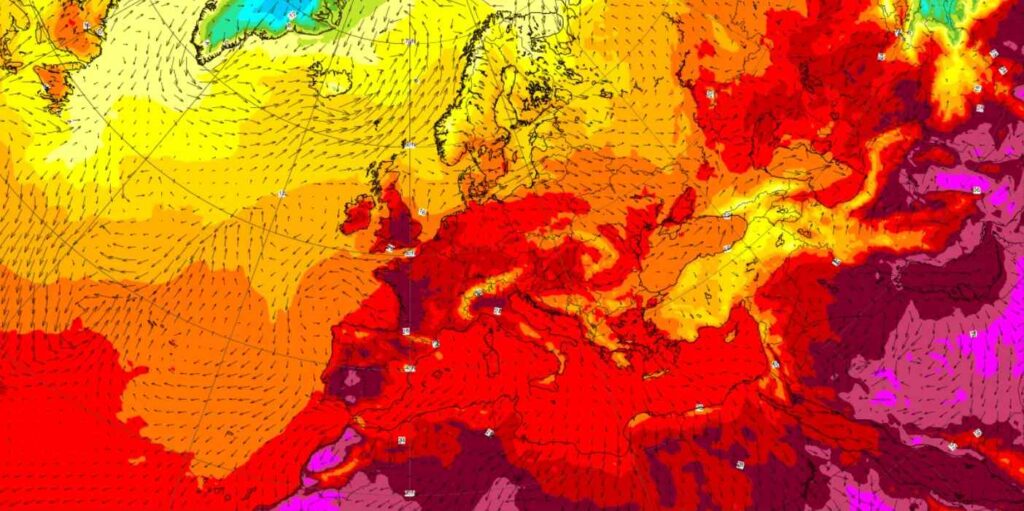
“A hybrid anticyclone” between Africa and the Atlantic.
According to Antonello Pasini, a climate physicist at the CNR, the phenomenon cannot be considered an isolated episode. “The heat wave that is hitting Spain, France, and the United Kingdom carries completely summer-like characteristics,” he explains to Last Draft. “This is shown by the temperature records for May broken one after another.”
At its base is what Pasini calls“a hybrid anticyclone“: a system fed together from northwestern Africa and the tropical Atlantic, and it is this dual origin that makes it so. A configuration that mainly affects Western Europe. “It extends more directly over Spain, France and the United Kingdom and less over us,” the climatologist points out.
Italy on the sidelines, but the heat is advancing here too
Italy is on the eastern edge of the anticyclonic system and is less directly affected by the hotter air mass. “In spite of this,” Pasini notes,“the last days of May are also setting temperature records in Italy.”
The most significant finding, however, concerns the long-term trend.“Summer is ahead: it is eating a part of spring, but also a part of autumn,” the climate physicist points out. A transformation that clearly emerges from the Italian time series. This is documented by the analysis of meteorologist Pierluigi Randi, cited by Pasini: in Romagna, until thirty years ago the first day with 30 degrees arrived around June 15. In the last thirty years it has moved to May 29.
The “heat dome” and the risk of extremes
It is a sign of progressively earlier summer conditions, consistent with rising average global temperatures and more frequent heat waves: they are more intense but also earlier and more persistent.
In these hours we often talk about“heat dome,” an expression that has become recurrent in meteorological parlance. Pasini points out, however, that it is not a simple synonym for heat wave.“It is used in stagnant anticyclonic conditions with subsidence, that is, with air that counteracts vertical motions,” he explains. In this case, he points out, it was the heat wave itself that formed a dome that did not dissipate.
For the next few days the warm weather is expected to continue, although cooler air infiltrations can be seen on the eastern side of the peninsula, with precipitation expected mainly over the Triveneto and along the Adriatic.
Warmer summer and heavy rains in autumn
It is especially the look toward the following months that worries experts. “Seasonal forecasts show us a summer that is definitely warmer than normal,” Pasini warns. “And what we are concerned about is that towards the end of the summer, between August, September and October, intense precipitation could come.”
The risk is that of a season marked by opposite extremes: long periods of heat and energy buildup in the atmosphere, followed by violent weather events. All that stored energy, the climatologist concludes, is likely to discharge into violent precipitation in late summer.