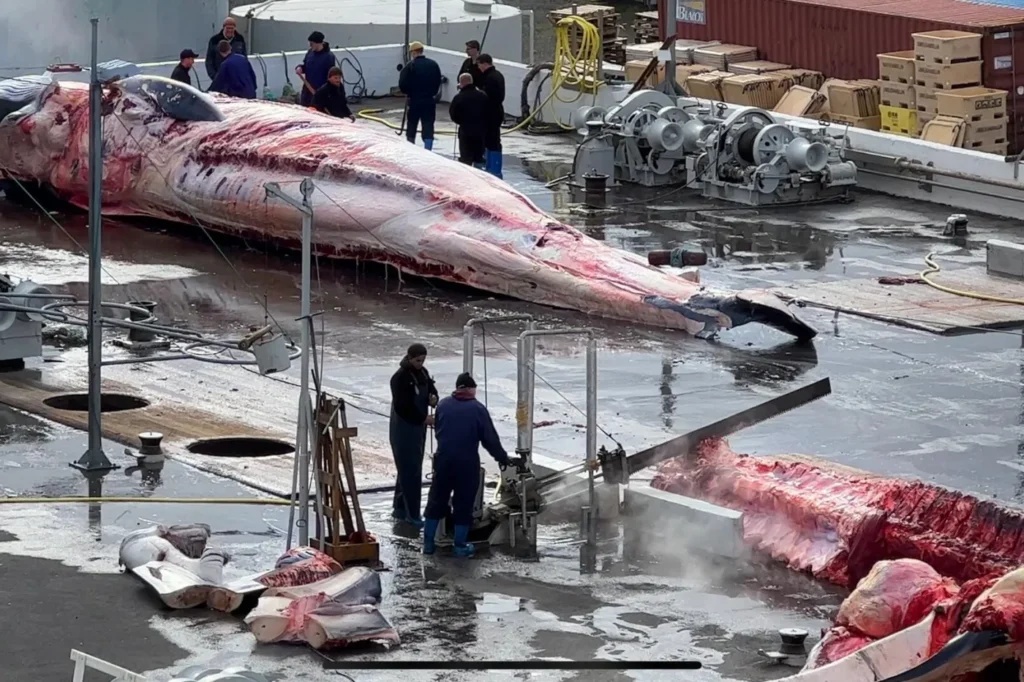
On the night of June 21–22, the whaling ship Hvalur 9 returned to Hvalfjörður with two fin whales on board. These were the first catches—and, more importantly, the first two killings—in Iceland since 2023. The news was confirmedby the public broadcaster RÚV and prompted an immediate reaction from international animal rights organizations. The news was not unexpected: the ships had set sail from Reykjavik the previous Friday evening, with a valid five-year license issued by the Icelandic government in December 2024.
The fin whale (Balaenoptera physalus) is the second-largest animal on Earth after the blue whale. The International Union for Conservation of Nature classifies it as a species that is globally vulnerable to extinction. Despite this, Iceland has killed more than a thousand of them over the past twenty years.
Between Breaks and Comebacks
The hiatus in 2024 and 2025 was not a decision based on principle. The hunting of fin whales in Iceland is managed by a single company, Hvalur hf., whose main export market is Japan. In recent years, Tokyo has accumulated stocks of whale meat that it cannot sell, as domestic demand is in structural decline, and at the same time has expanded its own whaling fleet. As a result, Icelandic whale meat cannot find buyers. The 2024 and 2025 seasons were canceled not due to diplomatic or environmental pressure, but because the numbers simply didn’t add up.
Reduced rates, but not enough
In April, the Icelandic Institute of Marine and Freshwater Research published its recommendations for the 2026 season: a maximum of 150 fin whales and 168 minke whales. Compared to the average quotas for the 2018–2025 period, these represent reductions of 28% and 23%, respectively. The five-year permit issued in 2024 theoretically authorized up to 209 fin whales and 217 minke whales per year through 2029. However, these numbers remain unacceptable, according to Humane World for Animals, an organization formed by the merger of Humane Society International and the Humane Society of the United States.
It is worth noting a statistic published in 2023 by the Icelandic Food and Veterinary Authority: 41% of the whales killed during Icelandic hunts suffer greatly before dying, with an average time to death of 11.5 minutes. In some cases, the agony has lasted up to two hours. The explosive harpoon, the standard method, does not guarantee immediate death.
The bill that will come too late
Iceland’s Minister of Industry and Commerce, Hanna Katrín Friðriksson, announced her intention to introduce a bill this fall to ban whaling. Humane World for Animals welcomed the announcement, with one explicit reservation. “It’s too late to stop this heart-wrenching slaughter this summer,” said Joanna Swabe, the organization’s senior director for European public affairs. “We know that this poor whale will likely have suffered immense and prolonged pain after being struck by an explosive harpoon—an agonizing death for meat that virtually no one in Iceland wants to eat.”
The paradox is clear: the government promises to ban hunting, but in the meantime it issues licenses and allows the ships to set sail. The explanation lies in the legal framework: the five-year permit had already been issued by the previous administration and cannot be revoked without legislative action. The law hasn’t been passed yet. The season is already open.
The European Issue
There is an additional political factor that complicates the matter. Iceland is a candidate for membership in the European Union, and a referendum on the issue is scheduled for August. The EU has historically opposed commercial whaling. Humane World for Animals has called it “a farce” that Reykjavik is conducting accession negotiations with Brussels while its ships hunt vulnerable species in open violation of the 1986 international moratorium. “The EU must take a firm and unwavering stance on this issue,” Swabe said. Iceland, Norway, and Japan are the only three countries that officially continue commercial whaling. The International Whaling Commission imposed the moratorium forty years ago. Iceland had left the Commission in 1992 and rejoined in 2002 with a special exemption. Since then, the moratorium has never truly been lifted.
Before the ships set sail on Friday, June 20, a protester had chained himself to the mainmast of the Hvalur 9 in the port of Reykjavik. He remained on board until the ship arrived in Hvalfjörður, where he disembarked and was removed by the police. According to the most recent polls, the majority of Icelanders oppose whaling. The industry persists, not because of popular support, but due to regulatory inertia and the economic interests of a single company.