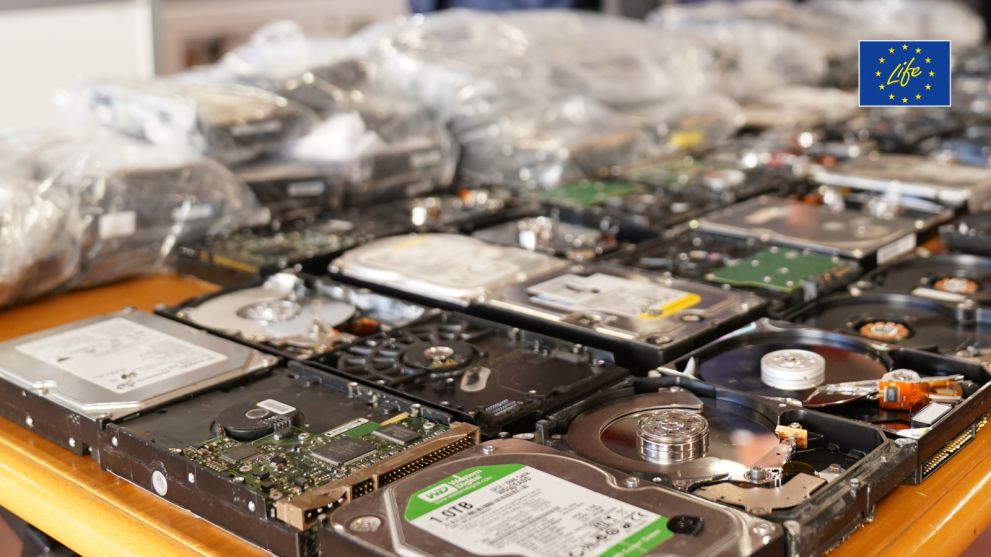
Hidden inside that old hard drive lying in a drawer—or in the motor of an end-of-life electric car—are extremely rare and valuable metals. These are rare earth elements, and without them, smartphones, wind turbines, electric vehicles, and much of modern electronics would not exist. Yet, to this day, these substances are largely thrown away along with discarded devices, resulting in the permanent loss of materials that are extremely costly to extract from the earth.
Now Italy is stepping up to change this approach. The Ministry of the Environment and Energy Security has given the green light to Life Inspiree, Europe’s first facility dedicated to recovering rare earth elements from electronic waste. It will be built in Ceccano, in the province of Frosinone, and will be operated by Itelyum in collaboration with a group of Italian and European partners.
Seventeen Factors That Keep the Global Economy Afloat
Rare earth elements are a group of 17 chemical elements —including neodymium, dysprosium, praseodymium, and terbium—that scientific nomenclature has given a somewhat misleading name. They are not particularly rare in nature: they are found in reasonable quantities in the Earth’s crust. The problem is that they occur in very low concentrations in rocks, which makes their extraction costly, energy-intensive, and often harmful to the environment.
Today, Beijing controls a dominant share of global production of these materials. Europe imports nearly all of them from abroad—and largely from China—placing it in a position of dependence that has proven increasingly risky as geopolitical tensions have escalated.
One facility, five partners, one simple idea
The Inspiree project is based on a simple line of reasoning: if rare earth elements have already been mined and incorporated into the products we use every day, why not recover them when those items become waste? The high-performance magnets found in hard drives and electric motors represent a reservoir of these metals that have already been processed and concentrated. All it takes is knowing how to disassemble and process them properly.
The process consists of two main phases. The first is dismantling: the old devices are opened up and the magnets are removed. This part of the work is carried out by Glob Eco, one of the project’s partners. The second phase is chemical: the magnets are treated to separate the rare earth elements from other materials and convert them into oxides or salts that industry can purchase and reuse. The Ceccano plant will be able to process up to 2,000 metric tons of magnets per year.
Itelyum is in charge of coordination. Erion, the Italian consortium that manages the collection of discarded appliances from the public, is responsible for ensuring the collection of incoming electronic waste. The University of L’Aquila is handling the technical aspects and monitoring the project’s environmental and social impact. EIT RawMaterials, a European organization that brings together universities, research centers, and industry players in the sector, will be responsible for disseminating the results and connecting the project to a broader network. The project builds on experience gained from a smaller-scale pilot plant, called New-RE, which has already tested the technologies in question.
A piece of a larger mosaic
Inspiree is one of 47 strategic projects selected by the European Commission under the Critical Raw Materials Regulation adopted in 2024. The goal of that regulation is clear: by 2030, at least 25% of the annual demand for these materials must be met through recycling within the Union. Among the 47 projects, four are Italian, and all four involve the recovery of rare earth elements.
In 2023, the largest rare-earth deposit ever found in Europe was discovered in Sweden—a reserve that could reduce Europe’s dependence on the Chinese market. But even a deposit of that magnitude is not enough on its own to make Europe self-sufficient. We also need to learn how to recover metals already in circulation, closing cycles rather than opening new ones.