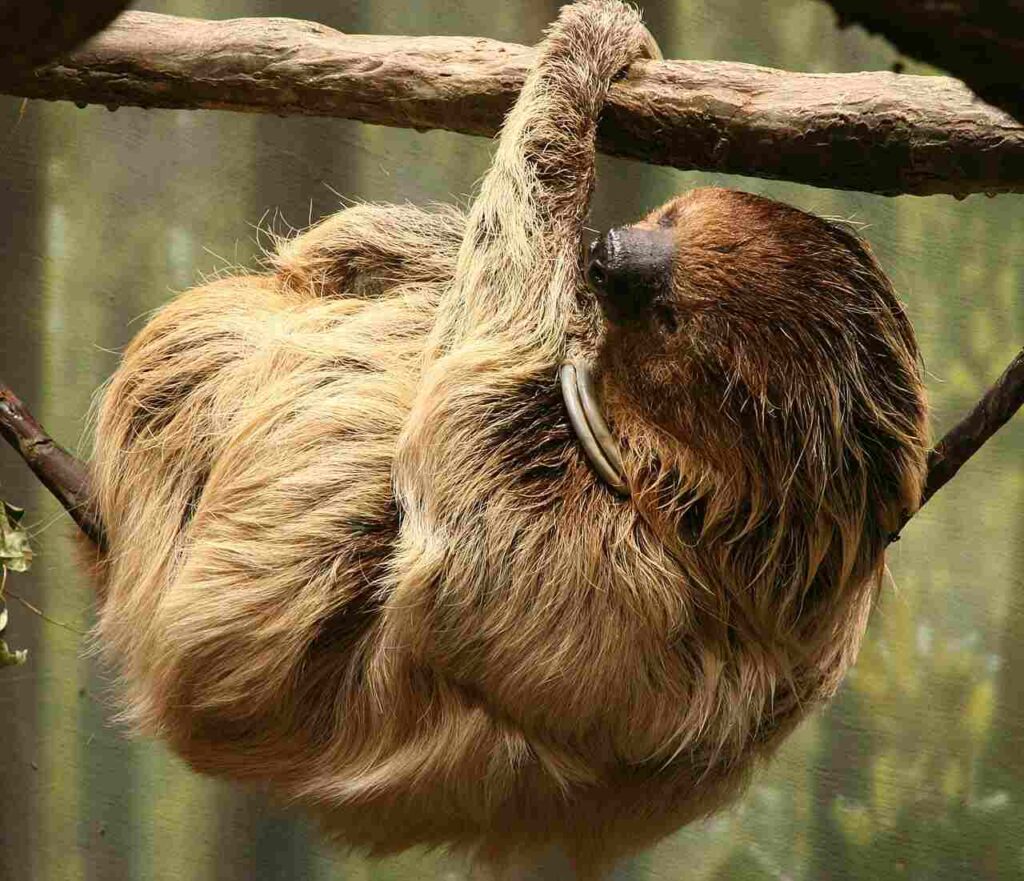
One month old, making its first attempts to cling to branches, and setting a national record: it is the only two-toed sloth born in Italy since the beginning of 2026. The cub was born at theButterfly Oasis at the Bioparco Zoom in Cumiana, near Turin, where it lives with its parents and is taking its first steps in a developmental process that, for this species, means learning right from the start to move… upside down.
The First Days of Life
For now, the cub spends almost all its time clinging to its mother Brooke’s belly, feeding exclusively on milk. But his curiosity has already gotten the better of him: he’s trying to grab branches and coordinate the movements of his four limbs—a crucial step for an animal that, as an adult, will spend most of its life suspended among the trees.
We’ll have to wait a little longer to find out whether it’s a male or a female. “We’ll only be able to determine the sex of the new arrival once it becomes more independent and we can perform its first veterinary checkup,” Irene Carnovale, curator of Bioparco Zoom, explained to La Stampa. “In the meantime, we’re watching its first attempts to grip the branch—first hooking one paw onto it, then the other—as it tries to coordinate all four limbs to test its balance.”
A Birth That Matters
The birth is also a significant achievement for European conservation programs. With this new arrival, the number of three-toed sloths housed in Italian zoos has risen to nine, and the cub will join the management program coordinated by the European Association of Zoos and Aquaria (EAZA), which aims to maintain a genetically healthy population through planned breeding.
The threat remains the loss of forests
In the tropical forests between Brazil and Venezuela, the two-toed sloth continues to grapple with the loss of its habitat. According to the International Union for Conservation of Nature (IUCN), in Brazil alone, the species has already lost about 9% of the forested areas where it lives, mainly due to the conversion of forests into pastures and land used for intensive agriculture.
This is also why the birth of an animal like Zoom Torino takes on special significance, because it contributes to international programs that seek to preserve the species’ genetic heritage and, at the same time, draws attention to the protection of the ecosystems on which the species’ future depends.