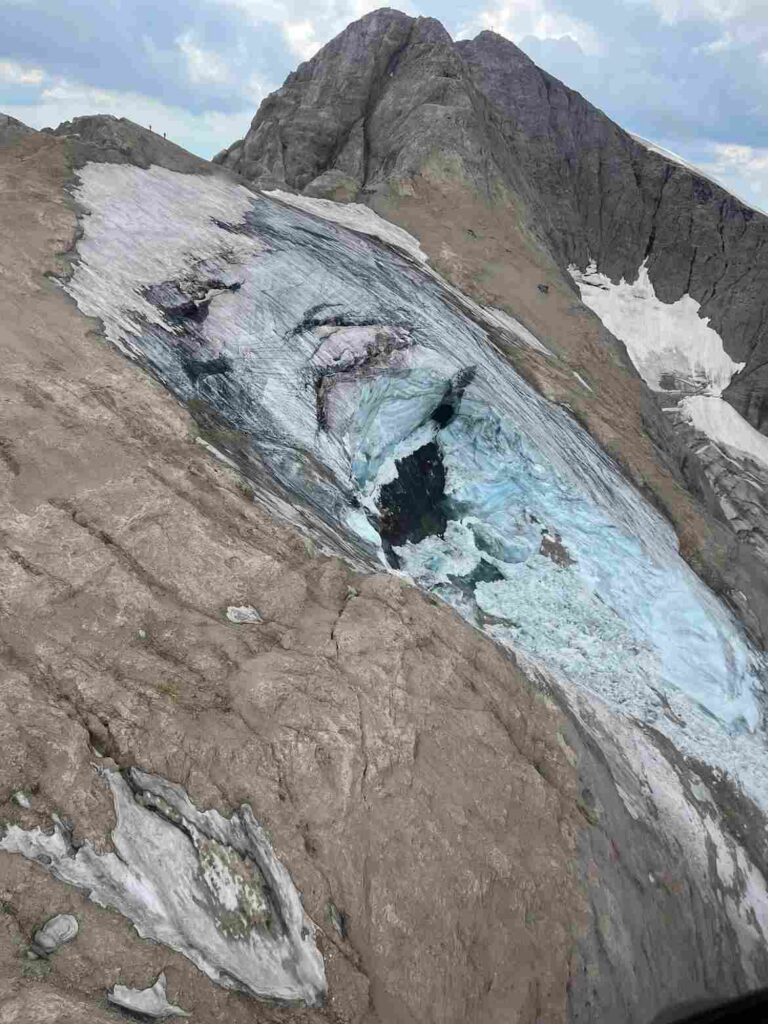
From the Marmolada to the cities. On July 3, 2022—exactly four years ago —a massive serac from the Punta Rocca Glacier on the Marmolada suddenly broke off and crashed down onto climbers who were on the standard route toward Punta Penia: 11 people were killed and several others were injured. Already that summer, on the summit of the Marmolada, the temperature had not risen above freezing.
Today, the heat—exacerbated by the climate crisis—is hitting cities. And the death toll is rising. Extreme temperature spikes cost Europe tens of thousands of deaths a year, as well as a slowdown in economic activity and instability in the electricity supply.
The list of climate-related disasters, both large and small, continues to grow. And this is generally what the news feeds on as it tries to sort through the problems to find solutions. Now, however, the time has come to acknowledge that this approach is no longer enough. It was useful and necessary during the many decades that led to widespread public awareness of climate issues.
Today, awareness of the risk is widespread because each of us sees it in our daily struggles. There are more and more moments when even breathing becomes difficult and we need artificial air, as if we were living on a planet that doesn’t belong to us. Utility bills are rising, reminding us that fossil-fuel-powered plants are a burden on both our health and the economy. Hospital admissions are on the rise, straining emergency rooms already weakened by progressive cuts to public healthcare.
Today we know what is happening to us. And we know why it is happening. The scientific community has documented and explained it unequivocally. If we pick up a pen and spread our fingers, the pen falls due to the law of gravity. If we continue to increase the concentration of greenhouse gases in the atmosphere, the planet will warm as a result of the physical phenomena already studied by Svante Arrhenius, who in 1896 calculated the consequences of a doubling of atmospheric CO2, coming very close to current estimates.
What we don’t know—or what isn’t officially stated—is why we don’t take action.
So, if we’re going to be honest, we have to say that inaction is the area that needs to be investigated. The news—that is, the unexpected element that grabs the listener’s attention—is not the list of climate disasters that are occurring—which have been predicted for 130 years and are now taken for granted—but the list of political actions that cause them. The trillions of euros spent each year to prop up fossil fuels and repair the damage they cause. The inaction of governments (such as Italy’s) that deny their citizens an effective climate action plan. The insult added to the injury when people representing the highest levels of government mock the climate crisis and, by extension, its victims: while the WHO counts the elderly, children, vulnerable people, and exposed workers who are dying from heat stress, hearing jokes in the Senate about how “the Caribbean at home isn’t so bad after all” only widens the gap between the public and our institutions.
However, we must not forget that another kind of politics exists. It is the politics carried out by organizations that fight to organize forms of climate resistance and to help those in need. It is the politics carried out by local officials who protect green spaces in their cities, make room for renewable energy communities, and support organic and biodynamic agriculture that helps the environment rather than harming it.
They, too—the climate activists—are making headlines because they are surviving and trying to thrive on a hostile political planet dominated by the lobbies of the old economy.
There is good news. We need to give it more attention.