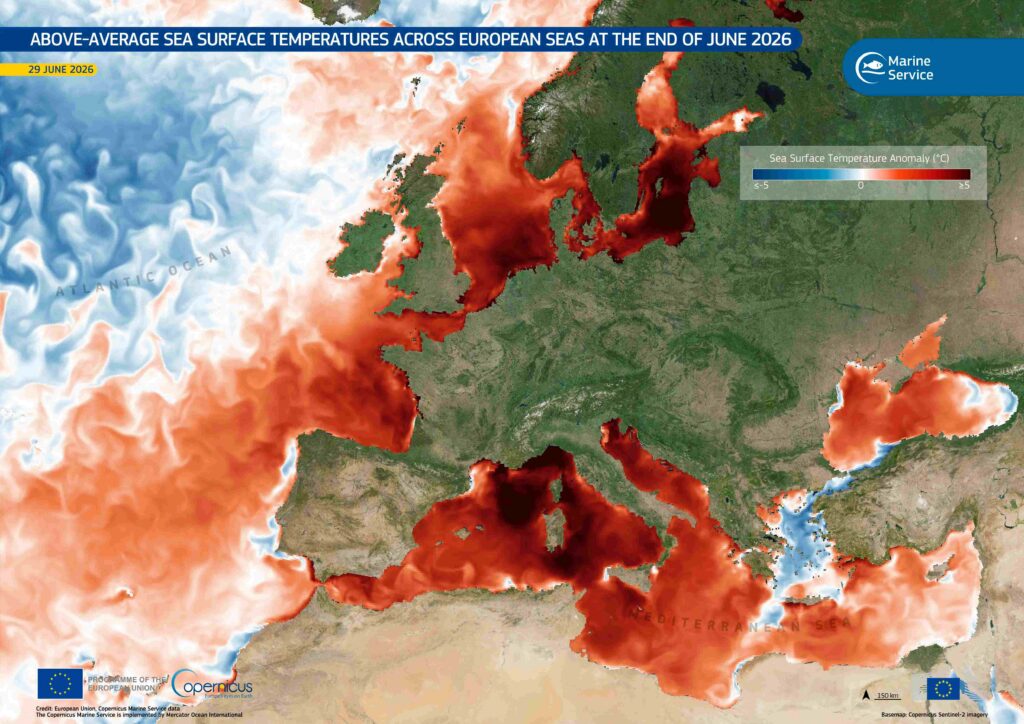
In recent years, Europe has entered a new climate regime, unlike anything that has shaped the continent’s history over the past three to four decades. Copernicus data show that the European continent has become a hotspot for global warming: since 1991, the average temperature has been rising by 0.56 °C per decade—more than double the global average, which stands at 0.27 °C. Compared to the pre-industrial era, Europe has already experienced more than 2.5 °C of warming.
Furthermore, 2024 and 2025 temporarily exceeded the global 1.5 °C threshold, and 2026 began with a heat wave that brought temperatures 14–18 °C above the seasonal average, with 44.3 °C recorded in France, 42.7 °C in Spain and Portugal, and nearly 38 °C in the United Kingdom. These are no longer anomalies—they are the new normal.
The Deadly Impact of Extreme Events
Climate change is not only manifested by rising temperatures, but also by the frequency, duration, and intensity of extreme weather events. Heat waves have become longer, occur earlier, and are more persistent. European cities are increasingly experiencing so-called “tropical nights,” during which the temperature does not drop below 20–25 °C, preventing physiological recovery. A warmer atmosphere holds more moisture, increasing the wet-bulb temperature (Twb), which measures the air’s capacity to absorb sweat. At a Twb of 35 °C, the human body can no longer cool itself: even a healthy person, in the shade and well-hydrated, enters a life-threatening zone within a few hours.
The Lancet Countdown 2026 quantifies this acceleration precisely. Specifically, in the three-year period from 2022 to 2024 alone, there were 160,000 premature deaths in Europe attributable to heat. Italy consistently ranks as the European country with the highest absolute number of deaths: 19,000 deaths in 2024. Over the past decade, exposure to heat waves has increased by 254%, and heat-related mortality has risen by 52 deaths per million inhabitants per year.
99.6% of the European regions monitored have seen an increase in heat-related deaths, and daily extreme heat alerts have risen by 318% compared to the 1990s. The European Environment Agency has identified heat waves as the main threat to public health in Europe in the coming years, and the Pan-European Commission on Climate and Health has declared climate change a direct threat to security and social stability.
The World Health Organization’s “Heat and Health” Action Plan
Against this backdrop, therefore, the WHO has published its new guide,“Heat–Health Action Plans,” which sets a radical goal: zero heat-related deaths. The guidance acknowledges that the climate crisis is intertwined with urbanization and an aging population: today, 75% of Europeans live in cities—a figure that will rise to over 80% by 2050—and the number of people over 65 will triple. Cities, with their dense layout, dark surfaces, poor ventilation, and lack of vegetation, amplify heat through the urban heat island effect, keeping temperatures high even at night.
The thermal performance of buildings is therefore a key factor in health. The WHO guidelines thus emphasize the need to cool not only individual apartments but also entire neighborhoods: trees, parks, bodies of water, reflective roofs, natural ventilation, light-colored materials, and green and blue infrastructure.
The Key Issues in Italy’s Energy Crisis
Extreme heat is not just a health crisis—it’s an energy crisis. Power outages during a heat wave become a direct health risk: they cut off air conditioning, disrupt the refrigeration of medications, and shut down essential services precisely when they’re needed most. On June 23, 2026, partly due to the excessive use of air conditioners, Terna recorded a peak of 55 GW in daily demand, a 4.4% increase from the previous week . However, there was no shortage of energy—there was a shortage of grid capacity to distribute it.
The medium- and low-voltage power grids, designed for the last century, cannot handle intense and widespread loads concentrated during the same hours. Underground cables, trapped beneath scorching asphalt, cannot dissipate heat. Secondary substations are failing. The bottleneck is the last mile.
Distributed generation feeds energy in both directions, increasing complexity. Consequently, the energy crisis is not just a crisis of demand—it is a crisis of management. Over-generation during peak hours drives electricity prices to zero or below zero. The cannibalization of renewables reduces operators’ revenues, generates curtailment costs, and destabilizes the market. Production is no longer the problem—management is. The simultaneous nature of loads creates peaks that the grid cannot sustain. The problem is not how much energy is consumed, but how much power is demanded at the same time.
Accumulations are crucial
In this context, storage becomes crucial. Without electrical and thermal storage, excess generation cannot be absorbed. Without storage, the grid remains vulnerable to spikes and blackouts. Without storage, flexibility remains an abstract concept. Flexibility, as Aurore Dudka points out, is not, however, merely a technical issue: it is a social one. Price signals alone are not enough to change behavior. Flexibility cannot be left to market forces: it must be built through communities, cooperatives, and relationships based on trust. Demand management is not just about shifting consumption: it is about building an energy culture, fostering participation, and creating a sense of belonging.
Professor Livio De Santoli, now at ARERA, puts it plainly: without flexibility, electrification itself becomes a source of rigidity. Without storage, the grid falls victim to its own modernization. Without active demand management, the energy transition leads to instability rather than security. Without a structural transformation of the grids, renewable generation cannot be fully utilized. Without a cultural transformation, flexibility cannot be achieved.
Three Forms of the Crisis
The climate crisis, the energy crisis, and the infrastructure crisis are all the same crisis manifesting in three different forms. Extreme heat kills because the grid fails. The grid fails because demand skyrockets. Demand skyrockets because the climate is changing. Renewable energy is wasted because the grid is inflexible. The grid is inflexible because it was not designed for today’s climate. Flexibility does not work because it was not built as a social process. Demand management does not work because it was not built as a public good.
The energy transition, therefore, cannot be viewed as a shift in energy sources, but rather as a transformation of infrastructure, cities, behaviors, and social relationships. It cannot be viewed as a technical process, but rather as a systemic one.
A Systemic Solution for Pragmatic Decarbonization
The answer must be a structural, dynamic, and adaptive reimagining of the urban system. Cities must be reimagined as energy and climate ecosystems, in which urban planning, energy planning, social welfare, infrastructure, and nature-based solutions are not silos, but parts of a single metabolic system. Cities must become flexible systems, capable of absorbing climate and energy shocks, redistributing loads, protecting the vulnerable, managing demand, promoting renewable energy production, cooling public spaces, ventilating buildings, integrating green spaces and water, and to build energy communities that are not merely technologies but social institutions.
In conclusion, the crisis we are experiencing is not just a crisis—it is an opportunity. It is an opportunity to rethink our energy system, our urban systems, our healthcare system, and our social system. It is an opportunity to build more resilient networks, cooler cities, better-ventilated buildings, more participatory communities, and more flexible infrastructure. It is an opportunity to build a system that is no longer a victim of its own rigidity, but one capable of adapting, protecting, and including. It is an opportunity to build a country that is finally up to the challenge of the climate in which we live.