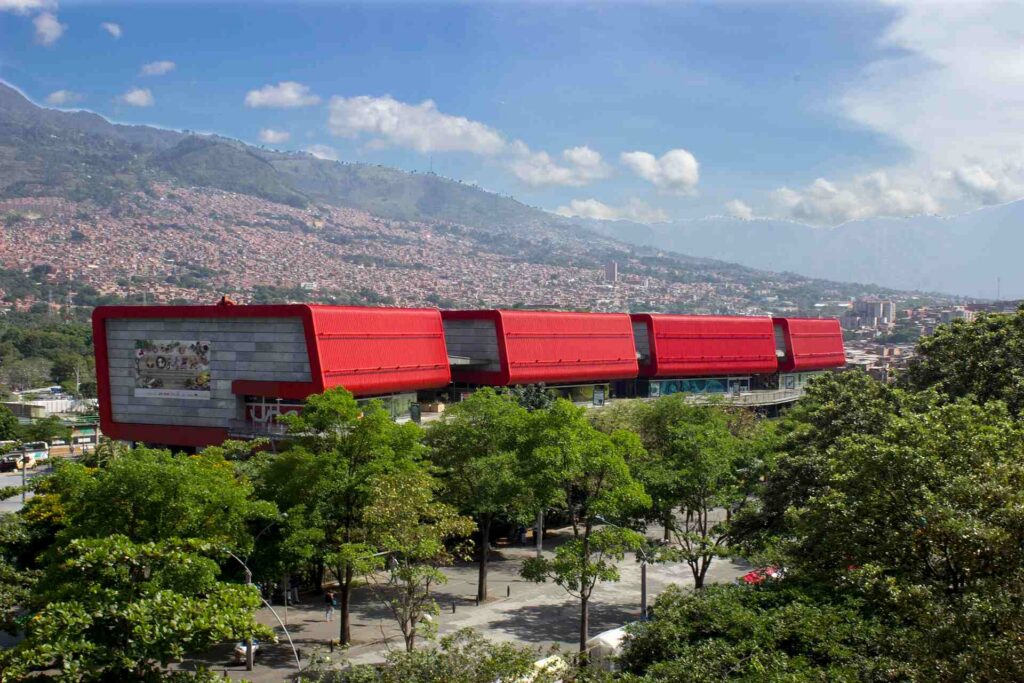
Not more powerful air conditioners, but trees. Since 2016, Colombia’s second-largest city has created thirty “Corredores Verdes”: rows of trees, shrubs, and vertical gardens that line streets, canals, and pedestrian paths, connecting existing parks. According to city officials and the international C40 network, temperatures in these areas have dropped by about 2 degrees.
And the costs are surprisingly low: the World Economic Forum estimates the cost of the first phase at $16.3 million, plus about $625,000 per year for maintenance—just over $6 per resident. The winning strategy was to bring shade and evapotranspiration into the built-up city, where people walk, bike, and wait for the bus.
A global movement
Medellín is not an isolated case. Singapore has designed the Nature Ways, paths lined with multiple layers of vegetation that replicate the structure of a forest in miniature and connect parks and nature reserves.
In Düsseldorf, the Kö-Bogen II building is enveloped by approximately 30,000 plants that provide shade from the sun and cool the microclimate. Paris, through its Oasis program, is transforming schoolyards— currently expanses of asphalt— into oases of coolness that are open to the neighborhood outside of school hours.
Barcelona has built a network of climate shelters that includes museums, libraries, schools, and parks— an approach also adopted by Brussels, Rotterdam, and Buenos Aires. Science backs up this approach: a study by the European Commission’s Joint Research Center covering 200 cities indicates that concentrating green spaces where the most people are exposed to extreme heat is more effective—and less expensive—than distributing them evenly.
Italy is making progress, but it’s uneven
And what about Italy? The issue is urgent: densely populated neighborhoods, impervious surfaces, and often piecemeal interventions. But something is changing. The most ambitious project is Forestami, launched in 2019 based on research by the Politecnico di Milano: it aims to plant 3 million trees by 2030 in the Milan metropolitan area. To date, about 20% of the goal has been achieved, with plantings concentrated mainly in municipalities in the surrounding area: to reach the target, more than 400,000 new trees would be needed each year. Meanwhile, the European Nature Restoration Regulation sets the course for everyone: starting in 2030, there will be no net loss of urban green space, and there will be a requirement to gradually increase it.
Rome and Italy’s First “Piano Caldo”
The latest development comes from the capital. In July 2026, Rome presented its first Heat Wave Plan, becoming the first Italian city to adopt a comprehensive strategy against heat waves. The plan combines assistance for vulnerable people, climate shelters, a dedicated app, and—above all—green spaces and the removal of pavement. City data show that this effort is already underway: since 2022, the city’s tree count has increased by 38,000 trees; green spaces have increased by 187 hectares (+4.56%) since 2021, and since 2024, forty projects have removed asphalt from 44,501 square meters of roads, squares, and sidewalks. “Reducing heat in cities is indeed possible,” said Mayor Roberto Gualtieri, noting that depaving, trees, and shaded areas can lower perceived temperatures by as much as 10 degrees.