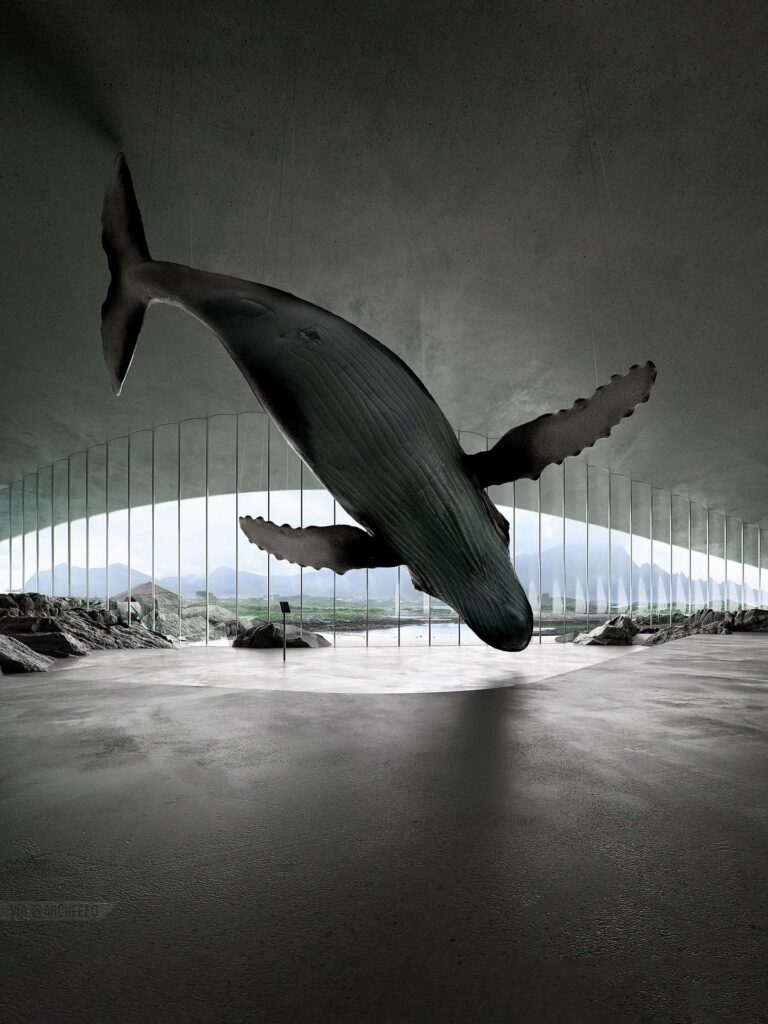
On the northern tip of Andøya, an island in the Vesterålen archipelago about 300 kilometers beyond the Arctic Circle, one of the most anticipated buildings on the European museum scene is taking shape. It is called The Whale and will open to the public on June 4, 2027. Designed by the Danish firm Dorte Mandrup, the center appears to rise from the rocky coastline like the back of a whale arching before diving. The curved roof, clad in local stone, is accessible to the public: a public terrace overlooking the Norwegian Sea, with a view of the Andenes lighthouse, which has illuminated this stretch of coastline since 1859.
What to Expect
Inside, the exhibits curated by Ralph Appelbaum Associates promise an immersive journey through science and art: a gallery featuring all 90 species of living cetaceans, life-size wooden sculptures of orcas breaking the surface, rooms dedicated to anatomy, and a multisensory area that recreates the deep ocean through whale calls. The project, in the works since 2014 and entrusted to the Mandrup firm in 2019, secured final public funding in November 2024. Admission will cost 540 Norwegian kroner, about 49 euros.
The Norwegian Paradox
Here, the story gets complicated. The museum presents itself as “a voice for the whales.” But Norway is now the world’s leading whaling nation, ahead of Japan and Iceland combined (Norway hunts a record number of minke whales; Japan has a lower quota but spreads it across four species, including large whales such as the fin whale and the sei whale, and also operates a deep-sea “factory ship”).
In 2025, ten Norwegian vessels killed 429 minke whales; for 2026, the government raised the quota to 1,641 whales, the highest in the world. In 1986, Oslo filed a formal objection to the International Whaling Commission’s moratorium, and in 1993 it resumed commercial whaling, effectively circumventing the global ban. The Minister of Fisheries and Oceans, Marianne Sivertsen Næss, defends it as “sustainable” and “strictly regulated.”
The numbers, however, tell a different story. Almost no one in Norway eats whale meat anymore: according to a survey by the Respons Analyse institute for the NOAH association, only 1% of Norwegians consume it regularly, down from 4% in 2019. And, as Inside Climate News has pointed out, most of the animals killed are females, often pregnant. The number is rising while the market is drying up: for environmentalists, it is now more of a political practice than a food source.
A contradiction that divides
It’s no surprise that the museum project has been criticized in Norway: it has been accused of trying to hide the central issue—namely, the commercial whaling that still kills hundreds of minke whales every year—while 19th-century Norway, with the explosive harpoon invented by Svend Foyn, led the industrial slaughter of large whales. The Museum Nord group withdrew from the initiative precisely because of disagreements over how much weight to give that history in the museum’s narrative. And beneath the post announcing the opening, dozens of comments repeat the same question: what’s the point of celebrating animals that we continue to harpoon? The real challenge for *The Whale* will be deciding whether to confront this contradiction head-on or simply admire the view from the roof.