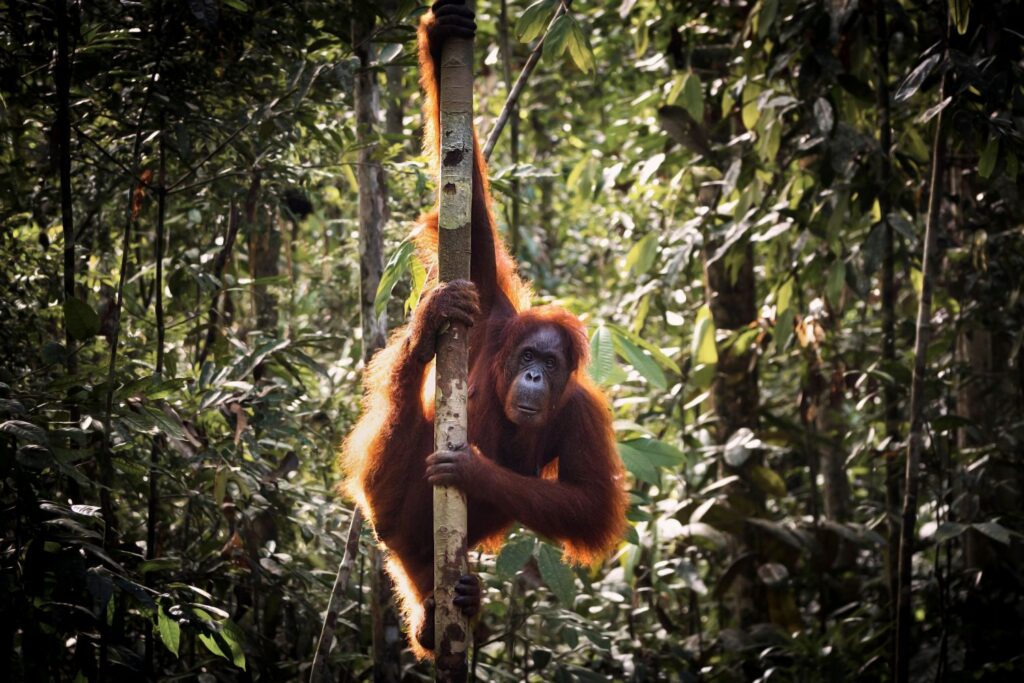
His name was Sempurna, which means “perfect” in Indonesian. He was a male orangutan who died on August 30 in Ketapang, West Kalimantan. The autopsy revealed lung damage consistent with exposure to smoke. He wasn’t killed by the flames—it was the air he breathed that killed him. His story, as reported by Mongabay, symbolizes a fire season that has had Indonesian Borneo in its grip for months.
A Season Out of Control
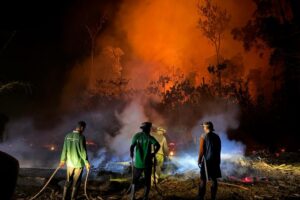
As early as mid-August, the Ministry of Forestry had recorded 202,000 hectares of burned forests and land across Indonesia. In the first six months of the year, the affected area had already more than doubled compared to the same period in 2023 (+110%). West Kalimantan was the hardest-hit province. In Gunung Palung National Park alone—one of the orangutans’ historic refuges—approximately 9,055 hectares went up in smoke: an area that historically was home to about 2,500 orangutans. The fires are being fueled by an exceptionally strong El Niño, which has made the dry season hotter and drier and could persist until 2027.
The Fire Hidden in the Peatlands
The climate, however, is merely a catalyst. There are other causes as well: deforestation for plantations and mines, the use of fire to clear land, and drainage canals dug into peatlands to grow oil palms. A healthy peatland acts like a sponge; once drained, it becomes combustible. The government has suspended the license of the company Mayawana Persada and is investigating 19 other companies.
A cloud that knows no boundaries
The Indonesian Ministry of Health has recorded approximately 277,000 people affected by acute respiratory infections linked to the fires. The smoke has crossed borders: Malaysia closed schools in Sarawak, then in Johor and Kuala Lumpur, while in Singapore, air quality dropped to unhealthy levels. In Indonesia, approximately 2,400 flights were affected by the haze. The Center for Research on Energy and Clean Air estimates that pollution from the fires has caused more than 1,700 deaths in the region.
Orangutans Under Siege
For Borneo’s orangutans, the toll is extremely heavy. Between June and the end of August, 78.5% of the fires detected on the island were located within their habitat, according to Geopix’s satellite analysis. “The orangutans can’t go anywhere anymore. There are fires everywhere, and they’re surrounded,” he told Mongabay Mohammad Taufik Hidayat, of the organization Sangga Bumi Lestari. In the Sungai Paduan area, by mid-September, 49% of the land had already been burned. “The orangutans are fleeing these forests. It’s just horrible,” primatologist Cheryl Knott of Boston University told the same publication. In West Kalimantan, the NGO YIARI and local authorities have evacuated 51 animals since August, and eight rescued orangutans have been transferred to a protected forest. The Ministry of Forestry reports approximately 96 rescues across Kalimantan in recent months; the most recent involved a 20-year-old male in the village of Hampangen, in Central Kalimantan.
Defending the Last Forest
At the Cabang Panti research station, deep within Gunung Palung, more than 40 people cut a firebreak and set up a makeshift irrigation system to stop the flames, which had come within about 200 meters of another base, the Rangkong station. It is a courageous effort, but it is not enough on its own: as long as the peatlands continue to be drained, every new El Niño will find Borneo ready to burn.