Can a lake change its name by presidential order? On paper, in the United States, yes. On maps of the rest of the world, definitely not. The dispute between Washington and Ottawa over Lake Ontario has made its way onto smartphone screens and raised a curious—but by no means trivial—question: Who decides what a geographic location should be called when two countries advocate different names?
The story stems from an executive order issued by Donald Trump, which mandated that Lake Ontario be renamed “Lake America” in the United States. The measure comes amid a period of intense trade tensions with Canada, marked in part by U.S. tariffs on Canadian steel and retaliatory measures announced by Ottawa.
The change had an immediate impact on digital maps. Google Maps adopted the new name for U.S. users, kept “Lake Ontario” in Canada, and displays both names to users in other countries. Apple took a similar approach. Geography, then, changes depending on where you’re looking from.
A matter of boundaries—including linguistic ones
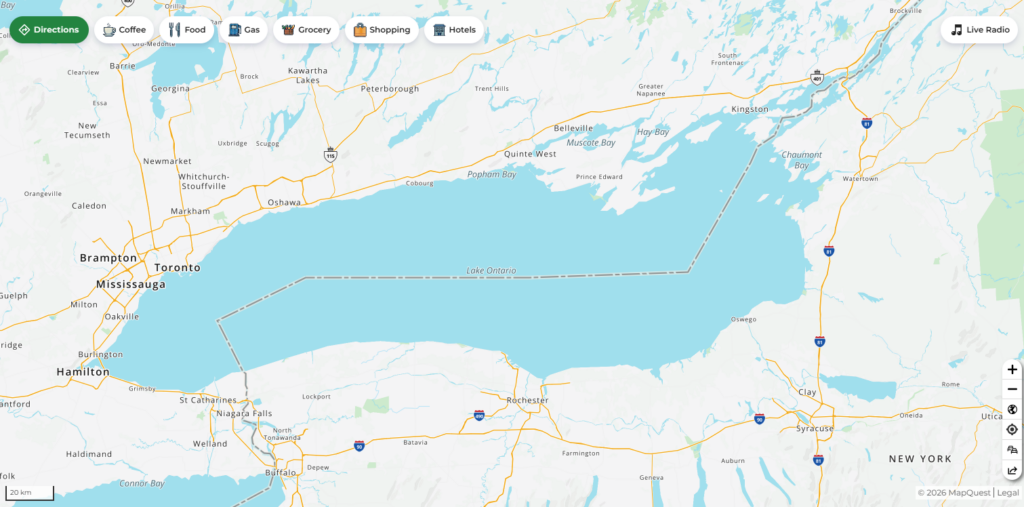
With an area of over 19,000 square kilometers, Lake Ontario is the smallest of the five North American Great Lakes and lies right along the border between New York State and the Canadian province of Ontario. It is a shared body of water, a physical feature that predates current political borders.
Even its name tells a story that predates the modern-day United States and Canada. “Ontario” derives from the language of the Wendat, an indigenous people of North America, and has been interpreted as referring to a “beautiful lake” or a “great lake.” The Grand Chief of the Wendat Nation, Pierre Picard, has opposed the American initiative precisely because of its cultural and historical significance.
Canadian Prime Minister Mark Carney rejected the name change, while Ontario Premier Doug Ford opted for a very concrete response: a large sign appeared near Grimsby with a phrase destined to be photographed more than discussed in diplomatic circles: “Lake Ontario. Now and always” (Lake Ontario. Now and always).
No global authority on place names
The crucial question, however, remains: which name is the “real” one? There is no international authority with the power to impose the name of a geographic location on all states. The UN hasUNGEGN, the group of experts on geographical names tasked with promoting standardization and international cooperation, but it cannot order Washington or Ottawa which name to use.
Each country therefore establishes its own official criteria. In the United States, the authority is the Board on Geographic Names and the Geographic Names Information System. Digital platforms can decide how to translate, pair, or display those names, but they must also deal with an inevitable reality: the same territory can have different names, all of which are legitimate in their respective contexts.
This is what is happening on Lake Ontario. Technology is not simply updating a map—it is revealing the political nature of place-name conventions.
MapQuest’s Unconventional Choice
In this context, the most interesting decision may have come from a name that seemed destined for the internet museum: MapQuest. The digital mapping service, launched in 1996 and gradually overshadowed by the rise of Google Maps and GPS navigation systems, announced that it would not change the lake’s name. CEO Doug Berger explained that the company intends to keep the names familiar to users, following the same approach it took in the previous dispute over the Gulf of Mexico.
We are aware that Lake Ontario is being correctly labeled on our map.
— MapQuest (@MapQuest) August 31, 2026
MapQuest has even introduced a feature that allows users to choose for themselves which name to display. This decision had an unexpected effect: the app reached the top of the free app charts on the U.S. App Store and, according to the company, saw approximately 50 times more usage than the previous week.
It is difficult to determine how long the novelty will last. But the case is telling: while the dominant platforms are aligning their geographic representation with official American place names, MapQuest has turned this refusal into a deliberate editorial choice for its service. And the web has rewarded it.
The case of Lake Ontario thus illustrates a very contemporary paradox. Geographical boundaries are physical, names are historical and political, while digital maps are technological products that must decide which version to show to billions of people. A lake stays where it is. Its name, however, can change on the screen depending on which country you’re in. And it is precisely this difference that has now become one of the most interesting aspects of the dispute between the United States and Canada.