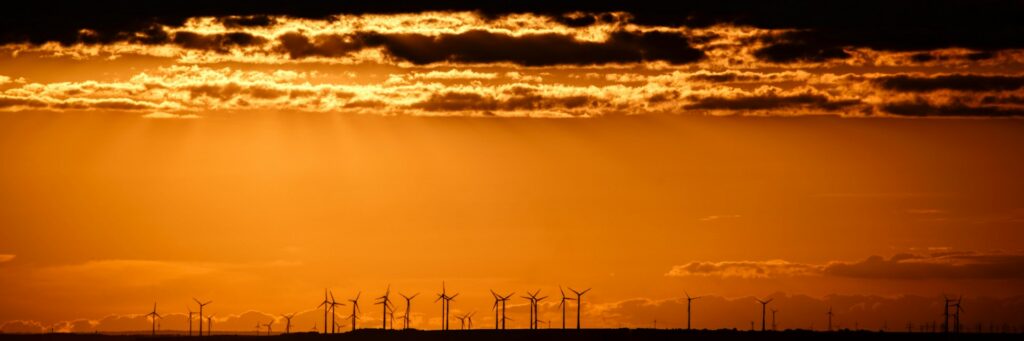
There are 552 gigawatts of new solar and wind capacity that could transform the Mediterranean’s energy landscape. This is the total capacity of major projects announced or already under development in the region, according to data from the Global Integrated Power Tracker cited by Global Energy Monitor. This portfolio is valued at approximately $792 billion, equivalent to 682.8 billion euros. To put this into perspective, the capacity exceeds the 548.3 GW of total electricity generation projected for the United States, across all energy sources.
However, this figure must be taken at face value: there is still a huge gap between the announced capacity and the electricity actually produced—a gap filled with permits, investments, infrastructure, and construction timelines. And it is precisely at this bottleneck that the Mediterranean’s energy future will be decided.
The Race Toward 2030
Nearly two-thirds of the capacity currently under development—361.3 GW—is expected to come online by 2030. If these deadlines are met, the region’s operational solar and wind capacity will increase by 43%, eventually accounting for about one-third of the current energy mix.
These figures point to significant growth, even if it is still insufficient to meet regional energy transition goals. The Global Energy Monitor report notes, however, that Mediterranean governments have implemented “ambitious policies, programs, and strategies.”
The transition from announcements to construction sites, however, remains crucial. A project can be counted as future capacity long before it produces its first kilowatt-hour. And once the plant is built, we need grids capable of absorbing and distributing the electricity, as well as storage systems capable of managing the variability of solar and wind power.
The Lesson from Spain
In Europe, Spain already offers a glimpse of what can happen when the growth of renewables becomes a structural component of the electricity system.
The country has the greatest large-scale solar potential among those analyzed, at 108.8 GW, and ranks third in wind capacity, at 56.6 GW. Last year, 75% of its electricity came from non-fossil fuel sources. Furthermore, since 2019, the increased availability of renewable generation has reduced the influence of fossil-fuel power plants on electricity prices by 75%.
Households also benefited: according to the data presented in the analysis, investments in wind and solar power contributed to an average savings of about 10 euros per month on electricity bills.
“Spain has broken the damaging link between energy prices and the volatility of fossil fuels,” Chris Rosslowe, a senior analyst at the think tank Ember, explained to Euronews. But the transformation is not yet complete. “Expanding the power grids and battery infrastructure will help Spain break free from its dependence on fossil fuels once and for all,” Rosslowe added.
This is an issue that affects the entire region. Increasing renewable energy production without simultaneously upgrading the grid and storage infrastructure means running the risk of not being able to fully utilize the new available capacity.
Egypt is also focusing on hydrogen
Growth is not limited to Europe. Egypt is emerging as one of the main hubs for North Africa’s new renewable energy capacity, with nearly 100 GW of solar and wind projects under development.
In this case, a significant portion of the investments is also linked to the decarbonization of industry. According to Global Energy Monitor, 37.7 GW of renewable capacity currently under development is directly linked to green hydrogen production applications.
Greece, Italy, Morocco, France, and Western Sahara follow on the list of projects. This picture illustrates not only how widespread the push toward the new generation of renewable energy is, but also how different conditions are from one country to another.
“Mediterranean countries aren’t starting from scratch in the energy transition,” notes Hailey Deres, a senior researcher at Global Energy Monitor. She adds that COP31 in Antalya can serve to “showcase the incredible progress made so far” and to build on what has already been achieved.
The Bottleneck
The European power grid remains one of the main unknowns. Deres points to the obsolescence of grid infrastructure as one of the obstacles that will “ultimately” determine how much of the planned renewable capacity will actually be built.
The Mediterranean has the sun, wind, and space needed to develop new electricity generation capacity; it also has a growing volume of investments that have already been announced. The next step, however, requires adequate infrastructure: connections, grids, storage systems, and power plants that are actually built.
The 552 GW therefore represent an enormous—but still incomplete—opportunity. The value of the transition will be measured by the megawatts that come online and by the ability to transform that new electricity into a system less vulnerable to the volatility of fossil fuels. For consumers, too, this is ultimately the figure that matters: how much of that capacity will reach the grid and how much it will affect energy costs.