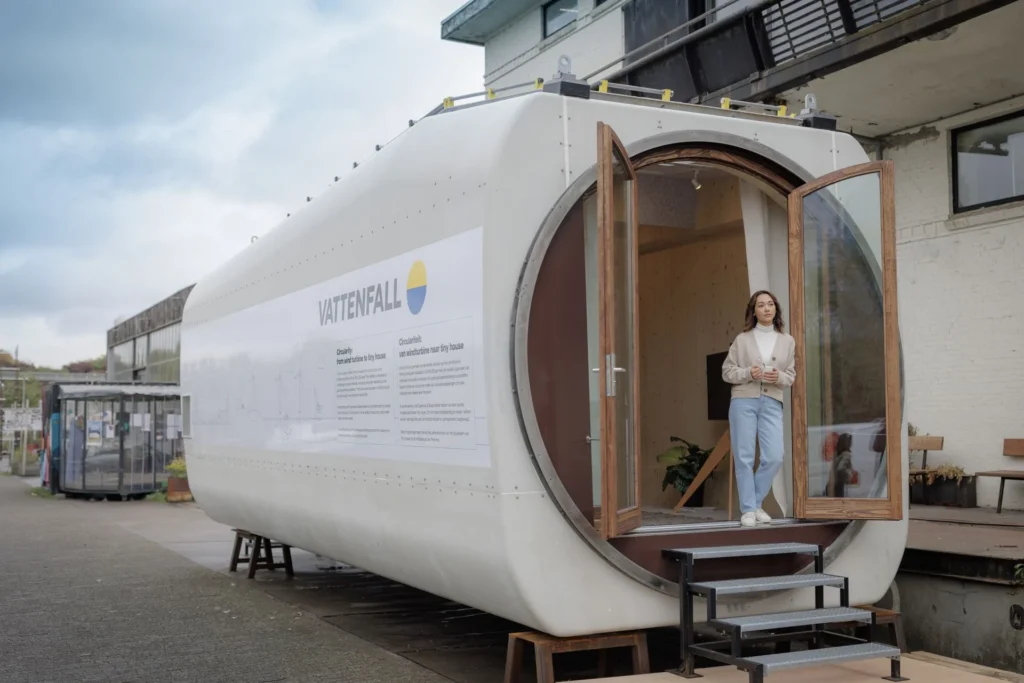
What happens to a wind turbine when it reaches the end of its operational life? Steel, copper, aluminum, and concrete can be recovered with relative ease. The blades, however, are much harder to recycle. So, some companies are trying a different approach: instead of dismantling them to recover raw materials, why not use the parts that are still intact directly?
The Turbine Becomes a Home
This is the approach chosen by Vattenfall in collaboration with the design firm Superuse. An old cover from the nacelle of an Austrian wind turbine was transformed into a small home: four meters wide, ten meters long, and three meters high. Inside, there is a kitchen and a bathroom; the building is also equipped with a heat pump, solar panels, and a solar water heating system.
The project was presented at Dutch Design Week in 2024 and explores one of the approaches currently being tested to manage the growing volume of components from end-of-life equipment.
This isn’t the only example. In Lund, Sweden, 57 blades from a Danish wind farm decommissioned in 2023 were used to build the facade of a multi-story parking garage. Other projects have used turbine components for solar panel structures and even to manufacture skis.
The hard part is the blades
The problem mainly concerns composite materials. A wind turbine blade can be between 50 and 100 meters long and is designed to withstand wind, rain, and extreme conditions for decades. It is made up of layers of fiberglass or carbon fiber, epoxy resins, balsa wood, metals, and other materials. Separating these materials requires specific processes and, in some cases, high temperatures and a great deal of energy.
For this reason, Vattenfall has banned the landfilling of blades and other composite components since 2021 and aims to achieve their complete circularity by 2030. Options include reuse, repair, remanufacturing, and recycling; when the recovery of high-value materials is not possible, energy recovery and co-processing in the cement industry remain as alternatives.
An issue that will become increasingly significant
Europe continues to install wind turbines: in the first half of 2026, 8.8 GW of new wind capacity was added, 30% more than in the same period the previous year. But the growth in wind farms also means that, in the coming years, the number of turbines that will need to be decommissioned (and disposed of) will increase.
The creative reuse of a spacecraft as a home certainly cannot solve the problem on its own. Even the people behind these projects still consider it an experimental phase. Its main purpose is to understand which components can be given a second life and to build a market for these applications.
European regulations are also still evolving: there is no general EU ban on landfilling wind turbines, while some countries have already introduced binding national regulations. WindEurope is calling for common regulations and a framework that makes circular supply chains economically viable.