The super El Niño could cause 451,000 additional heat-related deaths during the first part of the current climate event. This estimate is contained in the new report from the Climate Impact Lab, authored by Michael Greenstone, Tamma Carleton, Genevieve Maricle, and Emily Grover-Kopec. The projection refers to additional deaths compared to a typical year and uses the period 1996–2025 as a baseline.
Six Months That Foreshadow Future Weather
For the next six months, from September 2026 to February 2027, the report estimates 239,000 additional deaths, with a margin of uncertainty of about 11,000 deaths. The total figure of 451,000, however, includes projections starting in June, when the current El Niño episode began. The authors also warn that the death toll could continue to rise, as abnormal temperatures and their effects on mortality could persist until June or July 2027.
The reason is a particularly intense combination of the natural El Niño phenomenon and a planet that is already warmer. According to the report, average land temperatures in the coming months could be 1.2 °C above normal, with 44% more days of extreme heat compared to a normal year.
Nigeria, Indonesia, and India top the list
The risk is not evenly distributed. The areas expected to see the highest number of additional deaths are primarily in the Global South. The Sahel, the semi-arid belt that crosses Africa south of the Sahara, could see 66,800 additional deaths between September and February. Of these, 31,400 are expected to occur in Nigeria, 17,500 in Sudan, 10,000 in Niger, and 8,000 in Chad.
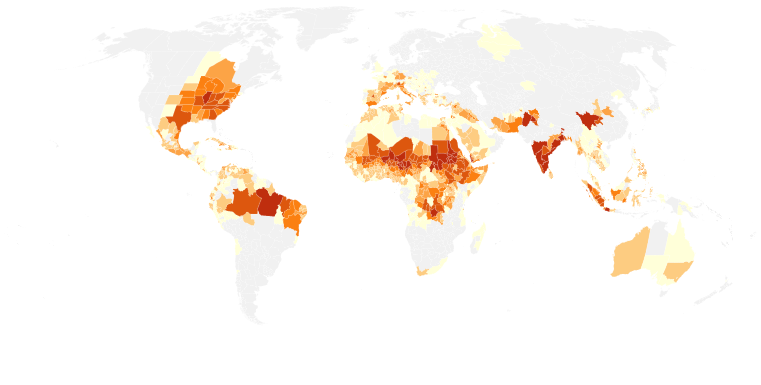
In Southeast Asia, the report estimates an additional 19,400 deaths in the Philippines, Vietnam, Thailand, and Cambodia, as well as 19,300 in Indonesia. Next are India, with 15,800 additional deaths, and Brazil, with 13,300. The top ten countries also include the Democratic Republic of the Congo, Niger, Chad, the Philippines, and South Sudan.
Italy also appears in the global ranking, in 49th place in terms of the estimated number of additional heat-related deaths. This figure places the country among the 50 most affected by the health consequences expected from this El Niño event, though it remains far below the estimated figures for the most exposed tropical regions.
Heat waves can be predicted and, to some extent, prevented
The report emphasizes a key practical point: projections can be used before heat waves cause their consequences. The Climate Impact Lab analyzed the relationship between temperatures and mortality in 24,378 regions around the world, taking into account local climatic differences, population vulnerability, and adaptive capacity. The relationships thus identified were applied to the ECMWF’s seasonal forecasts, and the results were compared with the average for the period 1996–2025.
Among the measures outlined by the authors are heat warning systems, assistance for vulnerable individuals, cooling centers, protective measures for outdoor workers, and increased capacity in health care services. The report also mentions heat action plans, which enable health authorities to identify at-risk individuals in advance and intervene through home visits, the provision of water, and symptom monitoring.
The central focus of the research is therefore temporal: some of the projected deaths will occur in the coming months, but the authors use this phenomenon as a preview of weather conditions that could become more common in the coming decades. The report describes these temperatures as a “postcard from the future”: what appears abnormal today could become the norm as the planet continues to warm.
The authors note that the report will be submitted to a peer-reviewed scientific journal. The current estimates are therefore projections based on seasonal forecasts and mortality models, not an observed count of deaths.