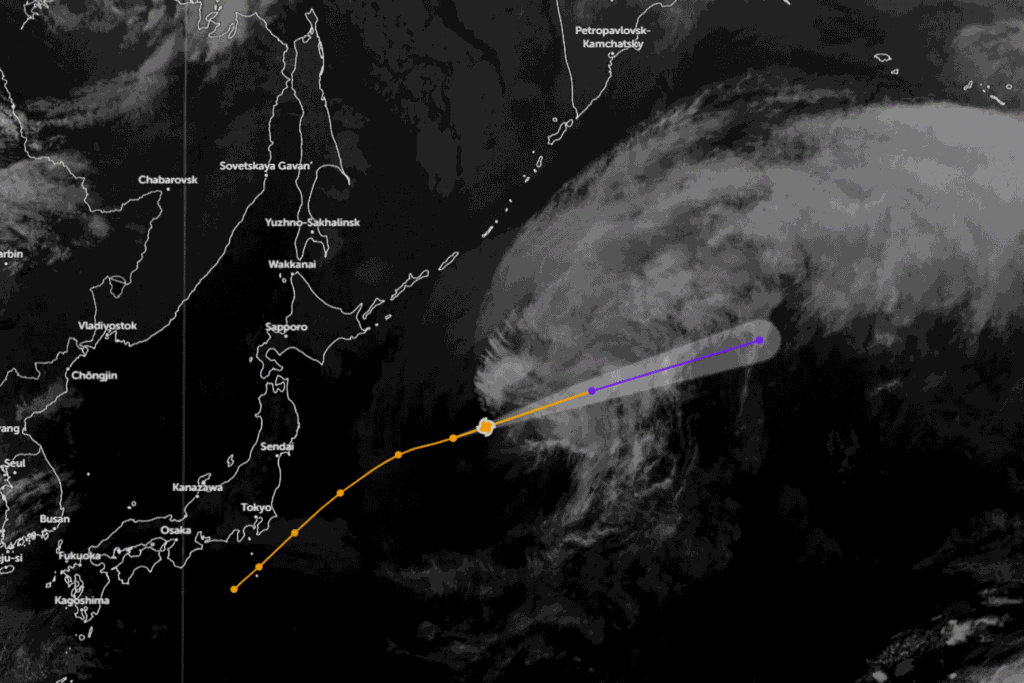
Just under two million people were ordered to evacuate their homes. The Japanese Ministry of the Interior reported more than 1.6 million residents in the prefectures of Ibaraki, Chiba, Tokyo, Kanagawa, and Shizuoka. Typhoon Dujuan, the 25th storm to hit the country this year, had been classified by the Japan Meteorological Agency as an “imminent threat to life,” a warning that applied particularly to the city of Oshima, where nearly 800 millimeters of rain fell in just a few hours.
Typhoon Dujuan slams Japan with heavy rain and strong winds triggering landslides in the in the Kanto region. Multiple people died after debris swept into homes https://t.co/xJSzl41qs9 pic.twitter.com/WIfhPLtb7T
— Reuters (@Reuters) September 22, 2026
The numbers paint a picture of a country at a standstill. Japan Airlines canceled 120 domestic flights and 15 international flights, while All Nippon Airways canceled another 140: according to Flightradar24, cancellations at Haneda and Narita airports neared 500. Several rail lines in and around Tokyo, including some high-speed trains, have been suspended, while more than 9,000 homes in the prefectures of Chiba, Saitama, and Shizuoka are without power. In Kamakura, a tourist destination south of the capital, flooded streets prompted Mayor Takashi Matsuo to warn residents not to drive.
Cancelled Events and the Prime Minister Staying Home
Typhoon Dujuan struck in the middle of a five-day holiday, forcing authorities to cancel dozens of events. Concerts at the Rock in Japan festival were called off, and the Tokyo Game Show—one of the world’s largest video game expos—ended early. An equestrian event at the Asian Games, currently underway in Japan, has also been postponed: approximately 4,000 athletes are staying aboard the cruise ship Costa Serena, which—according to the Asahi Shimbun newspaper—will have to be moved in the event of a direct impact.
Another significant factor is the decision by Prime Minister Sanae Takaichi, who postponed her trip to New York, where she was scheduled to address the United Nations General Assembly and meet with U.S. President Donald Trump. She chose to remain in the country to monitor the emergency, urging the public to follow evacuation orders. The toll, for now, remains limited: one person suffered minor injuries and nine homes were damaged.
An Ocean That’s Too Warm
Dujuan’s ferocity bears an increasingly familiar hallmark. The typhoon brought sustained winds of 130 km/h, with gusts up to 198, and waves over nine meters high, fueled by the so-called“super El Niño.” When the surface of the Pacific warms well above average, the air above the ocean becomes saturated with water vapor and heat: it is this reservoir of energy that a storm finds ready to unleash. This gives rise to cyclones capable of forming rapidly, gaining strength in just a few hours, and unleashing off-the-charts rain and winds on land.
It is the same mechanism that is causing typhoon seasons to become increasingly marked by extreme events. With an overheated Pacific, Japan finds itself more vulnerable to torrential rains and destructive winds. In this sense, Dujuan serves as a warning: this is another way we pay the price for climate change—with millions of people fleeing and a capital city holding its breath.