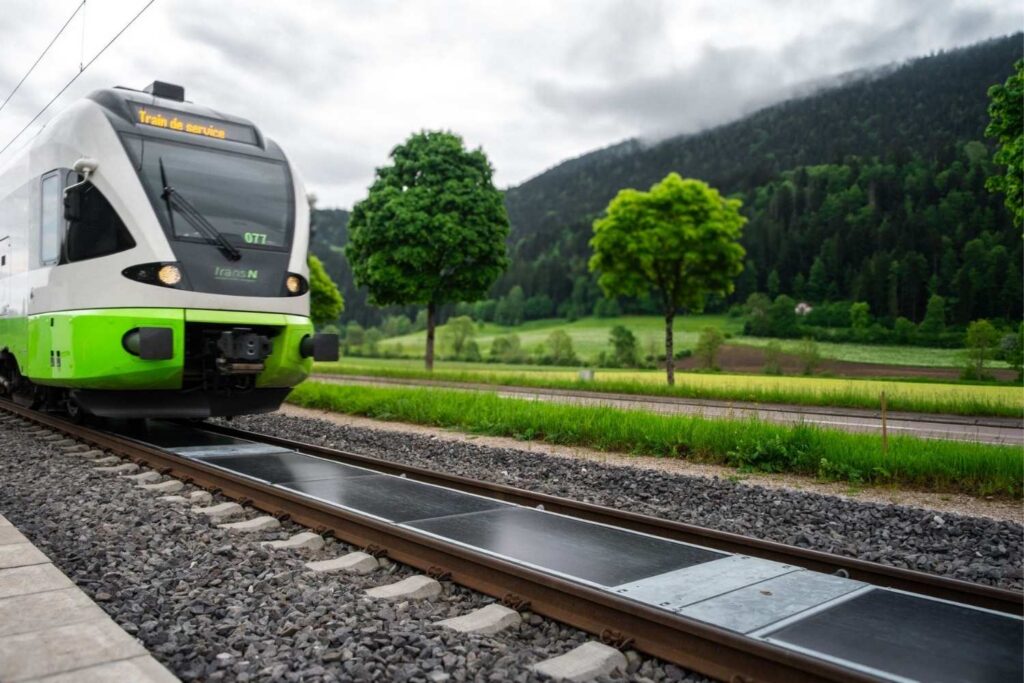
In the village of Buttes, in the canton of Neuchâtel, an interesting experiment is underway, though it is still very small in scale. Since April 2024, about 100 meters of railroad tracks have been transformed into a (small) solar power plant. Solar panels are installed between the railroad ties, generating energy as trains speed by—and even when no trains are passing. The idea comes from Sun-Ways, a startup seeking to address the issue of land use for renewable energy. Instead of searching for new land to cover with expanses of solar panels, the founders are tapping into an existing infrastructure: the railroad tracks.
After more than a year of testing, the results are encouraging. More than 11,000 trains have traveled along the route without any safety or operational issues. The system has generated more than 16,000 kilowatt-hours of electricity, which has been fed into the local grid. “This technology is as solid as a rock,” insists Valerio Tamellini, project manager at TransN, the public transportation company overseeing the project.
The simplicity of the system
The secret lies in the system’s simplicity. The panels are secured using pistons that latch onto steel rails. A single operator can remove them in about ten minutes when maintenance is needed, and then reinstall them immediately afterward. It’s not an entirely new idea, explains Joseph Scuderi, founder of Sun-Ways: more than a dozen previous patents had explored the concept. But the current design, with its securing pistons, is the first to prove truly practical.
However, there are many practical obstacles standing in the way of Sun-Ways’ dreams. Installing the system along thousands of kilometers of railroad track would require considerable investment. Thousands of modules installed outdoors, often in remote areas, would be at risk of theft. And not all sections are suitable: many lines have insufficient sunlight or present access difficulties for maintenance.
The success of the test has, however, sparked interest. In February, the French railway company SNCF signed a partnership with Sun-Ways to evaluate the technology on its nearly 30,000 kilometers of track. “We want to become a major producer of solar energy,” explains Nicolas Phan-Trong, head of energy and decarbonization projects at the company, which is the largest landowner and electricity consumer in France. SNCF is testing at least ten different solar designs and planning large-scale installations.
An unexpected benefit
There is also an unexpected benefit: the panels between the tracks prevent weeds from growing, reducing maintenance costs and potentially offsetting part of the installation expenses. South Korea is also working on this idea, with a two-year pilot project at the Railway Research Institute.
The main advantage remains the use of land that is already in use. Ground-mounted power plants require about one hectare per megawatt, and such land is often scarce or expensive. Utilizing existing infrastructure would circumvent this problem, at least in theory.
One challenge is how to transport electricity to other locations where it can be used or fed into the grid. A significant amount of energy is at risk of being lost during transmission, explains Julien Pouget, who studies electrical systems at the University of Applied Sciences of Western Switzerland in Valais. Pouget and his colleagues are working on a specialized electrical architecture to minimize these losses, which should make the expansion of solar-powered railways more feasible. His research was presented at an energy systems summit in Paris this month.