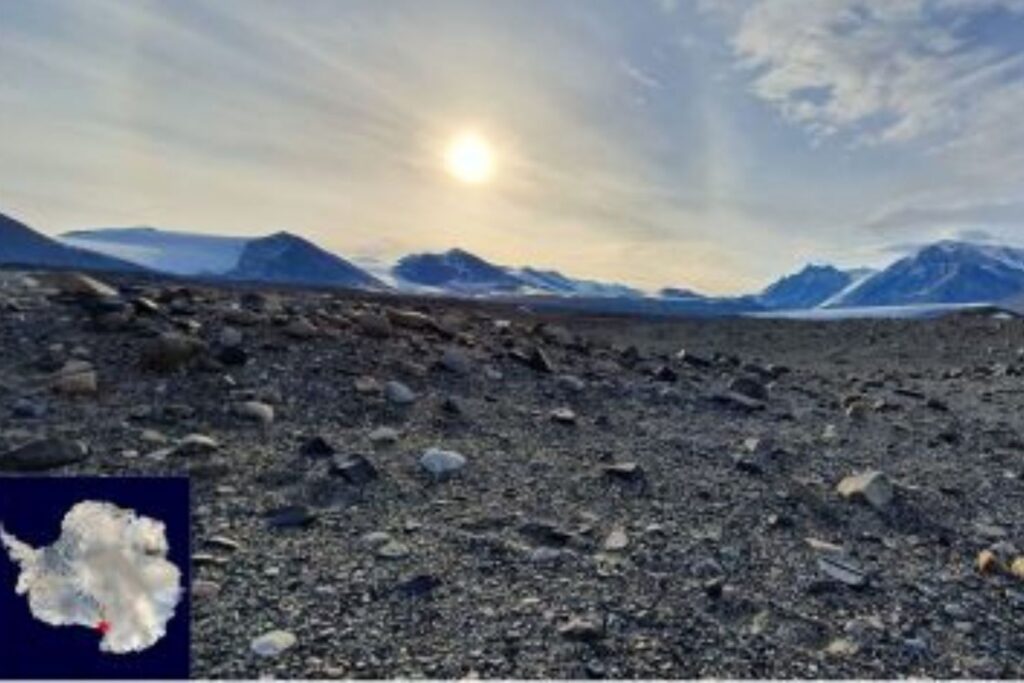
In the McMurdo Dry Valleys, it almost never snows, there is no vegetation, and the wind blows down from the glaciers to the Ross Sea. It is the largest ice-free area in Antarctica, a polar desert often compared to Mars. Yet carbon dioxide is rising from this frozen ground—and it’s rising at an ever-increasing rate. In Taylor Valley, the average CO₂ flux rose from 1.73 grams per square meter per day in 2020 to 9.49 in 2025—an increase of about 5.5 times— while the maximum measured value has risen from 11.36 to 72.99 grams. And these are not just a few outliers: the increase affects both the extreme values and the entire distribution of the observed fluxes.
The data comes from a study published in *Global Biogeochemical Cycles* and authored by researchers from the CNR, the INGV, and the Universities of Otago and Waikato in New Zealand. The data were collected as part of the Seneca and Seneca 2 projects of the National Antarctic Research Program during three different Italian expeditions, with logistical support from ENEA and Antarctica New Zealand.
The Carbon Footprint
The most surprising finding concerns the origin of the gas. Molecular and isotopic analyses of carbon dioxide and methane indicate that, in most samples, the gas does not simply result from microbial activity at the surface but rises from deep underground. According to Alessandra Sciarra, a senior researcher at the INGV, a significant portion of the carbon has “a deep geological origin.” In other words, permafrost is not an impermeable barrier: according to Livio Ruggiero, a geochemist at the CNR, it can be “penetrated by carbon originating from much deeper systems.”
Salted highways beneath the ice
The pathways leading to the surface may already be known. In 2015, a survey using helicopter-mounted electromagnetic sensors—published in *Nature Communications*—identified areas of low resistivity, interpreted as brine-rich materials, at depths of over 100 meters throughout the lower Taylor Valley, apparently connected to McMurdo Sound and the Ross Sea. This is the same system that feeds Blood Falls, where iron-rich brine stains the glacier a deep red as it oxidizes on the surface. However, the authors caution that the data do not yet allow for the identification of a single upwelling pathway or a specific mechanism responsible for the anomalies.
The Heating Issue
The most sensitive issue is the “why.” The study does not directly attribute the increase to permafrost thaw: soil temperature, water content, and the thickness of the active layer were not systematically measured in all field seasons. The context, however, is not neutral. A series of measurements collected in the Dry Valleys from 1993 to 2023 shows that winter soil temperatures have risen at multiple sites at rates exceeding summer warming, to the extent that part of the Antarctic permafrost may be approaching a transition to a discontinuous state. And in 2024, an unprecedented late-season warming event produced a record-breaking release of meltwater, well beyond the summer peak.
A missing piece in the models
This finding should be interpreted in the proper context: it does not mean that the entire continent emits five times as much CO2, but rather that a process—one that has been largely overlooked until now—has been observed in a specific area. This is a release mechanism that is still poorly represented in reconstructions of the carbon cycle at high latitudes, and whose extent and persistence remain to be determined. This is no small detail in a region that, via the Southern Ocean, absorbs about 40% of the human-generated carbon captured by the world’s oceans.
For this reason, researchers are calling for seasonal and multi-year monitoring, measurements of permafrost temperature and hydrology, and geophysical surveys. INGV President Fabio Florindo, a co-author of the study, emphasizes the need for long-term programs that can return to the same locations and measure changes.