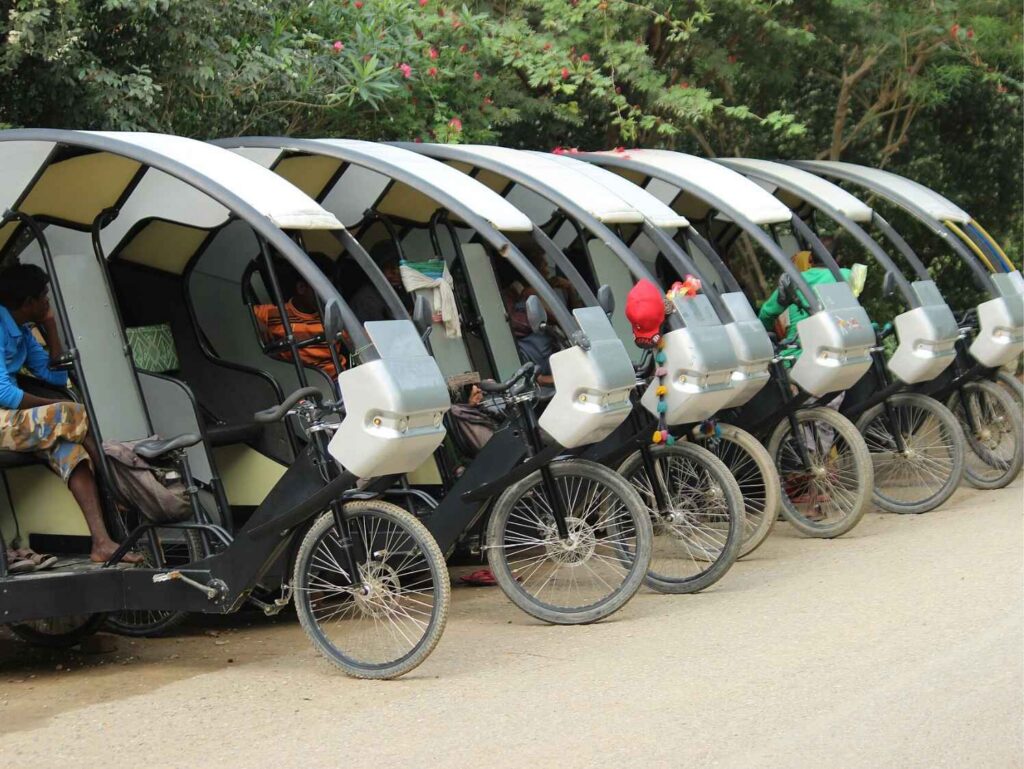
There has been a real boom in three-wheeled electric vehicles in India: e-rickshaws—that is, traditional rickshaws powered by electric motors and batteries—are now everywhere. Hundreds of thousands of these vehicles transport millions of people in major cities, providing countless low-income drivers with a way to earn a living—without polluting and with less physical strain.
For decades, pedal rickshaws have crisscrossed the streets of India. These tricycles have a seat for the driver and a bench in the back for two or three passengers, though sometimes they can fit more. A five-minute ride costs just a few rupees, offering an affordable way to get around the city. Driving them has been one of the toughest jobs in the country for many decades: drivers must pedal in all kinds of weather on heavy vehicles loaded with people and goods, working 10- to 12-hour shifts that pay a pittance.
Data from BloombergNEF
Rickshaws still exist today, but they are increasingly equipped with electric motors. According to BloombergNEF, the number of registered electric rickshaws in India rose to 1.8 million in early 2025, up from 78,700 in 2021. However, a great many operate without registration; BloombergNEF also estimates that the informal sector accounts for at least 70% of sales of electric three-wheeled vehicles in India.
Electric versions are eroding the market for auto-rickshaws, which are faster and sturdier motorized tricycles. The new e-rickshaws are similar in size to auto-rickshaws, but offer little protection from the elements aside from a canopy, and reach a top speed of about 25 kilometers per hour, compared to 50–60 for traditional auto-rickshaws. It’s very easy to spot e-rickshaws lined up near train stations or in crowded commercial areas. Like the pedal-powered versions that came before them, they’re mostly built in sheds, garages, and makeshift workshops. A veritable industry of small merchants and artisans thrives by selling wheels, rims, headlights, horns, speedometers, and seats, or by making upgrades and customizations: elegant upholstery, sound systems, and decorations of all kinds, in the classic flamboyant style of the Indian subcontinent.
The northern and eastern states
Electric vehicles accounted for 8% of all motor vehicle registrations in India in fiscal year 2025-26, according to an analysis by Down To Earth, a leading Indian magazine specializing in the environment, science, and sustainable development, which drew on data from the government’s VAHAN system. The adoption of e-rickshaws is concentrated primarily in the northern and eastern states of the country: Uttar Pradesh leads the list with over 200,000 new registrations, followed by West Bengal (nearly 90,000), Bihar (over 60,000), Assam (over 50,000), and Delhi (over 30,000). Together, these five states account for about 80% of all e-rickshaw registrations in India.
The use of these vehicles has increased thanks to government policies aimed at cutting fossil fuel imports and reducing the terrible air pollution in major cities. More than two decades ago, the capital’s government banned gasoline- and diesel-powered auto-rickshaws, allowing only compressed natural gas models. Other governments are following suit, albeit slowly. A great many e-rickshaws are purchased and operated by companies—both large and small—that pay their drivers. In many cases, however, the drivers are individual citizens trying to escape poverty and the informal economy.
The battery problem
The boom in e-rickshaws, however, also brings some environmental (and other) problems. Most of these vehicles use lead-acid batteries, the same type found in traditional cars. These batteries are quite heavy, last no more than two years, and must be disposed of properly to avoid environmental problems.
Lithium-ion batteries would be the ideal alternative: lighter, longer-lasting, and faster to recharge. But they’re still too expensive for most drivers, who therefore have to come up with creative solutions to “fill up” on electricity. In working-class neighborhoods, it’s common to find makeshift charging stations where drivers leave their vehicles plugged in overnight, with cables and outlets stretching across sidewalks and alleys. It’s an improvised system that works, but it still awaits proper infrastructure.