The scent of mulled wine, wooden huts, illuminated squares, and stalls laden with gifts. Every winter, Christmas markets attract thousands of visitors to European cities, with an impact on energy consumption, waste production, and transportation. In recent years, several organizers have introduced measures to reduce these effects: energy-efficient lighting, reusable tableware, organic products, food surplus recovery, and incentives for public transportation. From South Tyrol to Spain, we’ve selected ten markets that combine Christmas traditions with documented environmental initiatives and responsible consumption practices.
Bolzano: a Christmas focused on reducing waste
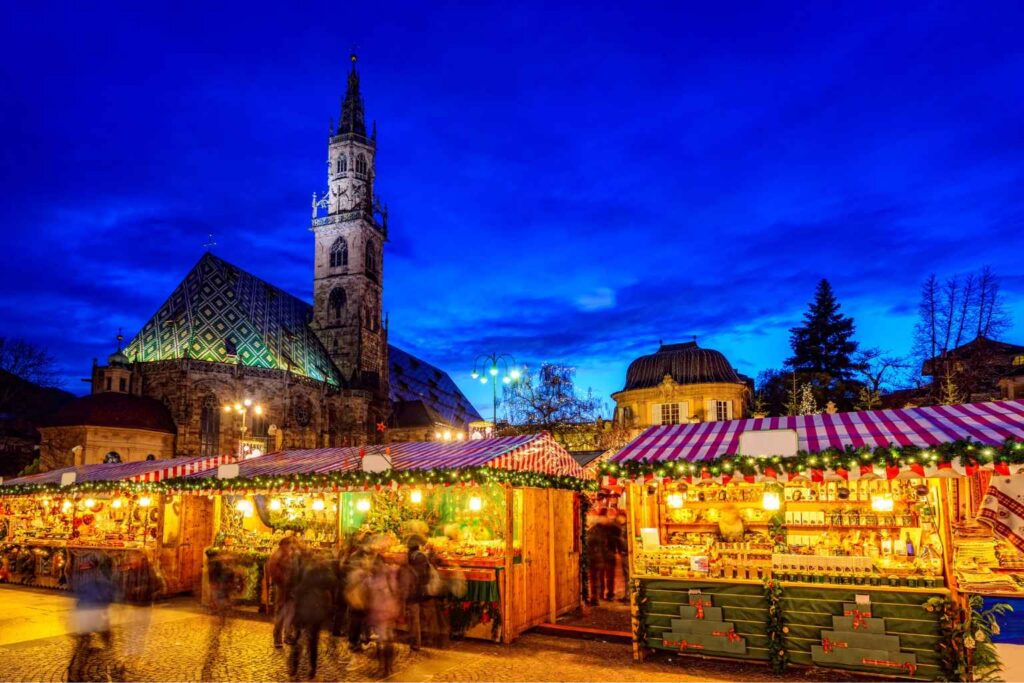
Set among the arcades of the historic center and Piazza Walther, with the cathedral as a backdrop, Bolzano hosts one of Italy’s most famous Christmas markets. The 2026 edition will open on November 27 and run through January 6, 2027, with the inauguration ceremony on November 26 at 5 p.m. The market stalls also extend into the surrounding streets, featuring handcrafted decorations, South Tyrolean specialties, and traditional sweets.
Since 2014, the market has been certified as a “Green Event,” a designation awarded by the Autonomous Province of Bolzano to events organized according to environmental sustainability criteria—ranging from waste management and energy conservation to transportation and food service. Measures implemented include reusable tableware, recycling, and the promotion of regional and seasonal products. Organic and vegetarian options are also available. The organizers encourage visitors to travel to the city by train. The initiatives are described on the market’s official website.
Bressanone: a Christmas celebration for artisans at the foot of the cathedral
In Bressanone, the market takes place in Piazza Duomo, surrounded by the historic buildings of the city center and dominated by the cathedral’s two towers. It is one of the oldest in Italy: founded in 1991, it is celebrating its 35th anniversary this year. The 44 stalls, run by 28 exhibitors, will welcome visitors from November 26, 2026, to January 6, 2027, with the stalls opening at 4 p.m. on the first day and the official opening ceremony at 5 p.m.
What sets it apart is the emphasis on local crafts. Among the market stalls, you’ll find decorations, handmade items, and local culinary specialties. Bressanone also participates in the Green Event program, which promotes waste reduction, responsible use of resources, and sustainable mobility. The market is also part of a cultural program that involves local associations, concerts, and Christmas events in the historic center.
Brunico: alpenhorns and energy-efficient lights
In Brunico, in the heart of the Puster Valley, the market stretches along Via Bastioni, Piazza Paul Tschurtschenthaler, and Via Ragen di Sopra. From November 27, 2026, to January 6, 2027, the market stalls will be accompanied by traveling concerts, Christmas music, and the sound of traditional alpenhorns. From Friday through Sunday, Palazzo Sternbach will also host a market dedicated to crafts.
From an environmental standpoint, the organizers have opted for LED lighting and reusable tableware for food and beverages. The town center is easily accessible from the train station, while the Kronplatz Guest Pass—reserved for guests of participating accommodations—allows for the use of South Tyrolean public transportation at no additional cost. The official Brunico tourism website features the program and information for visitors. The market will be closed on December 25; on December 24, it will close at 2 p.m.
Pietrarsa: Christmas amid historic locomotives and handcrafted goods
Just outside Naples, the National Railway Museum in Pietrarsa is hosting a truly unique Christmas market. Amid steam locomotives, vintage railcars, and 19th-century pavilions overlooking the Gulf, the wooden stalls, shows, and children’s activities return from November 28, 2026, through January 6, 2027.
The call for exhibitors accepts artisanal goods, organic food products, and traditional, non-industrial specialties. This focus on local products is complemented by the option to reach the museum without a car: the Pietrarsa–San Giorgio a Cremano train station is located right at the entrance. The event does not hold a specific environmental certification, but it does feature certain characteristics consistent with more sustainable tourism. Information and participation criteria are available on the official website.
Freiburg: the market that turns off unnecessary lights
In the medieval center of Freiburg, on the edge of the Black Forest, the Christmas market winds its way through squares and alleyways, featuring stalls selling handicrafts, culinary specialties, and traditional decorations. The 2026 edition will take place from November 19 to December 23, with an exceptional closure on November 22.
The German city has introduced specific measures to reduce energy consumption. The lighting has been gradually converted to LED technology, and starting in 2022, the lights are turned on at 2 p.m. instead of 10 a.m. A programmed system turns off non-essential lights starting at 10 p.m. All electricity is purchased from renewable sources through the regional supplier Badenova.
A deposit system is in place for glasses and tableware; the deposit is refunded when visitors return the items. Five mobile units handle the washing. The official environmental program documents the measures taken and the energy savings reported by the organizers.
Strasbourg: Christmas among the half-timbered houses
In Strasbourg, Alsace, Christmas takes over much of the historic center. The market stalls are spread out across Broglie Square, the area around the Gothic cathedral, and the streets lined with characteristic half-timbered houses featuring exposed wooden beams. The market, whose tradition dates back to 1570, will open on November 27, 2026, and close on December 24.
The event has earned ISO 20121 certification, an international standard that establishes requirements for organizing events according to sustainability criteria. The French city has introduced reusable cups with a deposit system, separate waste collection, and systems for recovering organic waste produced by exhibitors. This waste is used to produce biogas, a fuel obtained from the decomposition of organic materials.
Some of the decorations are reused in subsequent editions. The city’s environmental strategy also includes initiatives to raise visitors’ awareness of responsible consumption.
Essen: an international market in an industrial city
Essen, in the heart of Germany’s Ruhr region, has a long history tied to coal and steel. In 2017, it was named the European Green Capital, and today its international Christmas market fills the squares in the city center, starting at Kennedyplatz. The 2026 edition will take place from November 13 to December 23, with the market closed on November 22.
Attractions include a medieval market featuring artisans and traditional products, as well as light installations that wind through the city center. A vast web of lights spans Kennedyplatz, while illuminated figures and Christmas decorations appear in the streets.
The event uses renewable electricity supplied by E.ON, bans plastic bags, and provides reusable tableware with a deposit. Regional, organic, and fair-trade products are also taken into consideration when selecting exhibitors. The official tourism portal documents these measures and highlights the “Best Sustainable Christmas Market in Europe” award, presented by the tourism portal European Best Destinations.
Vienna: pedal-powered rides and organic food
In front of the Karlskirche, one of Vienna’s most impressive Baroque churches, the Art Advent market at Karlsplatz stands out for its lineup of artists and artisans. From November 13 to December 23, 2026, the stalls will feature ceramics, jewelry, wooden objects, and creations, some made from reclaimed materials. The works are selected by a jury, and the program includes live music, traveling performances, and light installations.
According to Vienna Tourism, Art Advent is the only Austrian Advent market with a selection of food and drinks that is entirely certified organic. Another unique feature is the carousels, which are driven by muscle power rather than electric motors. The emphasis on craftsmanship and the reuse of materials also offers an alternative to mass-produced gifts.
Brussels: food recovery and no space heaters
In Brussels, Winter Wonders transforms the city center into a long Christmas trail. From the Grand-Place, with its light show, all the way to Sainte-Catherine and the Marché aux Poissons, 238 stalls line the route alongside a Ferris wheel and other attractions. The 2026 edition will take place from November 27 to January 3, 2027.
Over the years, the organizers have implemented a series of measures to reduce consumption and waste. Since 2012, electric heaters have been banned inside the cabins, and since 2021, outdoor heaters on the terraces have been eliminated. Reusable cups have been in use since 2016, and a food surplus recovery system has been in place since 2022 to prevent unsold food from ending up in the trash.
These initiatives are described on the official sustainability page. The market will generally be open from noon to 10 p.m., closing early at 6 p.m. on December 24 and 31 and January 3.
Barcelona: gifts from the solidarity economy under the tree
In downtown Barcelona, Plaça Catalunya will host the Fira de Consum Responsable i d’Economia Social i Solidària from December 18 to 30, 2026—a Christmas fair dedicated to responsible shopping. Among the stalls, visitors will find handmade goods, clothing, cosmetics, books, and toys offered by businesses and organizations in the social economy—a model that values work, community, and a more equitable distribution of economic benefits. The event offers an alternative to traditional Christmas shopping, prioritizing local products and initiatives focused on sustainability. It is presented by the Catalan Tourist Board as part of the city’s Christmas offerings.