Every year, Italians spend 1.33 billion hours stuck in traffic, at an estimated economic cost of 22 billion euros—equivalent to 1% of GDP. More than 80% of this time is wasted in cities. Yet, two out of every three car trips cover distances of less than eight kilometers. These figures highlight how urgent it is to rethink urban mobility, starting with the shortest trips, for which there are often no convenient alternatives to private cars.
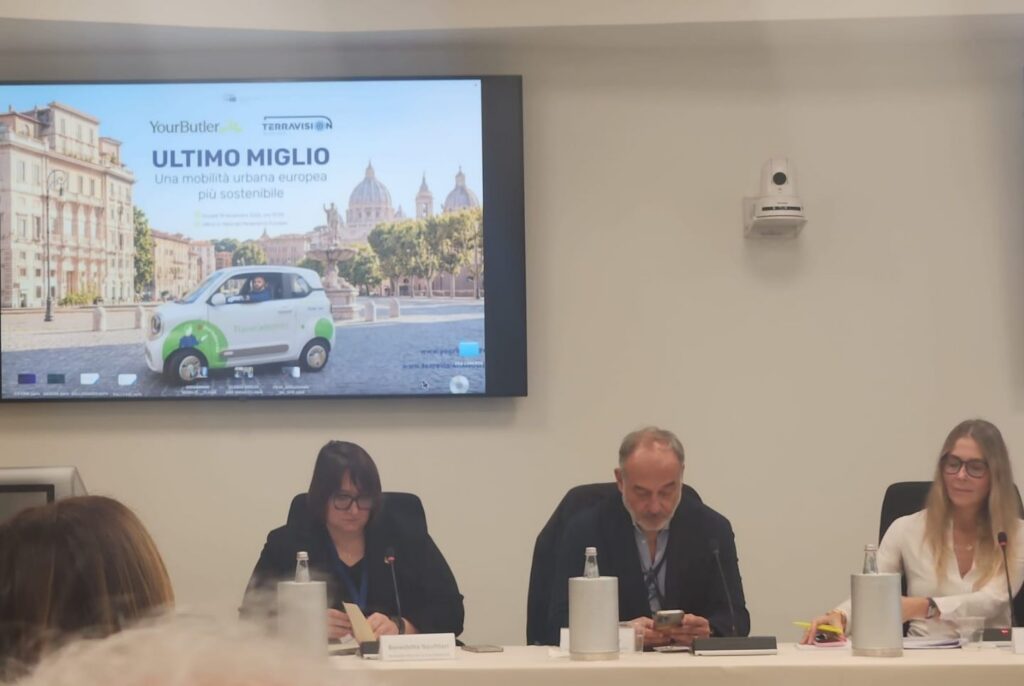
These figures served as the starting point for the conference“The Last Mile: A More Sustainable European Urban Mobility,”held on November 19 in Rome at the European Parliament’s Italian office. The event, organized by YourButler24 and Terravision Electric in collaboration with the European Parliament’s Office in Italy, brought together institutions, businesses, and experts to discuss how to make travel more efficient and less polluting.
The Impact of Traffic on Cities
Fabrizio Meroni of the National Center for Sustainable Mobility (MOST) quantified the costs of traffic congestion. One statistic highlights how slowly change is occurring: each year, only 3.71% of Italy’s vehicle fleet is replaced. For Pierfrancesco Maran, chair of the European Parliament’s Environment Committee, the priority is to strengthen alternatives to private cars. According to European Commission data he cited, urban areas account for 23% of the EU’s transportation-related greenhouse gas emissions.
We therefore need more efficient public transportation, safe routes for pedestrians and cyclists, and connections that integrate trains, buses, and ride-sharing services. This is the principle of intermodality: allowing people to use different modes of transportation during the same trip, thereby reducing wait times and the hassle of transfers.
The Last Mile Becomes a Service
Among the initiatives presented is YourButler24, which has been operating in Rome since May and in Milan since September. The service combines an electric microcar with a personal assistant—trained through the Butler Academy—who accompanies residents and travelers in their daily activities.
Sessions last 30 or 60 minutes, and the amount paid is refunded in the form of a Mobility Eco Bonus, a credit that can be used to purchase electric products and maintenance services. The pilot phase, carried out in partnership with Terravision Electric, was initially reserved for TerraFastPriority customers.
Starting in late November, the project plans to expand its services to businesses, government agencies, households, and tourists. For businesses, it could become an employee benefit; for local governments, a tool to assist the most vulnerable members of the community.
The company also aims to expand the service to the seven Italian cities involved in the European mission to achieve climate neutrality by 2030. This goal will depend on the ability to make these services accessible, economically sustainable, and integrated with public transportation.
Rome and Bologna Put to the Test on Sustainable Mobility
The discussion also included Rome and Bologna, both of which are working to transform their transportation systems. Rome City Councilor Eugenio Patanè highlighted investments in rail infrastructure, bike lanes, and shared mobility. These initiatives aim to reduce dependence on cars, particularly for connections between neighborhoods and public transit hubs.
This challenge directly involves municipal governments, which are called upon to redesign streets, transportation links, and public spaces. As Benedetta Squittieri, president of the Network of Sustainable Municipalities, pointed out, “urban regeneration takes place at the municipal level.” However, transforming projects into usable services requires resources, administrative continuity, and collaboration with businesses, research institutions, and the nonprofit sector.