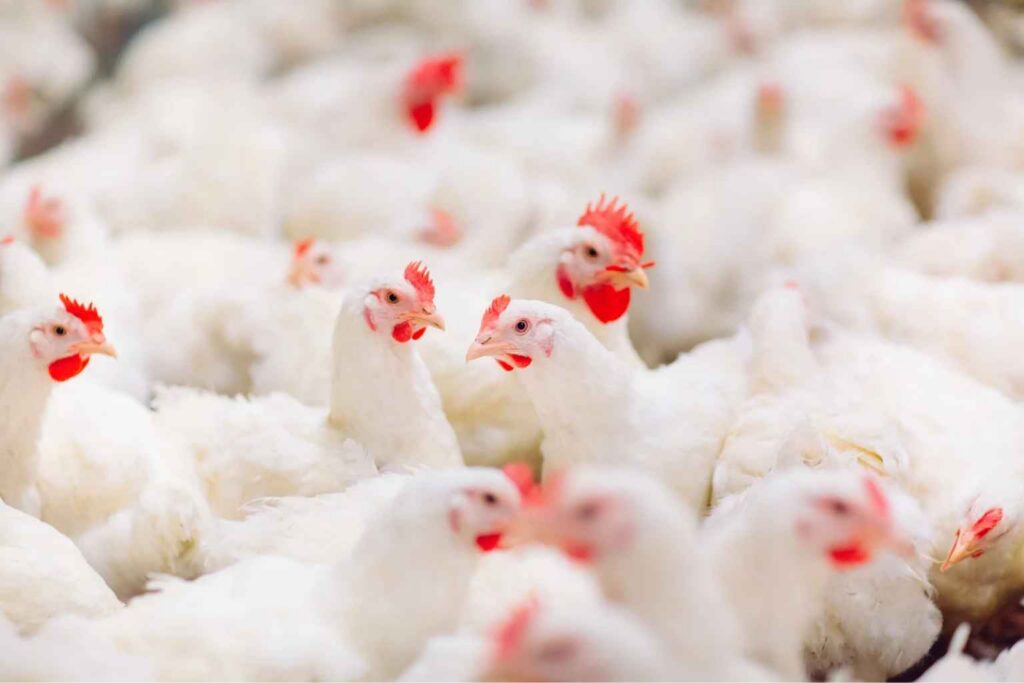
From 50 grams to two kilograms in just over a month. This is the staggering growth rate of Ross 308 chickens, one of the most widespread genetic lines in European intensive poultry farms. These animals are bred to gain weight rapidly, at the expense of their health. In Denmark, where approximately 120 million broiler chickens are raised each year—80 million of which are Ross 308s— the government has decided to address the issue: banning so-called “turbo” chickens and calling on the European Union to do the same.
The announcement came on October 28 from Christian Rabjerg Madsen, Minister for Nature and Animal Welfare, following an investigationby the public broadcaster TV 2 that brought the conditions at a large farm in Northern Jutland to the public’s attention.
The footage, shot with hidden cameras, documented a particularly controversial practice: the animals were allowed only three hours of darkness per day, compared to the six hours required by Danish law. This decision allows for more time to be devoted to feeding, further accelerating weight gain.
As reported by the Danish news outlet CSR.dk, the animal welfare organization Dyrenes Beskyttelse filed a complaint against the producer with the police. The farmer acknowledged that he had made poor decisions and stated that he had corrected the irregularities. It will be up to the authorities to determine whether anyone is liable.
Chickens That Grow Too Fast
To understand the scope of the Danish proposal, we must start with the animals. Ross 308s are broiler chickens that have been genetically selected through crossbreeding to achieve very rapid growth and high productivity. The problem primarily concerns the physical consequences of this growth. The skeleton and internal organs may struggle to support such a rapid increase in body mass. Animal welfare groups report mobility issues, leg injuries, and heart problems. In fact, over 95% of conventional fast-growing chickens have difficulty walking.
The government wants a ban, but there are obstacles
“I want to work toward a national ban,” Madsen told TV 2, noting that the legal and economic consequences would need to be examined. The proposal enjoys broad parliamentary support. As confirmed by a press release from the Danish association Anima, even the Moderates, one of the parties in the governing coalition, have come out in favor of phasing out extremely fast-growing chickens.
The ban, however, is not yet law, and the government has not set a date for its implementation. One of the main obstacles concerns imports. If Denmark were to ban these farms without taking action regarding the sale of meat from abroad, supermarkets could continue to source their supplies from producers in other countries.
This concern has also been raised by the farmers’ association Landbrug & Fødevarer, which fears an increase in imports and consumer prices. The government will also have to verify whether any trade restrictions are compatible with European regulations.
The game moves to Brussels
Copenhagen therefore intends to bring the issue to the EU level, calling for common rules to bridge the differences among member states. The discussion also involves supermarkets and public cafeterias. As early as 2023, Denmark had agreed to certain initiatives to improve the welfare of broiler chickens, including a commitment to promote the phasing out of fast-growing breeds in the European Union and in government procurement.
According toa survey published by Anima in October 2026, more than half of the chickens sold in Danish supermarkets still belong to faster-growing genetic lines. However, there are still considerable differences among the retail chains. The associations are calling for more space in poultry farms, a reduction in stocking density, and less aggressive growth schedules.
For now, “turbo chickens” continue to be raised and sold. But the Danish initiative could spark a European debate on an issue that directly affects Italy as well: How fast must an animal grow for its meat to be inexpensive?