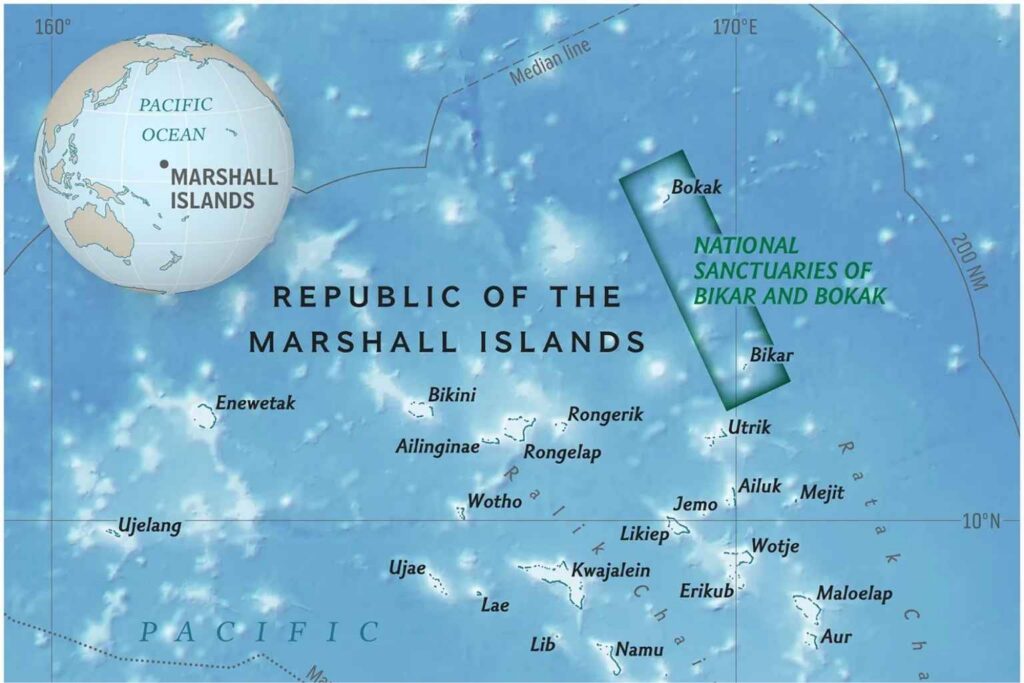
More than 850 kilometers from the capital of the Marshall Islands, in the Pacific, there are two uninhabited atolls where sharks still rule the coral reefs, seabirds nest in large colonies, and sea turtles lay their eggs on the beaches. They are called Bikar and Bokak and are home to two of the tropical ecosystems least disturbed by human activity.
This is documented in a study published on November 11 in *Frontiers in Marine Science*, conducted by an international team of researchers as part of Pristine Seas, the National Geographic Society’s ocean exploration and conservation program.
These sites, which are home to unique biodiversity, offer a glimpse into how a marine ecosystem functions when intensive fishing, urbanization, and other local pressures have had only a limited impact. They serve as an increasingly rare benchmark for assessing the damage suffered by the world’s coral reefs.
A heritage that remains unknown
In 2023, scientists explored the two atolls using scuba dives, underwater cameras, and a small submersible. Their investigations covered forests, beaches, coral reefs, and the deep seabed.
The results reveal extraordinary biodiversity: 266 taxonomic groups of reef fish, 138 of which were observed during submersible dives, and 79 vertebrate species detected by cameras in deep waters. Fifteen groups of open-water predators were also identified. The submersible explorations documented 14 organisms never before reported in the Marshall Islands. Two others may belong to species still unknown to science, but further analysis will be needed to confirm this.
The presence of large predators is significant: at Bokak, sharks account for nearly 34% of the biomass of the fish observed on the outer reef—that is, their total weight. This figure attests to the presence of a food chain that is still rich in predators.
Two Different Paradises
Bikar and Bokak are 116 and 385 kilometers, respectively, from the nearest inhabited atoll, Utrik, and exhibit different ecological characteristics. At Bokak, corals predominate and the biomass of reef fish is higher. Bikar, on the other hand, is home to extensive native forests of Pisonia grandis —a tropical tree that provides shelter and nesting sites for seabirds—as well as greater seaweed coverage and important sea turtle nesting areas.
Here, researchers recorded 71 tracks left by turtles on the beach and 132 nesting pits, most of which were attributed to the green turtle. In addition, 17 species of seabirds were observed on both atolls.
A Vast Marine Sanctuary
In 2025, the Marshall Islands established their first national marine sanctuaries around the two atolls, covering a total area of 48,136 square kilometers—larger than Lombardy and Piedmont combined. This protection comes at a critical time: even the most isolated ecosystems, those least affected by human activity, are vulnerable to ocean warming, coral bleaching, and rising sea levels.