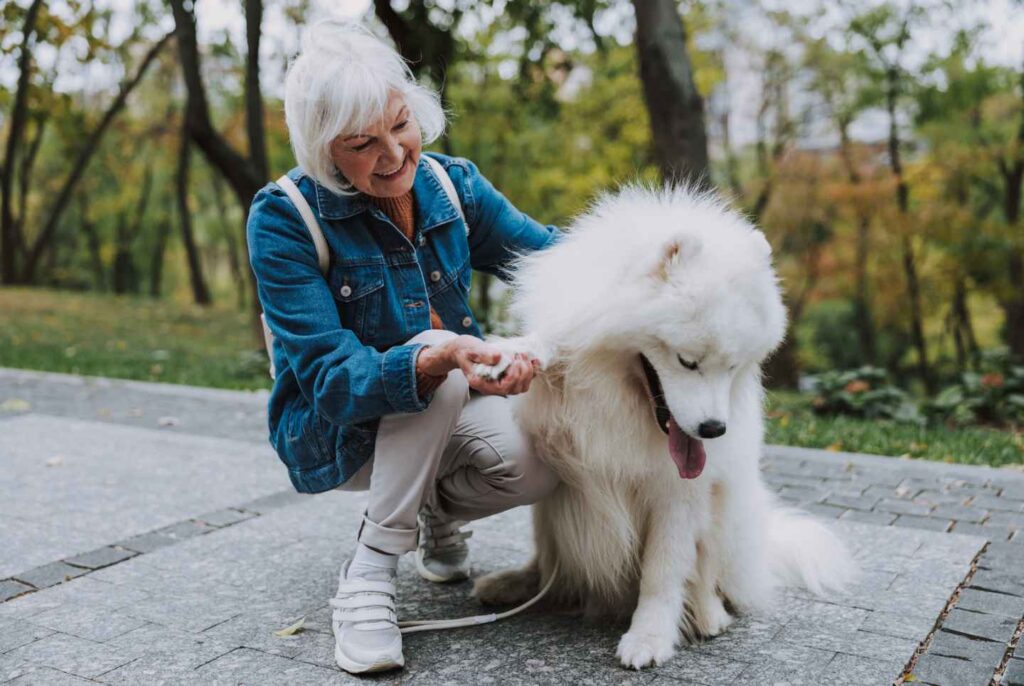
Owning a dog may help protect the brain from aging. This is suggested by a Japanese study that followed more than 11,000 older adults for seven and a half years and found that people who live with a dog are less likely to develop a form of dementia severe enough to impair their daily independence.
The study, published in July 2026 inthe *International Journal of Environmental Research and Public Health*, adds new insights to a line of research investigating the benefits of living with pets. It suggests that the routines involved in caring for a dog may help keep the brain healthy even in old age.
The risk of dementia has been nearly halved
The researchers analyzed data from 11,224 people between the ages of 65 and 84 who lived in the Ota Ward of Tokyo. At the start of the study in 2016, 963 participants owned a dog, 2,539 had owned one in the past, and 7,722 had never owned one.
By the end of 2023, 1,989 people had developed disabling dementia—that is, a decline in cognitive function severe enough to require at least some supervision in daily activities.
The disease had affected 12.8% of dog owners, compared with 18.1% of those who had never owned a dog. After accounting for numerous individual differences, including age, health status, and social relationships, the researchers found that dog owners had a 47% lower statistical likelihood of developing disabling dementia.
This is a significant finding; however, it does not prove that adopting a dog automatically reduces the risk by the same percentage. Furthermore, among former owners, the benefit was not statistically significant.
Walking and Relationships: The Potential Benefits
Why might living with a dog help protect cognitive function? According to the authors, part of the explanation may lie in daily habits. Having a pet to care for encourages people to go outside, take walks, and maintain a routine. Walks also promote interactions with other people, counteracting social isolation—one of the factors associated with cognitive decline.
The data collected confirm certain differences: 81% of dog owners left the house at least once a day, compared with 74.3% of those who had never owned a dog. Social isolation affected 24% and 34.2% of the participants, respectively.
Researchers are also considering the possible role of psychological well-being and emotional interactions. Other mechanisms, such as changes in the gut microbiota—the collection of microorganisms that live in the gut—remain hypotheses that require further investigation.
A potential resource for the healthcare sector as well
The study also examined the economic implications. Using a simulation, the authors estimated that a more widespread practice of living with dogs could reduce Japanese public spending on medical care and treatment. However, when private expenses associated with pet care are also taken into account, the economic benefits are less favorable.
There are still some important caveats. The study is observational and does not definitively prove a cause-and-effect relationship. People who are already healthier and more independent may be more likely to own a dog. For those who already live with a dog, however, the results offer yet another reason to make the most of walks and opportunities for social interaction. For older adults who are unable to care for a pet on a regular basis, the authors themselves suggest exploring shared walking programs and assisted activities with dogs—options that should be evaluated through further research.