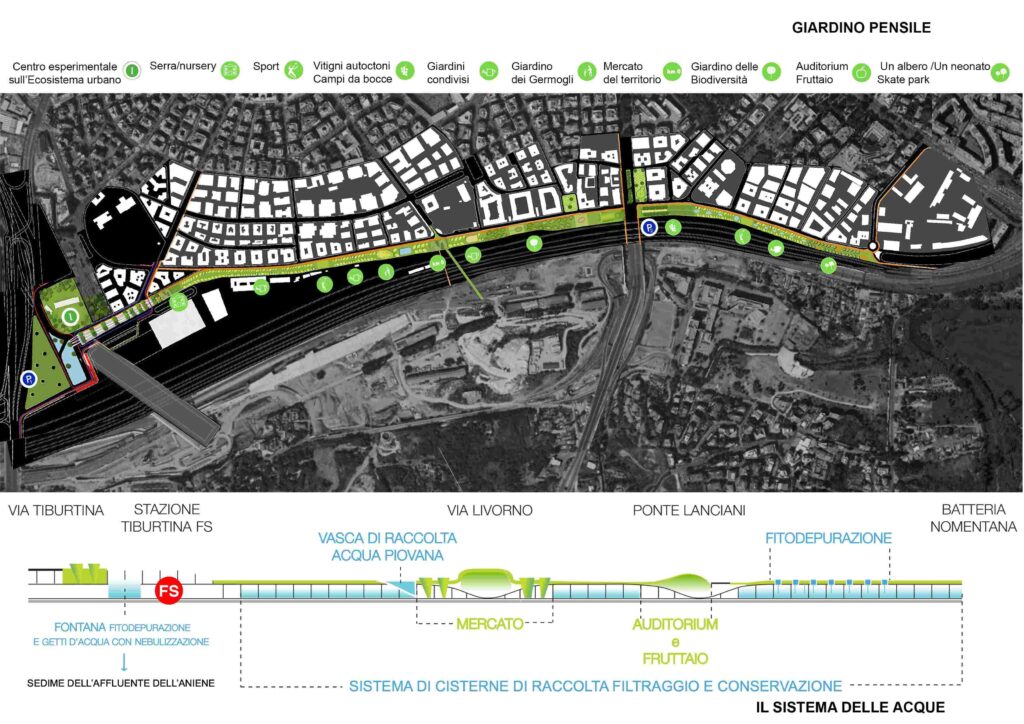
An old gray infrastructure becoming a green corridor in the heart of the city. Between Tiburtina station and the Nomentana Battery could be born a Green Tangenziale about two kilometers long, an elevated linear park inspired by New York’s High Line but dropped into the Roman reality, with a mix of nature, sports, culture and public services.
The project-which affects about three and a half hectares-aims to transform a now unused stretch into a continuous public space with more than 500 trees, theme gardens, sports areas, a skate park, a covered market and even an auditorium. An urban regeneration operation that the Capitol has decided to take seriously, launching a technical study to assess its feasibility
A true ecological infrastructure
The idea was presented by the association Res – Research Education and Science, with a project signed by architect Nathalie Grenon and a working group linked to the principles of theUN Agenda 2030. Not just ornamental greenery, but a true ecological infrastructure: agronomic gardens, shared vegetable gardens also designed for horticultural therapy, educational spaces for children and a“garden of biodiversity” that should host varieties of traditional fruit trees from Lazio.
Next to greenery, space for sociality. The design includes tennis and soccer courts, bocce courts, and leisure areas shielded from traffic by vegetated barriers against noise and particulate matter. Also planned is a greenhouse-nursery as an experimental center on the urban ecosystem and a covered market with photovoltaic surfaces, designed as a multipurpose place for events, food initiatives and incubation of new businesses related to the urban economy.
From the institutional point of view, the project is considered consistent with other regeneration strategies put in place by the municipality, such as those for the Ostia shoreline. For this reason, the relevant departments have given an initial political green light, asking the offices to start planning activities and open a coordination table involving the territory, associations and the scientific world.
The resource node
The knot, inevitably, is that of resources. The preliminary estimate speaks of about 39 million euros, but the total cost could reach 50 million, considering divestment and implementation of the works. A major investment, which will also require considering forms of private participation, since this operation will not be able to rely on Pnrr funds.
Meanwhile, residents look to the project with high expectations. The expected environmental benefits are clear: reduction of pollution, mitigation of heat islands, recovery of rainwater, and a new connection between the Tiburtina and Nomentana bike paths. But there is also an economic and social bet: to transform an abandoned infrastructure into an engine of urban quality, able to restore value to a piece of the city that has so far remained on the margins.
If it goes through, the Green Bypass could become one of those rare cases where Rome manages to turn over a new leaf without erasing the past, but reusing it. And that is no small feat in a city where concrete often has the last word.