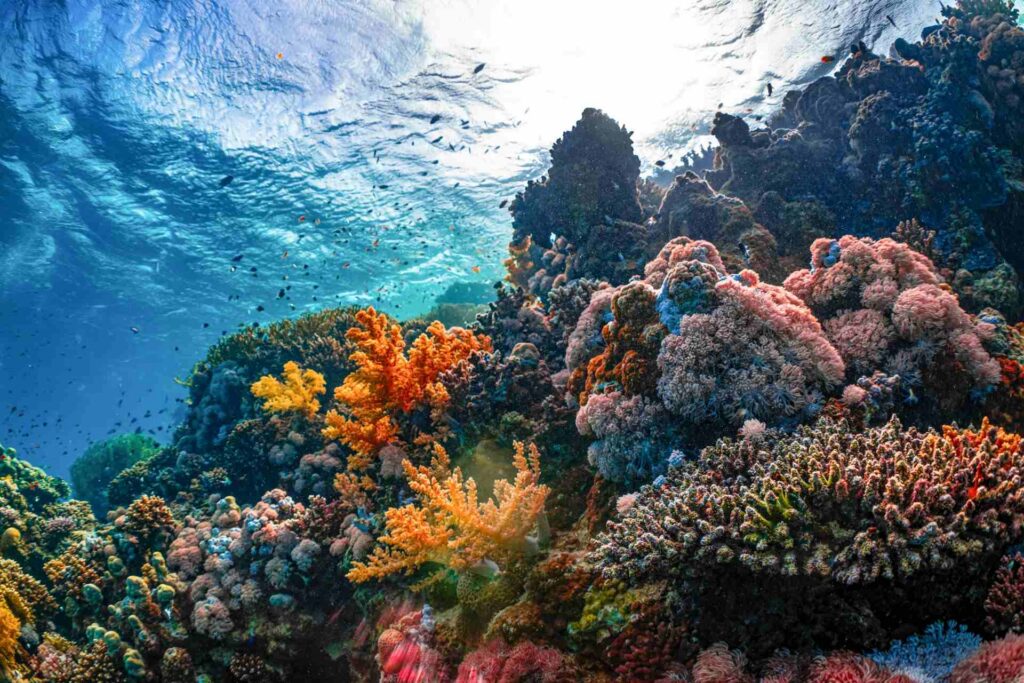
On Jeju, a South Korean island, the corals aren’t just bleaching—they’re losing their shape. As reported by Reuters in an investigative piece by Hyeyoon Cho, the phenomenon has a technical name that is not yet widely known—“collapse”—and affects soft corals, which lack the rigid calcium carbonate skeleton that supports hard corals. When environmental conditions change abruptly, the internal fluid pressure that keeps them upright is lost, and the colonies collapse in on themselves.
A UNESCO World Heritage ecosystem under stress
The Paran Ocean Citizen Science Center, a group of volunteer divers that monitors the area, has documented that about half of the islands off the coast of Beomseom Island have experienced a new collapse in recent months. This is not the first time: researcher Kim Taihun, along with his colleague Anna Beate Jöst of the Korea Institute of Ocean Science and Technology, had already described an initial major collapse in 2024 in a study published in *Scientific Reports*.
The problem, Kim explains to Reuters, is that each recurrence leaves the corals weaker: “They partially recover, then many break again, and their ability to recover continues to decline.” This year, factors include a record heat wave on the Korean Peninsula, heavy rains, and freshwater inflow from the Yangtze River, which alters salinity in an area already at the northern limit of coral distribution in the East China Sea.
Those who make their living from that sea are the first to notice it
It is not only the data that tells the story of this change, but also those who dive for a living. Ko Myeong-hyo, a third-generation “haenyeo”—the traditional female free-diving fisherwomen of Jeju, who for centuries have dived without breathing apparatus to gather shellfish and seaweed, a craft recognized by UNESCO as intangible cultural heritage—describes the rapid changes of the past two years as follows: “Seeing the coral garden collapse and turn white was truly disorienting. I feared that the entire sea might collapse.”
Her mother, Son Choon-sook, who has been diving for 45 years, notes that the catch has decreased and her workdays have gone from five to three hours. For Yoon Sanghoon, an environmental expert from Paran, the stakes are systemic: “If this basic ecosystem collapses, there is a real possibility that the entire marine ecosystem could collapse.”
It’s the same story in Europe, too
Jeju is the latest addition to a pattern that NOAA has described since 2024 as the fourth-largest global coral bleaching event on record—the second in ten years—with more than 80% of coral reefs exposed to bleaching-induced thermal stress. This issue also closely affects Europe: in the Mediterranean, according to studies by Joaquim Garrabou and colleagues published in *Global Change Biology*, marine heatwaves have already caused mass mortality among gorgonians such as *Corallium rubrum* and *Paramuricea clavata*, with damage also observed along the Italian coast, from Portofino to Elba. Different seas, same cause: temperatures rising faster than these organisms can tolerate.