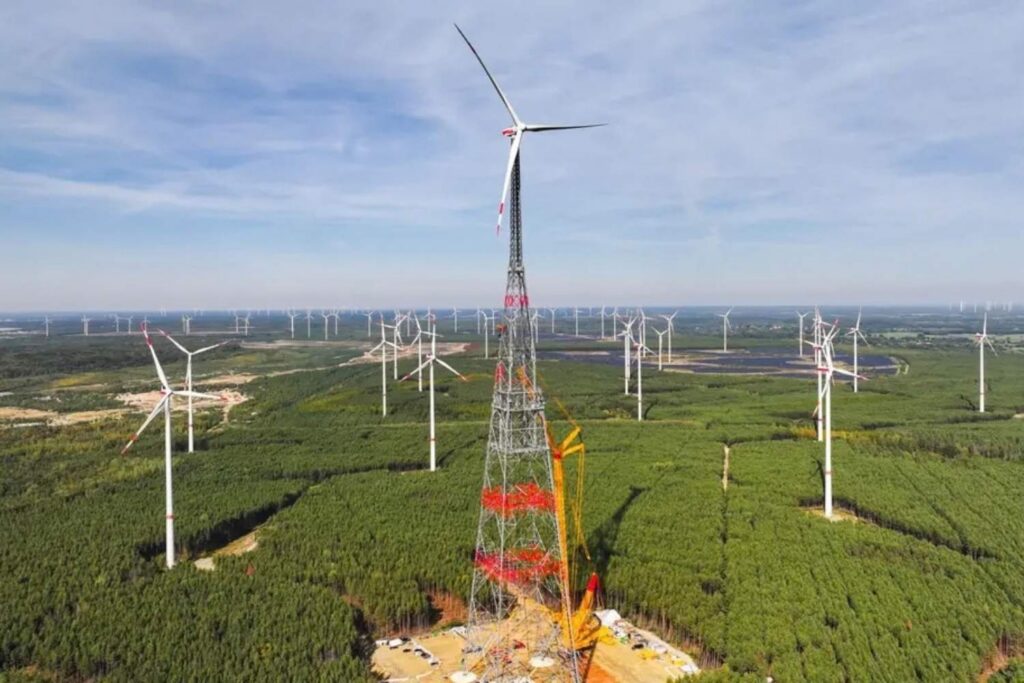
In Germany, a wind turbine has reached a height of 365 meters, setting a new world record, according to its developer, Gicon. The facility is located in Schipkau, Brandenburg, and is expected to begin operations in November. The structure is now complete, including the rotor blades, and, given its size, has become the second-tallest structure in Germany, just three meters shorter than the Berlin TV Tower.
The project takes one of the trends in the wind power industry to the extreme: placing turbines at ever-greater heights to capture more favorable wind conditions. According to Gicon, the plant is expected to produce twice as much energy as a conventional wind turbine.
A 365-meter tower
A unique technical solution was used to reach this height. The interior of the tower was extended using a special cable-hoisting system, allowing the structure to reach its final height without resorting to a traditional construction method. The turbine, on the other hand, was built within the Schipkau wind farm, which was constructed in 2000 and consists of about fifty turbines. The new turbine stands out clearly from the others in terms of size and height.
The goal is to harness the winds at higher altitudes, which Gicon describes as stronger and more consistent than those found closer to the ground. The company expects the plant to generate enough electricity to meet the needs of approximately 7,500 households. This figure, provided by a Gicon official to Agence France-Presse during a site visit, refers to the projected capacity of the new plant.
The comparison with a conventional turbine, however, remains an estimate by the developer: the doubling of production indicated by Gicon will need to be verified once the plant is actually operational.
The redevelopment of the former coal mining site
The turbine’s location also has industrial significance. Schipkau is located in a region of eastern Germany with a long history of coal mining. The area’s large open-pit mines are gradually closing as part of Germany’s climate goals, while the region is home to new renewable energy projects.
The construction of the turbine received public funding of between 20 and 30 million euros through the German government agency for disruptive innovations. The investment is intended to test a technology that aims to generate more electricity from a single plant, primarily by adjusting the height of the structure.
The project has also faced local opposition. Among the opponents is Alternative für Deutschland, a far-right German party that denies human-caused climate change.
The transition from coal to wind power, therefore, is taking shape in the same region through radically different types of infrastructure. To determine how much of an impact this solution will actually have on electricity production, we will now need the most important data: the operational turbine figures, expected in November.